What's All This Stuff About Germanium Diode Leakage?

If they look like Schottky diodes (small, orange glass packages), then they are Schottky. 1N60P are definitely Schottky. Most Schottky diodes are leaky, but not nearly as leaky as Germanium and their leakage current is not nearly as temperature-sensitive as Germanium. If the leakage current takes off when you touch the diode body, then that's a strong sign they are Germanium. Also, Ge diodes tend to have a higher forward resistance than Schottky or Silicon. I have a lot of Ge diodes with a higher Vf than 1N4148 when measured at 10mA.
 
Quick question - could you not use a current mirror to syphon off the leakage current? (at least from the operating point).
 
Most of the time, it's the AC leakage current that affects circuit performance. For example, in a BMP, the DC current in the diodes is zero because there is a series blocking cap. The AC leakage current reduces the gain of the soft clipping stages.
 
First you need a 1/2-way decent DMM. It has to have a 200mV range (or something like that) and it has to have 10M input resistance.

Hook everything up like this:
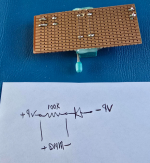
Plug a 100K resistor into your breadboard. Connect +9V to one end. Plug in the diode you want to test with the cathode connected to the other end of the 100K resistor. Connect the ground side of the 9V supply to the anode of the diode. Connect your DMM +lead to the +9V end of the 100K resistor. Connect the DMM -lead to the diode end of the 100K resistor. Set the DMM to read millivolts.

Make sense so far?

When the DMM reading stops changing, write down the number. If it's 83mV, write it down as 83. Divide the number you wrote down by 100. That's the leakage in μA. In this example, it would be 0.83μA. Now divide 52 by that number to get the resistance in KΩ. That's 52 / 0.83 = 62.65KΩ.

Old thread, but I am missing something. Where does the '52' come from?
 
It's in the equations in post #1. Vt, the thermal voltage, is a characteristic of semiconductor physics. At room temp it's 26mV. We multiply Vt by the shape constant "n" that lets us fine tune the shape of the exponential I/V curve. n is usually very close to 2.
2 x 26 = 52.
 
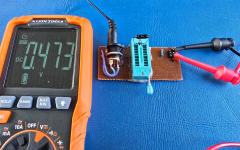
I implemented your diode tester with a ZIF socket for easy changing of diodes. I measured a D311 and a 1N4148.
The D311 was predictably leaky.
My Klein Tools MM450 reading on the 1N4148 was only 0.9mV. Is that correct, or my DMM is not accurate/sensitive at that level?

D311 -- 473 / 100 = 4.73 ua 52 / 4.73 = 11K

1N4148 -- 0.9 / 100 = 0.009 ua 52 / 0.009 = 5,777K

1787771085826.png


For anyone else who wants this, here is the underside showing the 1 cut and the schematic -

1787771144263.png
 
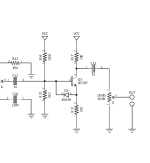
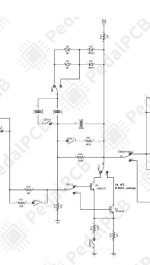
Chuck - I've been looking at some different Muff-type circuits lately and I'm still not completely sure when super-low leakage is required, what with all the variations out there now. I know the G-2 is supposed to be picky about that, not sure what else. Checking out Build Reports of the Psi Fuzz and Muffin Factory for example, I haven't noticed anyone mention a frustrating hunt for low-leak diodes. What are all the ones to watch out for when it comes to that? Here's the Kinetic/Psi/Op-Amp Muff's single Ge diode:
Screenshot 2026-08-28 at 2.27.41 PM.png
And here's the Muffin Factory's pair of Ge diodes:

Screenshot 2026-08-28 at 2.28.55 PM.png
 
Back
Top