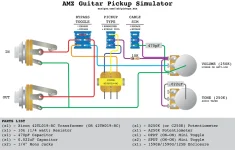
His layout with a couple of my things, like the status led. Which is not necessary for it to work but it lets me know when I have it turned on which is nice. I leave it with the volume dimed and control the fuzz from my guitar volume. But the tone knob is very useful to dial out harsh freqs on some fuzzes. Let look around I might have some docs or build notes I can send you.
No rush, I'm backed up on projects. But if it's easy and you get a moment, I would appreciate that.
I put his LM386 fuzz on a breadboard shortly after he released that video. I had some of those little PCBs on hand. Like a lot of his stuff, it was an agreeable way to pass the time, but as I recall only the first 5% of the volume pot was usable for me. Past that, it was an unpleasant cacophony of square waves.
No rush, I'm backed up on projects. But if it's easy and you get a moment, I would appreciate that.
I put his LM386 fuzz on a breadboard shortly after he released that video. I had some of those little PCBs on hand. Like a lot of his stuff, it was an agreeable way to pass the time, but as I recall only the first 5% of the volume pot was usable for me. Past that, it was an unpleasant cacophony of square waves.
Yah, it was a fun project and nice break from PCB's. I ordered the 386 amp boards from AliExpress.
There's definitely a lot of harsh tones out of it, which I expected seeing as it was an LM386 based dirt box.
I should dig it out and give it another go (or re-purpose the salvageable components... )
For something like the pickup-sim/buffer buster... the info's out there, SCULLY!
Several of AionFX's (Solaris, Proteus etc) — and perhaps a few of PedalPCB's projects — have a transformer-before-fuzz, from which you could extrapolate a buffer-buster/pickup-simulator, not to mention:
I've always been interested in buffer-busting aka pickup sims, been meaning to build one for eons, collecting info along the way...
Recently inspired by MichaelW's recent build report on one, I started cobbling together what I wanted to include in my own and then BuddytheReow's half-broken humbucker seemed like a good candidate for a Pickup Sim Pedal and the next thing I knew I had too much info to respond to in his thread, and here we are — a repository for all things Simming pups and bustin' buffers...
My needs/wants/druthers are to have a misbehavin' buffer-hatin' pedal...
Schematics & circuits for guitar effects with vacuum tubes and solid state electronics. FREE downloads of schematics such as TS-9, Fuzz Face and other classic rock devices.
www.muzique.com
I use a lot of different fuzzes in different configurations with a pedal switcher/looper (which has a built-in buffer) and I've been thinking about building a few of these to go in front of fuzzes. I wonder if stacking them will be a problem and/or if they undo some of the clarity that comes with buffers.
I also wonder if I could just build some buffers and tack this on the end of the circuit? Why doesn't everyone do that? (well, maybe because of the stacking issues?)
Working on a Buffer>Pickup simulator so I can have a buffer before vintage fuzz and boosts pedals that have a low input impedance and do not play nice with a buffer before them. I have a feeling the answer to my question is going to be use what you're trying to simulate, just use a cheap...
Your pedal board and amp collection are a potential playground for manipulating non-guitar signals. Yet, if you've spent some time reamping pre-recorded tracks, patching synths into fuzz pedals, or sending samples through amps, you know that the results are often disappointing compared to the...
Safety Precautions, Warranty, and Disclaimer Improper soldering and handling of electricity can cause serious injury and damage to your property. Read and understand the instructions below before beginning your project. Follow the instructions, build carefully, and use the appropriate tools...
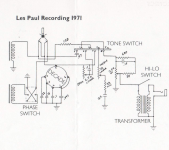
AND that brings us also to the topic of revoicing your guitar with some caps...
Get a bunch of caps on a rotary switch.
Since I play bass, most any guitar-oriented carefully curated collection of capacitors can't be capitalised upon by me, so I'll have to commit to culling my own happy cappy-freqiness...
Nonetheless the '71 LP WIRING schematic/diagram has some starter values on the DECADE rotary.
Now you've gotta decide do I need a fuil 12 options, or will 6, 5, or 4 do? How much rotary-ised capacitance will suffice for your needs?
For something like the pickup-sim/buffer buster... the info's out there, SCULLY!
Several of AionFX's (Solaris, Proteus etc) — and perhaps a few of PedalPCB's projects — have a transformer-before-fuzz, from which you could extrapolate a buffer-buster/pickup-simulator, not to mention:
I've always been interested in buffer-busting aka pickup sims, been meaning to build one for eons, collecting info along the way...
Recently inspired by MichaelW's recent build report on one, I started cobbling together what I wanted to include in my own and then BuddytheReow's half-broken humbucker seemed like a good candidate for a Pickup Sim Pedal and the next thing I knew I had too much info to respond to in his thread, and here we are — a repository for all things Simming pups and bustin' buffers...
My needs/wants/druthers are to have a misbehavin' buffer-hatin' pedal...
Schematics & circuits for guitar effects with vacuum tubes and solid state electronics. FREE downloads of schematics such as TS-9, Fuzz Face and other classic rock devices.
www.muzique.com
I use a lot of different fuzzes in different configurations with a pedal switcher/looper (which has a built-in buffer) and I've been thinking about building a few of these to go in front of fuzzes. I wonder if stacking them will be a problem and/or if they undo some of the clarity that comes with buffers.
I also wonder if I could just build some buffers and tack this on the end of the circuit? Why doesn't everyone do that? (well, maybe because of the stacking issues?)
Working on a Buffer>Pickup simulator so I can have a buffer before vintage fuzz and boosts pedals that have a low input impedance and do not play nice with a buffer before them. I have a feeling the answer to my question is going to be use what you're trying to simulate, just use a cheap...
Your pedal board and amp collection are a potential playground for manipulating non-guitar signals. Yet, if you've spent some time reamping pre-recorded tracks, patching synths into fuzz pedals, or sending samples through amps, you know that the results are often disappointing compared to the...
Safety Precautions, Warranty, and Disclaimer Improper soldering and handling of electricity can cause serious injury and damage to your property. Read and understand the instructions below before beginning your project. Follow the instructions, build carefully, and use the appropriate tools...
AND that brings us also to the topic of revoicing your guitar with some caps...
Get a bunch of caps on a rotary switch.
Since I play bass, most any guitar-oriented carefully curated collection of capacitors can't be capitalised upon by me, so I'll have to commit to culling my own happy cappy-freqiness...
Nonetheless the '71 LP WIRING schematic/diagram has some starter values on the DECADE rotary.
Now you've gotta decide do I need a fuil 12 options, or will 6, 5, or 4 do? How much rotary-ised capacitance will suffice for your needs?
For something like the pickup-sim/buffer buster... the info's out there, SCULLY!
Several of AionFX's (Solaris, Proteus etc) — and perhaps a few of PedalPCB's projects — have a transformer-before-fuzz, from which you could extrapolate a buffer-buster/pickup-simulator, not to mention:
I've always been interested in buffer-busting aka pickup sims, been meaning to build one for eons, collecting info along the way...
Recently inspired by MichaelW's recent build report on one, I started cobbling together what I wanted to include in my own and then BuddytheReow's half-broken humbucker seemed like a good candidate for a Pickup Sim Pedal and the next thing I knew I had too much info to respond to in his thread, and here we are — a repository for all things Simming pups and bustin' buffers...
My needs/wants/druthers are to have a misbehavin' buffer-hatin' pedal...
Schematics & circuits for guitar effects with vacuum tubes and solid state electronics. FREE downloads of schematics such as TS-9, Fuzz Face and other classic rock devices.
www.muzique.com
I use a lot of different fuzzes in different configurations with a pedal switcher/looper (which has a built-in buffer) and I've been thinking about building a few of these to go in front of fuzzes. I wonder if stacking them will be a problem and/or if they undo some of the clarity that comes with buffers.
I also wonder if I could just build some buffers and tack this on the end of the circuit? Why doesn't everyone do that? (well, maybe because of the stacking issues?)
Working on a Buffer>Pickup simulator so I can have a buffer before vintage fuzz and boosts pedals that have a low input impedance and do not play nice with a buffer before them. I have a feeling the answer to my question is going to be use what you're trying to simulate, just use a cheap...
Your pedal board and amp collection are a potential playground for manipulating non-guitar signals. Yet, if you've spent some time reamping pre-recorded tracks, patching synths into fuzz pedals, or sending samples through amps, you know that the results are often disappointing compared to the...
Safety Precautions, Warranty, and Disclaimer Improper soldering and handling of electricity can cause serious injury and damage to your property. Read and understand the instructions below before beginning your project. Follow the instructions, build carefully, and use the appropriate tools...
AND that brings us also to the topic of revoicing your guitar with some caps...
Get a bunch of caps on a rotary switch.
Since I play bass, most any guitar-oriented carefully curated collection of capacitors can't be capitalised upon by me, so I'll have to commit to culling my own happy cappy-freqiness...
Nonetheless the '71 LP WIRING schematic/diagram has some starter values on the DECADE rotary.
Now you've gotta decide do I need a fuil 12 options, or will 6, 5, or 4 do? How much rotary-ised capacitance will suffice for your needs?



 )
)