

You are using an out of date browser. It may not display this or other websites correctly.
You should upgrade or use an alternative browser.
You should upgrade or use an alternative browser.
What’s on *YOUR* workbench?
- Thread starter Bricksnbeatles
- Start date


CheapSuitG
The TubeSchemer

Silver Blues
Well-known member
That's for the 50,000 watt resistor yo.....

Bricksnbeatles
Member known well
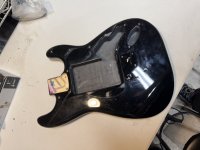
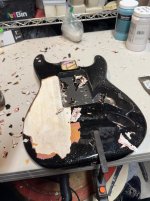
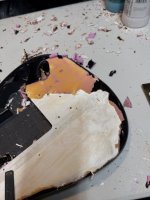
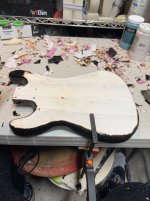
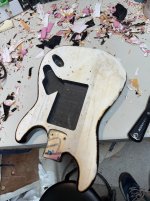
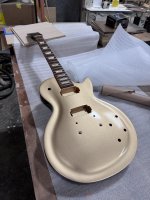
Stripping the thick poly finish (which was full of dents) off a Squier mini Strat. Eventually it’ll get a nitro sonic blue paint job and nitro amber on the neck. Still need to figure out the best way to strip the neck finish without delaminating the fretboard (heat and chemicals both seem like bad ideas)— might just go with a classic card scraper.
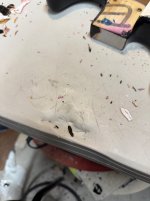
Accidentally melted + stabbed thru my ceramics bench in the garage. Fuck.


Accidentally melted + stabbed thru my ceramics bench in the garage. Fuck.
Last edited:

owlexifry
Well-known member
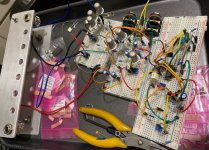
breadboarding some stuff.
it’s been fun

the most recent one is a maestro fz-1 with NPN Ge (GT404B) running at 3.3V.

i pretty much just approached the initial biasing/transistor selection as i did with tonebender mk1 and biasing it at 9V, but playing/testing at 3.3V.
(seems to make noise and oscillate if i try to run it at 9V)
well, it’s a fuzz sound.
but it actually sounded better in this recording than i expected to given what i was hearing in the room after comparing it to other fuzzes.
even somehow managed to handle drop G without dying or losing all it's definition.
it’s been fun
the most recent one is a maestro fz-1 with NPN Ge (GT404B) running at 3.3V.
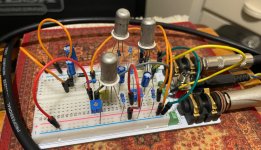
i pretty much just approached the initial biasing/transistor selection as i did with tonebender mk1 and biasing it at 9V, but playing/testing at 3.3V.
(seems to make noise and oscillate if i try to run it at 9V)
well, it’s a fuzz sound.
but it actually sounded better in this recording than i expected to given what i was hearing in the room after comparing it to other fuzzes.
even somehow managed to handle drop G without dying or losing all it's definition.
Last edited:
CheapSuitG
The TubeSchemer
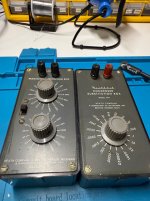
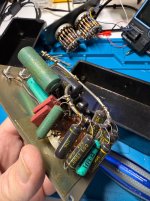
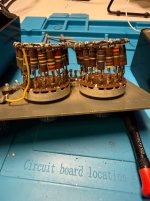
So many toanz!Got these guys off fleabay fairly cheap, going give them a whirl.
Sadly, most the caps are out of spec and the a number resistors are in the wrong places I think. The joys of second hand DIY Heathkit!
Attachments
CheapSuitG
The TubeSchemer
How do you keep the tower of power from tipping? I am 2 high in one place and it is sketchy at best. Drilled into the wall?

jessenator
Well-known member
those silkscreened panels are pretty dope, thoughThe joys of second hand DIY Heathkit!

DGWVI
Well-known member
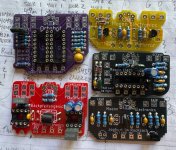
The power of gravityHow do you keep the tower of power from tipping? I am 2 high in one place and it is sketchy at best. Drilled into the wall?



BuddytheReow
Moderator
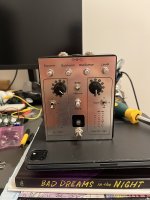
The LEDI made a big mistake with this faceplate that I fixed today. Will update with another picture later tonight. Can you spot the mistake?
View attachment 105040

giovanni
Well-known member
Well, yeah I didn’t take that into account initially because the drill template does not have the LED. But that’s been fixed in the pic above. There is another, pretty big problem in the pic above.The LED
BuddytheReow
Moderator
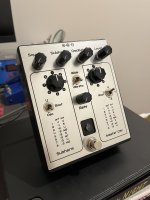
Yo' knobs!
giovanni
Well-known member
Thanks! This material turns out really well. It’s the best I’ve found.Damn that's a clean faceplate!!

Passinwind
Well-known member
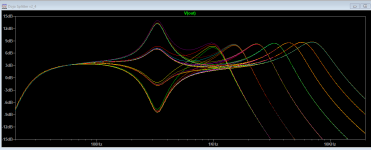
Working up a model for the last two magnetic pickup modules for my new Dojo (banjo dobro hybrid) pedal, then on to the much simpler piezo half:

Fully parametric mids for the mag side, 62-4kHz (shown at mid position). Resonant LPF sweeps ~1k-8.2kHz, and then variable HPF and Baxandall bass boost/cut. Piezo gets its own resonant LPF, which is all it needs since the piezo element is on the resonator and doesn't make any appreciable bass content, unlike the mag side. Both sides sum back to mono...finis.
Fully parametric mids for the mag side, 62-4kHz (shown at mid position). Resonant LPF sweeps ~1k-8.2kHz, and then variable HPF and Baxandall bass boost/cut. Piezo gets its own resonant LPF, which is all it needs since the piezo element is on the resonator and doesn't make any appreciable bass content, unlike the mag side. Both sides sum back to mono...finis.
jessenator
Well-known member
The white wa-Can you see the difference now?
