This Week on the Breadboard: The EHX Black Finger Sustainer

Chuck D. Bones

Circuit Wizard
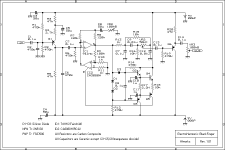
Back when I was a young lad, my friend & roommate Richard bought a Black Finger. As per usual, I would cajole him into letting me take it apart & trace the circuit with the the promise that he'd get it back intact. A very interesting circuit indeed. Years later he sold it to me and I still have it. The gain stage is a shitty little 741 because that's all we had back then. You young whipper-snappers have it so easy with your TL072s and LM733s. Q1 boosts the signal going into the 741 to reduce noise. A CA3080 OTA in the feedback loop acts as a VCA (voltage controlled amplifier). Actually, it's a current-controlled amplifier, but the principle still applies. The CA3080, made by RCA, was the first commercial OTA. The LM13700 is basically two of those plus a pair of Darlington emitter followers in a 16-pin package. Q2-Q5 make a very fast and very accurate peak detector. It seems like a whole lotta parts, but the performance cannot be matched. This compressor does not pop. One of the best features of this compressor is it retains some of the dynamics. Notice that the circuit runs on two 9V batteries providing ±9V rails.

EHX Blackfinger.gif

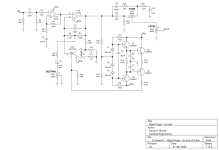
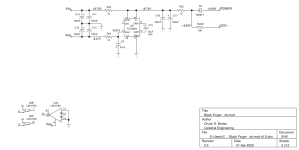
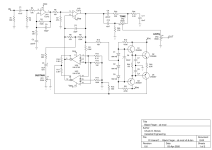
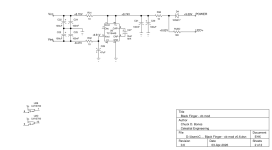
This circuit works very well, but would benefit from a refresh using some more modern technology. I replaced Q1 and IC1 with a TL072. I fiddled a few component values to get more range out of the SUSTAIN knob, retuned the TONE filter and deleted the output buffer (Q6). I added a charge pump to make a -9V rail. C8 is not strictly necessary since U1-7 sits within a few mV of GND. Max gain is around 64dB.

Black Finger - cb mod v0.5 sheet 1.png
Black Finger - cb mod v0.5 sheet 2.png

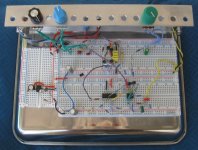
The charge pump and power conditioning is on the far left. U1 is lower right, U2 is lower left. The peak detector is top center and the tone network is upper left. I used a non-polar 10uF aluminum cap for C4, but a polarized tantalum cap works well too. The DC voltage across C4 is a few mV.

Knobs (L-R): LEVEL - TONE - SUSTAIN
Black Finger - cb mod v0.5 breadboard 02.jpg
 
Last edited:
I was curious so I read up on this a bit -- do I understand correctly that at a high level the CA3080/LM13700 are acting as a voltage-controlled resistor to vary the gain of the op-amp, and the control voltage for this is from the peak-detector circuit implemented by the four transistors?
 
Does the TL072 noticeably improve the noise floor?
Yes.
Is there any operational difference between the vintage CA3080 and the LM13700?
No difference when using just the OTA. The Darlingtons come in handy in filter circuits but are not needed here.

I was curious so I read up on this a bit -- do I understand correctly that at a high level the CA3080/LM13700 are acting as a voltage-controlled resistor to vary the gain of the op-amp, and the control voltage for this is from the peak-detector circuit implemented by the four transistors?
Close. The OTA (U2A) acts like a current-controlled resistor. The peak detector (Q2-Q5) outputs a current proportional to the peak amplitude at the output of U1B. That current is used to control the effective resistance of U2A.
 
Ah ok, now I understand better when I was reading about the operational transconductance amplifier, and when it talks about Iabc. The peak detector is presenting Iabc to the OTA, which controls its resistance. Thanks for explaining!

Let me ask another question then about this circuit. The peak detector, there's hysteresis, right? In other words is the current presented as Iabc tracking the waveform of the input, or is there some "decay" to this so that if there's a transient, that the gain will be suppressed for some amount of time afterwards? I see the 2.2M resistor and the two 1uF capacitors to ground in the middle of that detector. An impulse presented to that will decay on the order of seconds? Is it interesting to be able to adjust the response and/or decay of this detector?
 
Good questions. There is no hysteresis. but there is a slow-ish release. At first, I was concerned about the long time constant between R15 & C6/C7 (my schematic). It's a trade-off between release time and ripple. If we shorten the release time too much, by reducing R15 or C6/C7, then there is too much ripple in the control current and we get some 3rd harmonic coming out of U1B. When I play thru the Black Finger, it does not feel like the release is too slow. That's because the voltage on C6 & C7 doesn't need to change very much to get enough change in the control current. I tried reducing R15 and it did not help the dynamic performance, because with 2.2M the performance was already good enough. But reducing R15 did cause some 3rd harmonic distortion to show up. Bottom line is we're operating at a fraction of the R-C time constant. It's not as slow as it seems at first glance.
 
Most of the compressors we run into are feedback-type compressors. The output level is sensed and that is used in a feedback loop to adjust the gain. The Engineer's Finger compressor is a feed-forward type. The input signal level is sensed and that is used to adjust the gain. There is no level feedback. Both types have advantages & disadvantages.
 
Can both sides of the LM13700 be used like in later revisions of the engineer's thumb for even better performance? And can one maybe even use one or even both buffers of it for any extra benefit?

Thanks for sharing this btw, I heard about the Black Finger a couple of times now, going to try it out once I've done the Dark Esbat CB mod.
 
I suppose one of the buffers could be used to buffer the output. Not really necessary. but doable.

I was planning to try the parallel OTA trick once I had everything dialed-in. It will reduce the noise from the LM13700 by 3dB. Whether that will be audible is debatable. The LM13700's noise is highest when Iabc (current into pin 1) is highest and that only occurs when the guitar signal is large. This mod doubles the gain of the LM13700 since we're adding the currents from pins 5 & 12. Therefore we can cut Iabc in half by increasing R17 to 6.8K.

I'll let you know how it turns out.
 
Nice write-up as usual, Chuck! I'll generaly try and avoid using charge pumps as much as I can.
Apart from the headroom concerns, does the peak detector rely on the higher voltage available?

Thanks!
 
I does, but there might be a work-around. Another thing on my to-do list is to see if I can make a viable "no charge pump" version. The trivial solution is to simply run this circuit on +18V and create a Vref.
 
In my experience there's no problem with charge pumps when you put them like aion did in the Ember and the Straylight. Just add 470nF MLCC from the input and the output(s) to ground.
 
Yeah, if only switching power supply design was that simple. :LOL:

Bypassing is good, but unless the high-freq currents and EM fields are constrained, the switching noise will propagate. That being said, my breadboard is remarkably noise-free.
 
I have to respectfully disagree. :D There's no audible propagation and no charge pump whine. I'm putting 470nFs by default around charge pumps for quite a while now and haven't had an issue since.
After seeing what aion did I also found this post, which to my understanding says the same thing.
 
The charge pump noise is at 40KHz, so I would not expect that to be audible, buuuuut, if audio laced with 40KHz noise is then sampled by a BBD or PT2399, then there is a good chance that the 40KHz gets aliased down into the audio band. That, I have heard.

I just read that post and it says a lotta things. You can see the LC filter ringing in the scope pix. Electro caps stop acting like caps around 100KHz or lower, depending on the capacitance & voltage rating. MLCCs are good RF caps, but the leads & traces have to be very short.
 
Last edited:
Back
Top