Variable capacitor

JTEX

Well-known member
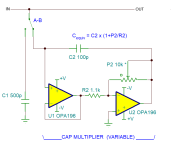
If you've used (or thought about using) something like a rotary switch to switch between different capacitor values in a circuit, you might want to consider a continuously variable "active cap" instead. It can be made with a simple pot and a couple of op amps that form a capacitance multiplier. I almost forgot that these things existed!

The circuit on the B side of the switch simulates a cap that does the same thing as the A side (a cap grounded at the bottom), except you can vary it between 100 and 1000pF with the values shown. C2 to, say, 10nF and then you can go between 10 and 100nF.

Screenshot 2026-03-02 111221.png
 
Nice.
Can this be utilized only when the varicap is to ground or can it be part of a larger network.
Say, in a opamp feedback network.
 
This might be just the thing I need to continuously change the knee frequency on a high-shelf filter...
 
Nice.
Can this be utilized only when the varicap is to ground or can it be part of a larger network.
Say, in a opamp feedback network.

I did a little bit of digging and stopped when it basically brought up conference papers on active component designs (which don't get me wrong, I love to nerd out and read these). There exists floating versions but it is basically two modified grounded versions back to back and cross coupled through what was ground and are prone to oscillation. So, four op amps, needing bipolar power (unless you want the active capacitor to clip your signal), and a chance at oscillation at high gain seems like a fun experiment but not a lot of usefulness.
 
Would this work in place of a standard vari-cap in something like an AM receiver? I have a sound installation thing I’ve been wanting to make for years with the intent of controlling the tuning of some AM receivers with LDRs. Was helping a friend install their MFA thesis exhibition today, and was talking about that idea with them, so now it’s on my mind again.
 
No idea. Is the vari-cap grounded in the radio? Then maybe, but you'd need an op amp with a wide bandwidth (tens of MHz), so it can still have significant gain (10x or so) at AM radio frequencies (up to almost 2MHz).
 
Radio Shack + Radio Shack employee who actually knows something about electronics = 🤯

They were always just trying to sell me an extended warranty for my rechargeable batteries, or towards the end there, a shitty cell phone plan.
 
I'm simulating this in LTSpice as part of a larger circuit and while AC analysis shows the wanted behavior, transient analysis does not.

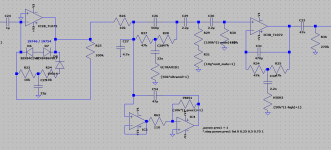
Relevant part of the circuit, excuse the messy drawing:
1775996913278.png

The capacitance multiplier around C54 is supposed to replace C27 (not connected here). At pres1 = 1 it should be equivalent to 47p, at pres1 = 0 it's supposed to be equivalent to 4.7n.

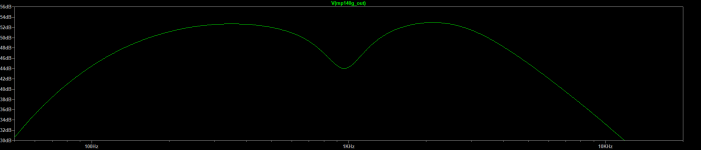
AC analysis with the multiplier removed and C27 4.7n connected to ground:
1775997061467.png

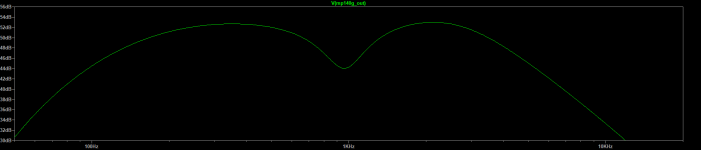
Compared to C27 disconnected and pres1 at 0:
1775997092489.png

And the same with both C27 and the capacitance multiplier removed:
1775997121245.png

And only C27 removed, but pres1 at 1:
1775997665488.png

That's identical for all intents and purposes and shows the capacitance multiplier working as expected. But transient analysis doesn't agree with this at all. I'm using a .wav of a DI guitar track at the input, simulating the entire circuit and writing the output to another .wav file.

With both C27 and capacitance multiplier removed:
View attachment withoutcap.mp3

Compared to C27 removed at pres1 at 1:
View attachment multipliermin.mp3

Yup, pretty close.

But here's C27 4.7n connected to ground, multiplier removed:
View attachment withcap.mp3

Compared to C27 removed and pres1 at 0 for an equivalent of 4.7n going to ground via the capacitance multiplier:
View attachment multipliermax.mp3

Not at all as expected. There's next to no change with the capacitance multiplier at min or at max in transient analysis, even though AC analysis suggests otherwise.

I haven't breadboarded any of this yet so I don't know whether the simulation is close to reality or not but will report back when I have done so. Just wanted to share this for now because I found it weird.
 
I'm using a .wav of a DI guitar track at the input, simulating the entire circuit and writing the output to another .wav file.

Thank you! I was today years old when I realized, thanks to you, that I could just use a wav file as the input to a circuit simulation (in my case, TINA-TI) and record its output back to a wav file. D'ooooh! Why didn't I think of that??

Who even needs to actually build physical stuff anymore?

Here's a quick clip of a clean guitar fed into a circuit simulation of a Rockman-style distortion going into a cab sim.

View attachment aaa.wav
 
I would actually use a dual opamp in real life. The only reason you see 2x OPA196 in the schematic is that I did it in a simulator and there are no dual opamps there. TL072 ought to work fine, too, if you're not into SMD.
 
Any benefit to using precision op amps in regards to operation? And is there a way to change the capacitor from say 470pF to 220nF? I would like to see if I can whip up Chuck's rotary mod with this.
 
I don't see why precision opamps (low DC offset) would make a difference.
You can change the C2 value to whatever you like. It just gets multiplied by 1 + P2/R2.
 
I don't see why precision opamps (low DC offset) would make a difference.
You can change the C2 value to whatever you like. It just gets multiplied by 1 + P2/R2.
How critical are the existing values of P2 & R2? Can P2 be up'd to 50K? That (by the equation) would make the 100pF cap's value change up to 4n6. Or is C2's value the only component that can be futz'd with? How about R2 - can it be lowered? I'm trying to sort out this circuit is best balanced.
 
Back
Top