
Chuck D. Bones
Circuit Wizard
This pedal gets pretty damned close to the real tone IMHO. The power consumption is low enough that you could install it in a Tele and power it with a battery.
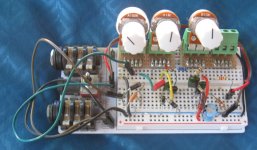
I breadboarded it per the Build Docs, except I used MPS6530 transistors (HFE around 70) and left out the switch. I installed 22nF for C2 & C5 because that's what I had and honestly, a 10% difference doesn't affect the tone. I quickly found out that I had no use for the BIAS knob. All the way up produced the best tone. Turning it down killed the volume and gain. I tried a few values for R1 and the smaller values sounded better to me... Mo' Nasty. I ended up with 2.2K because I wanted a little bit of resistance at the input to protect Q1 from being overstressed if it was driven hard by another pedal. I wanted some more gain, so I changed Q2 to BC549C and replaced the BIAS pot with a 3.3M resistor. That put Q2-C right around 4V with no signal. Now it goes to 11. Since the best SUSTAIN settings are at or near 10, C10K would be a better choice for the SUSTAIN pot.
This is how it looked before I deleted the BIAS pot.


I breadboarded it per the Build Docs, except I used MPS6530 transistors (HFE around 70) and left out the switch. I installed 22nF for C2 & C5 because that's what I had and honestly, a 10% difference doesn't affect the tone. I quickly found out that I had no use for the BIAS knob. All the way up produced the best tone. Turning it down killed the volume and gain. I tried a few values for R1 and the smaller values sounded better to me... Mo' Nasty. I ended up with 2.2K because I wanted a little bit of resistance at the input to protect Q1 from being overstressed if it was driven hard by another pedal. I wanted some more gain, so I changed Q2 to BC549C and replaced the BIAS pot with a 3.3M resistor. That put Q2-C right around 4V with no signal. Now it goes to 11. Since the best SUSTAIN settings are at or near 10, C10K would be a better choice for the SUSTAIN pot.
This is how it looked before I deleted the BIAS pot.
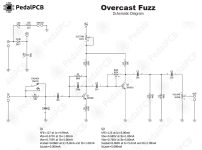


![OVERCAST [Spirit in the Sky Fuzz] CDB BIAS MOD.png](https://pedalpcb-forum.nyc3.digitaloceanspaces.com/data/attachments/119/119580-877d3bd00f6be8330f16075de5dceddc.jpg?hash=qQE9MIdpqB "OVERCAST [Spirit in the Sky Fuzz] CDB BIAS MOD.png")



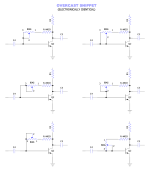
 so wasn’t sure why it was different in the Overcast schematic. Looks cleaner?