This Week on the Breadboard: The Spirit in the Sky Fuzz

Chuck D. Bones

Circuit Wizard
This pedal gets pretty damned close to the real tone IMHO. The power consumption is low enough that you could install it in a Tele and power it with a battery.
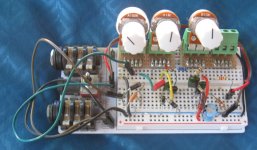
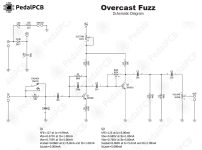
I breadboarded it per the Build Docs, except I used MPS6530 transistors (HFE around 70) and left out the switch. I installed 22nF for C2 & C5 because that's what I had and honestly, a 10% difference doesn't affect the tone. I quickly found out that I had no use for the BIAS knob. All the way up produced the best tone. Turning it down killed the volume and gain. I tried a few values for R1 and the smaller values sounded better to me... Mo' Nasty. I ended up with 2.2K because I wanted a little bit of resistance at the input to protect Q1 from being overstressed if it was driven hard by another pedal. I wanted some more gain, so I changed Q2 to BC549C and replaced the BIAS pot with a 3.3M resistor. That put Q2-C right around 4V with no signal. Now it goes to 11. Since the best SUSTAIN settings are at or near 10, C10K would be a better choice for the SUSTAIN pot.

This is how it looked before I deleted the BIAS pot.
Spirit in the Sky Fuzz breadboard 02.jpg

Spirit in the Sky Fuzz.png
 
I breadboarded this one before building it to trial transistors. I went with S9018s, as I had them on hand and they were near perfect hFE matches to the schematic.

We had similar impressions:

This pedal gets pretty damned close to the real tone IMHO.
As close as any pedal I've heard. I always have to add that I think there was a speaker defect in addition to Greenbaum's built-in fuzz circuit. I've read him say it was just the circuit, but I'll die thinking there was a torn cone or cracked surround in addition unless someone can come up with a pedal that makes the sound I hear on the record. I don't think he'd intentionally mislead anybody, I just think he forgot or wasn't aware in the first place.

left out the switch
I've left it in the same position since building the pedal. I wouldn't miss it. I guess it just jumps R1 keeping it from creating a LP filter with C1? And maybe lowers input impedance?

I installed 22nF for C2 & C5 because that's what I had and honestly, a 10% difference doesn't affect the tone.
Yep. Tried the 22nF because I didn't think I had the 20nF. Found some 20nF, couldn't hear any difference.

I quickly found out that I had no use for the BIAS knob. All the way up produced the best tone.
Yep.

* * *

I think I'll give your changes a try and see if they're enough improvement to warrant another build... though I don't think I'm going to have any BJTs that low-gain.
 
I find the bias knob to be the most useful part of this circuit. I found the sweet spot around 9-10am for the old shitty fuzz tone of the recording.
"Turning it down killed the volume and gain". Lol, that's why there are Volume and Gain controls available.
 
I stand corrected.
I put in a pair of 124 HFE transistors and I see what you mean. This circuit is not about gain, it's about that "old shitty fuzz tone." BIAS around 3 and SUSTAIN on 5 gets me there.
 
Last edited:
Yeah, there could/should be a 22K resistor in series with the BIAS pot.

So place the 22k between the collector and BIAS-1, or betwixt BIAS-3 and the gate?
Based on the discussion thus far, I imagine it should be the former (green below) not the latter (blue below):

OVERCAST [Spirit in the Sky Fuzz] CDB BIAS MOD.png

Hm I think I thinkered it out, should be the green.
 
Green.
On my breadboard, I put the 22K resistor on the base side and disconnected BIAS-3. I prefer to NOT connect pots or switches directly to the input side of a gain stage because the input is much more susceptible to stray pickup than the output side.

BTW, it's BASE, not GATE. 😁
 
Yes, humble apologies. I hate it when nomenclature is inaccurate, incorrectly used, or worse — abused ... more so when I've not had my coffee and I am the guilty culprit.

Yeah, it was the lack of coffee and being up at 4am to get ready for the Mum's OT visit. That's my Sad-Sack story and I'm stickin' to it.


Let the penance begin.

giphy.gif
 
Green.
On my breadboard, I put the 22K resistor on the base side and disconnected BIAS-3. I prefer to NOT connect pots or switches directly to the input side of a gain stage because the input is much more susceptible to stray pickup than the output side.

BTW, it's BASE, not GATE. 😁
At first glance it looked like Bias was set up as a rheostat, with lugs 2&3 connected together and meeting Q2’s base- now that I look at how the schematic is drawn it looks like that may not be the case..?
 
At first glance it looked like Bias was set up as a rheostat, with lugs 2&3 connected together and meeting Q2’s base- now that I look at how the schematic is drawn it looks like that may not be the case..?

Effectively BIAS-2&3 ARE connected together, UNLESS you were to put the 22k where I indicated in blue (or on BIAS-2 for that matter).

The electrons don't care...


GRID
 
Effectively BIAS-2&3 ARE connected together, UNLESS you were to put the 22k where I indicated in blue (or on BIAS-2 for that matter).

The electrons don't care...


GRID
Right, I’m just used to seeing a Bias control depicted like this ⬇️ so wasn’t sure why it was different in the Overcast schematic. Looks cleaner?
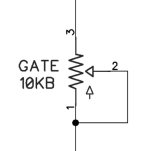

1782249355654.jpeg
 
Right, I’m just used to seeing a Bias control depicted like this ⬇️ so wasn’t sure why it was different in the Overcast schematic. Looks cleaner?
View attachment 119581

Yup, 1&2 in your example, 2&3 in the Overcast schematic.


Most people can't afford to patent their circuit (most pedal-circuits probably aren't unique enough to do so, anyway).

However, the graphic depiction of the schematic is copyrightable, which is why you'll see the same YATS circuit drawn up in a multitude of ways — be it PedalPCB, Mad Bean, Aion or if you could peek at the commercial producer's schematics from Keeley, EQD, Ibanez, Wampler etc.

Same goes for layouts, the expression of a circuit in physical form. For example many people were up in arms when a certain popular commercial-builder based one of its pedals on the PCB layout (artwork) of an established DIY-PCB supplier.

Same goes for the names of pedals, guitars, and more. Which is why a "Telemaster©" is not a Fender™ guitar, it's a remote-controlled airplane:

SENIOR TELEMASTER.jpeg


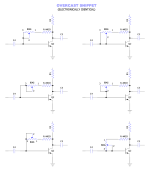
So, for the Overcast (comparable to the Spirit In The Sky Fuzz), the bias knob could be drawn up in a myriad of ways...

OVERCAST SNIPPET REDRAWS.png

I could've drawn it up a few more ways, but... where do I draw the line? Besides, you already get the point. It's all the same circuit.

Electrons are like Honeybadgers — they don't care, they go where they want and if there's a path of least resistance they'll take it.


Back
Top