


Chuck D. Bones
Circuit Wizard
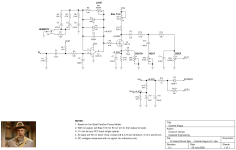
I've been meaning to breadboard this one for a long time. Not a bad sounding pedal, but there is a shit-ton of useless parts. Here's the PPCB schematic:
![Steel Panther Pussy Melter [Face Melter v2] sch.png](data:image/svg+xml;charset=utf-8,%3Csvg xmlns%3D'http%3A%2F%2Fwww.w3.org%2F2000%2Fsvg' width='1159' height='913' viewBox%3D'0 0 1159 913'%2F%3E "Steel Panther Pussy Melter [Face Melter v2] sch.png")
The first useless part that jumps out is IC1.2. Why install a dual opamp only to abandon 1/2 of it? The CA3240 is a dual version of the CA3140 MOS-Bipolar opamp, so why not just use a CA3140?
The CA3240 & CA3140 have MOSFET inputs, so why on earth would we need a MOSFET buffer up front? The short answer is "we don't." So C1, D1, Q1, R2 & R4 get tossed overboard. I changed the values of R1, R6, R8 & C3 to maintain the original input impedance. As an added bonus, we don't need Vref anymore, so we can 86 R100, R101 & C102.
IC1.1 is biased by Vref2. Q2 is also biased by Vref2. Therefore, the DC voltage drop across C8 is zero. If C8 is not needed to block DC, then we can replace it with a jumper and toss R11. D2 is not needed to protect Q2 from ESD, so we can ditch D2 as well.
Finally, I ditched R16. On reflection, R16 should probably stay and be made larger because this pedal is freakin' LOUD.
That's 10 parts we don't need to buy or solder onto a PCB.
All of the knobs work pretty well, so I left them alone. I increased R9 to 10K so the gain jump from 0 to 1 is a little smoother. I increased R10 to 47K to roll-off some of the extreme high-end in Q2.
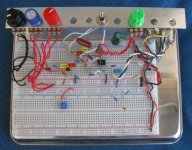
Here's where I ended up:
I renumbered the parts since so many were deleted. I changed S2 from ON/ON to ON/OFF/ON and added R7. This gives us a 3rd setting about 1/2 way between "Moist" and "Gushing." I also added a Bias Trim for Q1, totally optional.
With everything dimed and S2 in the UP position, the gain at Q1-D is a respectable 96dB at 1KHz.

Knobs (L-R):
DEEP - SOUTH - HEAT - HUMIDITY (switch) - LOVE

And it's true what they say: "All the women-folk just love Col. Angus!"
![Steel Panther Pussy Melter [Face Melter v2] sch.png](https://pedalpcb-forum.nyc3.digitaloceanspaces.com/data/attachments/120/120179-b21a8b8d89933894777ea42ca1129d22.jpg?hash=gzpVAEyIQX "Steel Panther Pussy Melter [Face Melter v2] sch.png")
The first useless part that jumps out is IC1.2. Why install a dual opamp only to abandon 1/2 of it? The CA3240 is a dual version of the CA3140 MOS-Bipolar opamp, so why not just use a CA3140?
The CA3240 & CA3140 have MOSFET inputs, so why on earth would we need a MOSFET buffer up front? The short answer is "we don't." So C1, D1, Q1, R2 & R4 get tossed overboard. I changed the values of R1, R6, R8 & C3 to maintain the original input impedance. As an added bonus, we don't need Vref anymore, so we can 86 R100, R101 & C102.
IC1.1 is biased by Vref2. Q2 is also biased by Vref2. Therefore, the DC voltage drop across C8 is zero. If C8 is not needed to block DC, then we can replace it with a jumper and toss R11. D2 is not needed to protect Q2 from ESD, so we can ditch D2 as well.
Finally, I ditched R16. On reflection, R16 should probably stay and be made larger because this pedal is freakin' LOUD.
That's 10 parts we don't need to buy or solder onto a PCB.
All of the knobs work pretty well, so I left them alone. I increased R9 to 10K so the gain jump from 0 to 1 is a little smoother. I increased R10 to 47K to roll-off some of the extreme high-end in Q2.
Here's where I ended up:
I renumbered the parts since so many were deleted. I changed S2 from ON/ON to ON/OFF/ON and added R7. This gives us a 3rd setting about 1/2 way between "Moist" and "Gushing." I also added a Bias Trim for Q1, totally optional.
With everything dimed and S2 in the UP position, the gain at Q1-D is a respectable 96dB at 1KHz.
Knobs (L-R):
DEEP - SOUTH - HEAT - HUMIDITY (switch) - LOVE
And it's true what they say: "All the women-folk just love Col. Angus!"


