Dual opamp RAT

HamishR

Well-known member
Heresy!! I drew this up a while ago because I wanted to hear what it sounded like if I used a dual opamp instead of the single opamp and JFET. I wasn't sure what to expect but I was curious as to how close it got to sounding like a regular Rat - spoiler - it doesn't! But I think I actually prefer it this way. And of course I added a bass pot. It wouldn't be difficult to leave that out but why not have a bass pot?

I've never really been into the Rat but appreciate that it's a classic and has been the basis for many other circuits. I actually bought one way back when the Rat was first introduced. It didn't do it for me then and still doesn't really. But I could use this circuit.

Opamp Rat with Bass.png

I use tantalum for some of the µF caps but you could use electrolytics. Most dual opamp ICs would probably work.
 
Heresy!! I drew this up a while ago because I wanted to hear what it sounded like if I used a dual opamp instead of the single opamp and JFET. I wasn't sure what to expect but I was curious as to how close it got to sounding like a regular Rat - spoiler - it doesn't! But I think I actually prefer it this way. And of course I added a bass pot. It wouldn't be difficult to leave that out but why not have a bass pot?

I've never really been into the Rat but appreciate that it's a classic and has been the basis for many other circuits. I actually bought one way back when the Rat was first introduced. It didn't do it for me then and still doesn't really. But I could use this circuit.
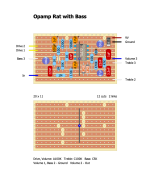
View attachment 125609

I use tantalum for some of the µF caps but you could use electrolytics. Most dual opamp ICs would probably work.
In my understanding of the traditional Rat circuit, it depends highly on the opamp's 'slew-rate'. Any slew-rate above ~0.4V/µs is not really discernable to the human ear. But below ~0.4V/µs, there is an inherent distortion imposed in the quality of a signal. The 308 and OP07 chips have a slew-rate of ~0.3V/µs and impose such break-up distortion.

Another dual opamp to try in a dual opamp Rat circuit is the LT1490 (it's a pin-for-pin drop-in replacement for a TL072), which has a slew-rate of ~0.06V/µs and really pushes that special "Rat-type" distortion factor.
 
Last edited:
I haven't tested this, but I feel like the right value capacitor in the feedback loop of the first opamp stage should mimic the effect of a low slew right. In both cases, the bandwidth is reduced with increased gain. I imagine you could get close with a little trial and error.
 
Back
Top