
You are using an out of date browser. It may not display this or other websites correctly.
You should upgrade or use an alternative browser.
You should upgrade or use an alternative browser.
Monarch
- Thread starter Chuck D. Bones
- Start date

Chuck D. Bones
Circuit Wizard
Do you not read my responses?Thanks. What about the 2N5089? Is that more easily substituted?
Whoops sorry! I was using my phone to read and I missed it. Thanks. Greatly appreciated!Do you not read my responses?
Chuck D. Bones
Circuit Wizard
It's all about getting the JFET biasing right. JFET circuits are not plug-n-play. Plan on selecting R4 & R12. Stock values might work, but there is no guarantee.
We're looking for around 5V on Q1-D. If it's higher than 5.5V or lower than 4.5V, then adjust R4. Increasing R4 makes Q1-D go up and vice-versa.
We want the current in Q2 to be between 1mA and 2mA. Measure the voltage on Q2-S, divide by the value of R12 and you have the current. Increase R12 to make the current lower and vice-versa.
Here's an easy trick. Assemble the board but do not solder R4 or R12. Wedge toothpicks in the 4 unsoldered holes so that the leads on R4 & R12 are held tightly in their respective holes. Power up the circuit and measure Q1-D. If it's outside the range of 4.5V to 5.5V, then remove R4 and try a different value. Use the same process for R12. Once you have the correct resistor values, solder them in.
Take your time with the build, inspect your work often making sure you installed the parts correctly and the solder joints are clean. Do a very thorough inspection and cleaning before installing the pots because once they're in, rework becomes much more difficult.
Good luck!
We're looking for around 5V on Q1-D. If it's higher than 5.5V or lower than 4.5V, then adjust R4. Increasing R4 makes Q1-D go up and vice-versa.
We want the current in Q2 to be between 1mA and 2mA. Measure the voltage on Q2-S, divide by the value of R12 and you have the current. Increase R12 to make the current lower and vice-versa.
Here's an easy trick. Assemble the board but do not solder R4 or R12. Wedge toothpicks in the 4 unsoldered holes so that the leads on R4 & R12 are held tightly in their respective holes. Power up the circuit and measure Q1-D. If it's outside the range of 4.5V to 5.5V, then remove R4 and try a different value. Use the same process for R12. Once you have the correct resistor values, solder them in.
Take your time with the build, inspect your work often making sure you installed the parts correctly and the solder joints are clean. Do a very thorough inspection and cleaning before installing the pots because once they're in, rework becomes much more difficult.
Good luck!

Chuck D. Bones
Circuit Wizard
That's a BJT and as such is not a sub for any JFETFWIW the MMBT5089 is the SMD equivalent and readily available (and cheap).
BF256B will have lower gain. J113 is a better sub and readily available. Adjust R4 and/or R12 in accordance with post #106.I am thinking of building this but the through-hole JFETs you mention are hard to get here. One place has suggested subbing BF256B JFETs because they have them in stock. I don't have a clue if they would work or not. Do you have any experience with the BF256B?
Chuck D. Bones
Circuit Wizard
It's there, you have to zoom way in.
It's all about getting the JFET biasing right. JFET circuits are not plug-n-play. Plan on selecting R4 & R12. Stock values might work, but there is no guarantee.
We're looking for around 5V on Q1-D. If it's higher than 5.5V or lower than 4.5V, then adjust R4. Increasing R4 makes Q1-D go up and vice-versa.
We want the current in Q2 to be between 1mA and 2mA. Measure the voltage on Q2-S, divide by the value of R12 and you have the current. Increase R12 to make the current lower and vice-versa.
Here's an easy trick. Assemble the board but do not solder R4 or R12. Wedge toothpicks in the 4 unsoldered holes so that the leads on R4 & R12 are held tightly in their respective holes. Power up the circuit and measure Q1-D. If it's outside the range of 4.5V to 5.5V, then remove R4 and try a different value. Use the same process for R12. Once you have the correct resistor values, solder them in.
Take your time with the build, inspect your work often making sure you installed the parts correctly and the solder joints are clean. Do a very thorough inspection and cleaning before installing the pots because once they're in, rework becomes much more difficult.
Good luck!
Hi Chuck,
OK. It's over a month since you gave this advice, but I had a couple of detours. First, given the complexity of the circuit and the biasing procedure -- I had bought both the Chop Shop V2 and this one at the same time, and I built the Chop Shop first. It's just as well, as I screwed that one up like four times before I got it right. Sounds really nice, BTW! Second detour was the holidays.
I got a lot of joy out of building this one (and the Chop Shop -- there was more cursing due to rookie mistakes), and as you said about taking your time, inspecting work, cleaning everything, it really paid off (I also measured every part as I put it on, and caught a couple of mistakes before they happened).
So I built this one, got it wired up tonight, and couldn't resist and plugged it in and it sounded great first try, before I even fiddled with the resistors. I used those socket pins for the resistors, and I socketed the transistors. I ended up getting the specified JFETs (the 5102s) and the 5089 NPN transistor as well.
I had made sure that Q2 had a higher Idss (0.67) than Q3 (0.43). I had to change R4 from 1k to 1.5k to get the Q1-D voltage from the initial 3.65V to 5.13V. I tweaked R12 from 560 (where I was getting 0.9ma) to 330 where I got about about 1.5mA for Q2-S.
Thanks, Chuck, for all of the advice on this one and the biasing procedure. This pedal is *really* pleasing sounding to my ear, with both humbuckers and single coils. It has much more overdrive/distortion range than the Chop Shop, and when pushed with the Juice switch sounds really great. With Juice switch off, and single-coils, it has a really pleasing midrange grit. Very musical. At higher gain that presence control is really useful. When I try to push the Chop Shop with a boost to get more distortion, it can sound really harsh, and the tone switch is only three values so I don't have a lot of choices to the sound coming out. This pedal on the other hand has a lot more flexibility. If I crank the drive, juice and presence all the way up, it'll get that same harshness, but dialing back presence makes it sound great.
(I notice if I crank the drive and juice up, turning up the treble control past about 75% can cause a whistling oscillation, but I have the pedal sitting on a breadboard--I didn't drill the enclosure yet--so we'll see if that still happens when it's in its enclosure.)
Thanks again! Just wanted to let you know this turned out great! This is my new favorite pedal. I really appreciate how friendly, helpful and thoughtful you (and everyone!) have been.
You'll be hearing more from me!
Take care,
--George
P.S. Two questions.
1. Given your experience with the circuit, if I have like 10 5102s, beyond Idss needing to be larger for Q2 are there ideal ranges for Q2 and Q3 Idss? In other words, is the pedal better with lower or higher Idss transistors if I'm selecting from what I have?
2. All of my capacitors in there are rated at 40V or higher. Is running this pedal at 18V recommended? If so, is there anything I have to do, bias-wise to the transistors, or will it just "scale up"?
1. Given your experience with the circuit, if I have like 10 5102s, beyond Idss needing to be larger for Q2 are there ideal ranges for Q2 and Q3 Idss? In other words, is the pedal better with lower or higher Idss transistors if I'm selecting from what I have?
2. All of my capacitors in there are rated at 40V or higher. Is running this pedal at 18V recommended? If so, is there anything I have to do, bias-wise to the transistors, or will it just "scale up"?
Chuck D. Bones
Circuit Wizard
Glad you like it!
You said "I had made sure that Q2 had a higher Idss (0.67) than Q3 (0.43)." and "I tweaked R12 from 560 (where I was getting 0.9ma) to 330 where I got about about 1.5mA for Q2-S."
First of all, those two statements are contradictory. By definition, Id can never be higher than Idss. So you may need to recheck your measurements.*
Second, I had to go back and correct a typo in post #85. Q3 is the top transistor and should have the higher Idss. Sorry about that.
There is an easy in-circuit test to determine if Q3 has a high enough Idss w.r.t. Q2. With power applied and no signal, measure the voltage from Q3-G (+ lead) to Q3-S (- lead). That voltage should be negative. If it's zero or positive, the Q3's IDss is too low and you should swap Q2 & Q3. You need to use a good quality DMM that has a 10M input impedance, not one of those cheap DMMs that Harbor Freight sells.
It's not surprising that this circuit oscillates when JUICE, GAIN and TREBLE are dimed and it's not in a box. Make sure that the pots, jacks and switch make metal-to-metal contact inside the box. Most of the boxes that Tayda sells have paint on the inside that must scraped off around the holes so you get good contact. It's important that the pot bodies, switch & jacks are properly grounded to the box.
Selecting JFETs for this circuit is more about gain and Vp. We want a Vp >0.5V on Q1 & Q2 so we don't overdrive the gate. Different part numbers have different gains for a given drain current. PF5102, J113 & MPF4393 have the right specs for this circuit. You still need to select them, of course.
You can run this on 18V and you will have more headroom on the 2nd stage. It will also get louder. The 2nd stage will bias itself correctly. The 1st stage bias will be good enough if you set the bias at 9V and then run it at 18V.
* The spec range for PF5102 Idss is 4.0 to 20mA. If Idss is outside that range, then the parts are fugazi.
You said "I had made sure that Q2 had a higher Idss (0.67) than Q3 (0.43)." and "I tweaked R12 from 560 (where I was getting 0.9ma) to 330 where I got about about 1.5mA for Q2-S."
First of all, those two statements are contradictory. By definition, Id can never be higher than Idss. So you may need to recheck your measurements.*
Second, I had to go back and correct a typo in post #85. Q3 is the top transistor and should have the higher Idss. Sorry about that.
There is an easy in-circuit test to determine if Q3 has a high enough Idss w.r.t. Q2. With power applied and no signal, measure the voltage from Q3-G (+ lead) to Q3-S (- lead). That voltage should be negative. If it's zero or positive, the Q3's IDss is too low and you should swap Q2 & Q3. You need to use a good quality DMM that has a 10M input impedance, not one of those cheap DMMs that Harbor Freight sells.
It's not surprising that this circuit oscillates when JUICE, GAIN and TREBLE are dimed and it's not in a box. Make sure that the pots, jacks and switch make metal-to-metal contact inside the box. Most of the boxes that Tayda sells have paint on the inside that must scraped off around the holes so you get good contact. It's important that the pot bodies, switch & jacks are properly grounded to the box.
Selecting JFETs for this circuit is more about gain and Vp. We want a Vp >0.5V on Q1 & Q2 so we don't overdrive the gate. Different part numbers have different gains for a given drain current. PF5102, J113 & MPF4393 have the right specs for this circuit. You still need to select them, of course.
You can run this on 18V and you will have more headroom on the 2nd stage. It will also get louder. The 2nd stage will bias itself correctly. The 1st stage bias will be good enough if you set the bias at 9V and then run it at 18V.
* The spec range for PF5102 Idss is 4.0 to 20mA. If Idss is outside that range, then the parts are fugazi.
OK...I worry that this is getting too close to "debugging my Viceroy" instead of "circuit of Viceroy" so if you want to give me the boot, fair enough.Glad you like it!
You said "I had made sure that Q2 had a higher Idss (0.67) than Q3 (0.43)." and "I tweaked R12 from 560 (where I was getting 0.9ma) to 330 where I got about about 1.5mA for Q2-S."
First of all, those two statements are contradictory. By definition, Id can never be higher than Idss. So you may need to recheck your measurements.*
Second, I had to go back and correct a typo in post #85. Q3 is the top transistor and should have the higher Idss. Sorry about that.
There is an easy in-circuit test to determine if Q3 has a high enough Idss w.r.t. Q2. With power applied and no signal, measure the voltage from Q3-G (+ lead) to Q3-S (- lead). That voltage should be negative. If it's zero or positive, the Q3's IDss is too low and you should swap Q2 & Q3. You need to use a good quality DMM that has a 10M input impedance, not one of those cheap DMMs that Harbor Freight sells.
It's not surprising that this circuit oscillates when JUICE, GAIN and TREBLE are dimed and it's not in a box. Make sure that the pots, jacks and switch make metal-to-metal contact inside the box. Most of the boxes that Tayda sells have paint on the inside that must scraped off around the holes so you get good contact. It's important that the pot bodies, switch & jacks are properly grounded to the box.
Selecting JFETs for this circuit is more about gain and Vp. We want a Vp >0.5V on Q1 & Q2 so we don't overdrive the gate. Different part numbers have different gains for a given drain current. PF5102, J113 & MPF4393 have the right specs for this circuit. You still need to select them, of course.
You can run this on 18V and you will have more headroom on the 2nd stage. It will also get louder. The 2nd stage will bias itself correctly. The 1st stage bias will be good enough if you set the bias at 9V and then run it at 18V.
* The spec range for PF5102 Idss is 4.0 to 20mA. If Idss is outside that range, then the parts are fugazi.
Interesting you mention about the PF5102 being 4.0 - 20mA Idss. I bought ten of these from stompboxparts and none of them are above 0.75mA on my meter (I have the F-NIRST one). In contrast testing random J113s yields around 1.5-2mA on the same meter. So I put the J113s in the circuit and it sounded like it was less compressed, and less distorted at full drive. Kinda lost the sound I liked, so I tried one of the fugazi 5102s at Q2, and there was more distortion, and had the nice sound I liked (had to adjust R12 of course).
> Note that the two JFETs do not necessarily need to be the same part number. Also, R12 & R13 do not need to be equal.
Not sure what part I actually have for the 5102, but Q3 and Q2 are definitely different now.
So I wonder just what I have that's ostensibly labeled 5102? Anyhow this is fun and hope I didn't distract too much.
Chuck D. Bones
Circuit Wizard
If the FNIRSI meter is anything like my CCTT, then it does not measure either Idss or Vp, it simply measures drain current at some arbitrary Vgs. I provide methods of measuring VP and IDss in this article.
Bottom line: we don't have enough information to know if your PF5102s are legit or not. In my experience, SBP sells good parts.
Bottom line: we don't have enough information to know if your PF5102s are legit or not. In my experience, SBP sells good parts.
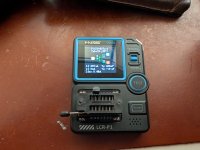
It would honestly not surprise me if the meter is screwball. I attached a pic w/one of the JFETs in it. It looks like it tries to figure out Vg at Id 0, and maybe takes another measurement and tries to project Idss, though I don't know? Idss looks like maybe 0.46mA but it's overlapped with "mA", but even if you could read it, I'm not sure I believe it.
But to bring this back to the Viceroy circuit, and its capabilities with the JFETs I happen to have on hand, I have used your bias procedure and have tried three different kinds of transistor:
This is a super fun project. I really like the sounds of JFET overdrive both with the Chop Shop and the Viceroy. The Viceroy can get a lot of the Chop Shop sounds, but is way more versatile. Particularly when playing with headphones and the so-so cab simulator built into my amplifier, being able to dial the Presence control down to take off some of the unpleasant high-frequencies when overdriven hard is great. It can do that without the pronounced affect on tone that the tone switch can have on the Chop Shop (though there are fun tones on the Chop Shop with the tone switch engaged!).
The Viceroy w/PF5102, when overdriven with my guitar with coils split and both pickups going (Seymour Duncan Custom '59 in bridge and "Whole Lotta Humbucker" at neck), has a beautiful quality where the chimey-ness of the clean signal comes through modulated in a really sweet way by the grit of the overdrive on the higher strings when playing chords. If I mess around with the Chop Shop and a compressor I can kinda-sorta-but-not-really get this sound, but this pedal on its own can get dialed in easily. The Viceroy has the really nice quality that even with a lot of overdrive (JUICE!) you can hear all of the strings of a chord pretty distinctly, and it's really responsive to volume, pick attack, etc. It also responds well to stacking boost or another overdrive in front of it.
Question about this circuit, in relation to the Chop Shop. Is it amenable to a "Sag" control that would starve the gain stages like the Chop Shop, or would that screw it up? (Six knobs isn't enough go for seven! See what I did there siiiiiixxxxx sevvveeen ... though my daughter who is 8 says 6-7 is so 2025.)
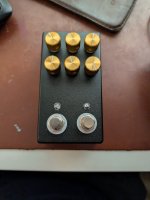
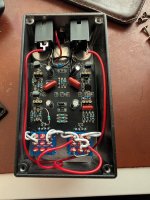
Here's pics of the tester, and the completed pedal. I have some orange knobs on the way, for now I stuck these ones on. I bought the enclosure in that color.


But to bring this back to the Viceroy circuit, and its capabilities with the JFETs I happen to have on hand, I have used your bias procedure and have tried three different kinds of transistor:
- PF5102 -- I think this one sounds the best in this pedal. Most range for the drive and juice controls. Very nice sounding in many different setting combinations with both humbuckers and single coils.
- J113 -- Works, but I don't think sounds as musical. The PF5102 just sounded sweeter and got much more complex tones.
- 2SK30A-Y -- These work and sound really nice. Not nearly as much range for drive and juice. This one makes the pedal sounds like a hot-rodded Chop Shop. At max drive with juice off, it's very Chop Shop-like. Quite musical. Juice sounds nice. But the pedal is just "nice" with these in there and you have to boost it with something to get even close to the overdrive of the PF5102 (I cranked level on a compressor in front as a boost just to test though both pedals are better with compressor off).
This is a super fun project. I really like the sounds of JFET overdrive both with the Chop Shop and the Viceroy. The Viceroy can get a lot of the Chop Shop sounds, but is way more versatile. Particularly when playing with headphones and the so-so cab simulator built into my amplifier, being able to dial the Presence control down to take off some of the unpleasant high-frequencies when overdriven hard is great. It can do that without the pronounced affect on tone that the tone switch can have on the Chop Shop (though there are fun tones on the Chop Shop with the tone switch engaged!).
The Viceroy w/PF5102, when overdriven with my guitar with coils split and both pickups going (Seymour Duncan Custom '59 in bridge and "Whole Lotta Humbucker" at neck), has a beautiful quality where the chimey-ness of the clean signal comes through modulated in a really sweet way by the grit of the overdrive on the higher strings when playing chords. If I mess around with the Chop Shop and a compressor I can kinda-sorta-but-not-really get this sound, but this pedal on its own can get dialed in easily. The Viceroy has the really nice quality that even with a lot of overdrive (JUICE!) you can hear all of the strings of a chord pretty distinctly, and it's really responsive to volume, pick attack, etc. It also responds well to stacking boost or another overdrive in front of it.
Question about this circuit, in relation to the Chop Shop. Is it amenable to a "Sag" control that would starve the gain stages like the Chop Shop, or would that screw it up? (Six knobs isn't enough go for seven! See what I did there siiiiiixxxxx sevvveeen ... though my daughter who is 8 says 6-7 is so 2025.)
Here's pics of the tester, and the completed pedal. I have some orange knobs on the way, for now I stuck these ones on. I bought the enclosure in that color.
Last edited: