Tungsten Preamp - another weird D.I. thing

vigilante398

Authorized Vendor
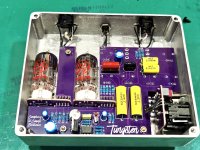
I've had this one ready to go and actually had boards on hand since about August, I just couldn't be bothered to write the damn build doc. I got it all together today, so this thing is up for sale now. It's kind of a neat circuit, it's pretty similar to a Fender Bandmaster/Alembic F-2B preamp, but it uses an additional triode basically set up as a cathodyne phase inverter to produce the balanced output, so you get a transformerless tube D.I.

IMG_20251217_123911.jpg

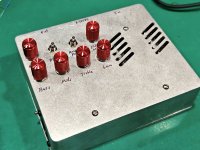
IMG_20251217_123928.jpg
 
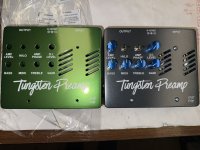
The paint files are great as usual as well as the drill files, I have a chrome green enclosure from Tayda ready to go for my next build.
Edit: I see the XLR daughterboard is for sale as well so I might have to grab some for spares on my next order.
Actually the XLR daughterboard for sale in the extra daughter board section is the transformer XLR board that comes with Nobelium and Steddi Go, but I can absolutely make these available as well.
 
Actually the XLR daughterboard for sale in the extra daughter board section is the transformer XLR board that comes with Nobelium and Steddi Go, but I can absolutely make these available as well.
That little PCB would fit so many projects where you have a XLR output, perfect for the back of an amplifier or a DI or ...... I just have to have a few spare in my little (HUGE) spare PCB box.
 
I’m kind of new to the whole D.I. thing….could this be another straight preamp option for guitar (like the bassdude)? And if so, getting in the ballpark of an old bandmaster sound?
 
Last edited:
I’m kind of new to the whole D.I. thing….could this be another straight preamp option for guitar (like the bassdude)? And if so, getting in the ballpark of an old bandmaster sound?
This could absolutely be another straight preamp option for guitar and will get you into the bandmaster territory. It doesn't have a speakersim so that would have to be added some other way if you want a more accurate amp sound, but this definitely covers the preamp territory.
 
Cool, thanks @vigilante398. I’ll have to have a look then (what a slippery slope this is 😅). Can you get much overdrive out of it?

And do I need to build the XLR part of the circuit if I’m just using as a regular preamp? Sorry if that’s a novice question.

Also FYI just looking at the schematic and I think the BOM is missing three pots (1M, 250k and 25k)..

Cheers
 
Last edited:
Question that I think I have sussed out the answer to, but will ask anyway knowing that the designer is here: I want to add a SPDT on-on switch to this for R5 such that it that would add additional resistance in series, e.g., 100K in one position as per the schematic, 250k in the second position for more gain out of the post-eq gain stage before the PI section, and I also want to add a second SPDT on-on switch that switches in and out of circuit a set of asymmetrical clipping diodes wired in antiparallel in a fat wire to ground, and plan to have the wire to the audio path connected to pin 2 of the gain control, which immediately follows the EQ section and immediately precedes the post-EQ gain triode's grid. The question is, will these two mods work without trouble? The biggest issue I can see is that because I am running wires from one end of the 100K resistor (the other is in the pad connected to the plate of the triode in question) and then back from the switch to the pad of R5 that faces the high voltage rail, perhaps there will be a problem with the high voltage running along 22AWG stranded wire? As for the clipping diodes, I can't put them pre-eq as the would be in a JCM900 given that there is (I think) insufficient gain between the first triode and the EQ section for the clipping to work with lower output pickups, but I can sandwich them between the EQ section and the second gain stage.

 
The size of the wire makes no difference to HV, it is the insulation on the wire that matters.
Make sure the wire is rated for high voltages, usually any wire that is rated for household mains wiring should be ok but check the rating to be sure.
Also make sure any switch you use is rated for the voltage you are switching.
I personally can't see the point in adding diode clipping to a tube circuit but if you do then please post a sound or video clip here so we can all hear what you come up with.
 
Back
Top