This Week on the Breadboard: Shallow Water

Chuck D. Bones

Circuit Wizard
This one has been in the queue for a loooooooooong time. I built it pretty much per the schematic I got from Robert. I subbed an MCP6002 for the MCP602, a CA3240 for the LM258, 1SS98 for the BAT48's and a 2N5246 for the 2K208-Y. The Shallow Water manual was helpful in setting the LPG trimmer and getting the most out of the control settings.

A clever circuit and most of it makes sense to me. Here's a quick rundown. Q1 & Q2 for a preamp. The gain a little over 12dB with both DIP switches open (off). From there, the signal goes three directions: to the envelope detector, to the BBD and to the Dry side of the MIX pot. On its way to the BBD, the signal is low-pass filtered by IC4.2. The signal then passes thru the BBD and is filtered again by a variable low-pass (IC3). IC3's cutoff freq is controlled by the envelope detector Q3, D1, D2 & IC4.1. If the signal level falls below a threshold determined by the GATE pot and D1 & D2's Vf, then the LP filter's cutoff freq is lowered to a freq determined by the LPG (low-pass gate) trimmer. Even with the GATE knob turned all the way up, I think the GATE threshold is too high. Closing DIP sw 2 boosts the preamp gain by 6dB, which helps, but is not enough IMO. The output of the LP filter goes to the Wet side of the MIX pot. The MIX pot is followed by the LEVEL pot and then another discrete preamp (Q4 & Q5). The BBD's clocks are generated by the CD4046. It contains a VCO which runs at a few hundred KHz, depending on the control signal coming from the Randomizer. IC2 is a microcontroller which contains a pseudo-random generator which is clocked at a rate determined by the RATE control. The output of IC2 is a high-speed pulse train that when averaged by the SLEW filter (SLEW pot & C16) becomes a random staircase waveform. Depending on the RATE & SLEW settings, the staircase varies from step changes to gradual ramps. The DEPTH pot control how much randomizing signal goes to the clock VCO (IC6). When the clock speed changes, the signal coming out of the BBD will have a variable delay and a variable freq shift.

I don't get why Fairfield adds gain in the first stage and then takes it all away in the BBD's input filter. I also don't understand why Fairfield runs the V3207D & CD4046 on 5V when they work as well or better on 9V. Definitely more headroom in the BBD at 9V. The input and output preamps work perfectly well, but could have been implemented by a dual opamp. There is a significant volume shift when turning the MIX knob from Dry to Wet. Not sure why Fairfield did that.

An interesting pedal, I'm still exploring its many sonic textures.

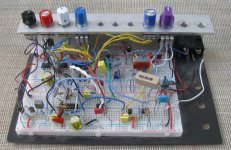
There is a metric shit-ton of parts in this pedal, as evidenced by my breadboard. 5V reg, randomizer and clock gen at the upper left. Envelope detector at the upper and right. Input amp is at the lower right. BBD is bottom center. Low-pass gate filter to the left of that and the output amplifier is at the lower left corner.

Knobs (L-R): LEVEL - MIX - RATE - SLEW - DEPTH - GATE
Shallow Water Breadboard 02.jpg
 
That's a busy breadboard for sure.... and a 10 ohm 5watt resistor....?
Looking forward what you come up with while I wrap my head around your analysis of what's going on there. It hurts. ;)
 
I don't get why Fairfield adds gain in the first stage and then takes it all away in the BBD's input filter. I also don't understand why Fairfield runs the V3207D & CD4046 on 5V when they work as well or better on 9V. Definitely more headroom in the BBD at 9V. The input and output preamps work perfectly well, but could have been implemented by a dual opamp. There is a significant volume shift when turning the MIX knob from Dry to Wet. Not sure why Fairfield did that.
This is really interesting. It sounds like there is a fair bit of simplification that can occur in Shallow Water. The only reason I could see running the BDD and CD4046 at 5v is because IC2, the pseudo-rng, is also running at 5v and the IC2 output of the random staircase is 0 to 5v and they wanted all signals (signal and audio) to match in amplitude.

Based on what you've written, it sounds like you're thinking about removing the transistor preamps and moving directly to ICs then shifting the V3207D and CD4046 to run on 9v -- which might also help alleviate the volume shift that occurs when mixing the wet and dry signals. Of course, now this post is making me try and locate a Shallow Water schematic and follow along.

I can't wait to see what you come up with!
 
It's easy enough to boost the 5V signal coming out of the TINY25V microcontroller, although it's not really necessary. The CD4046's VCO IN pin is analog and the VCO tuning range is not affected much by power supply voltage.
 
Is there a particular bias point people should look for with the gate and bbd trims, or are these up for personal preference/ component variability? I have a big and little lowtide and love them, but am never certain I have them set correctly or not.
 
Setting the LPG Trim is easy and a matter of personal preference. According to the Shallow Water Manual:

"The recovery filter’s lowest frequency can be adjusted, to fine tune the way it will react to incoming
signals. Lowering this frequency emphasises the action of the low pass filter, effectively raising
the threshold of sensitivity. Adjustment should be made with the following settings: MIX full wet,
LPG minimum, DEPTH minimum. While listening to a signal going through the pedal, you’ll hear the
effect of the recovery filter at its resting state. Carefully turn the trimpot labelled LPG adjust,
clockwise to raise the filter’s frequency, counterclockwise to lower. Be very careful, adjustments
should be minimal as the trimpot is very sensitive. After each adjustment, LPG should be turned up
momentarily to listen at the envelope’s response to the incoming signal."

I ended up swapping R32 & R33 to be able to obtain the full adjustment range. What they don't mention is that if you turn the LPG Trim far enough CCW, the filter turns completely off. I do not recommend doing that because it may pop when the filter turns on and off.

The Bias Trim is there to compensate for manufacturing variations in the BBD. The ideal setting produces the maximum headroom. The bad news is that only way to reliably obtain the best setting is to use an oscilloscope. The good news is that it's not that critical and we can usually get away with setting the Bias Trim in the middle and it will be good enough.
 
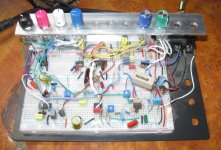
And here it is: The Heavy Water Modulator. I had considered some other names, such as Swamp Water, Mineral Water, Toilette Water and Bong Water. To really complete the Heavy Water motif, the enclosure should either be day-glo green or glow in the dark.

The parts count is significantly reduced from the Shallow Water. I touched just about every part of the circuit to some extent.
Preamp and input filter are at the lower right. The trimmer sets the gain from unity to 6x. Better than a pair of DIP switches IMHO.
BBD is bottom center with the Bias Trim next to it.
The output filter/gate and output stage are at the lower left. The LPG Trim varies the low-pass cutoff from 300Hz to 3KHz when the Gate is engaged. The filter is much simplified, I use an opto instead of an LM13700 to tune the filter.
The Randomizer and 5V reg are at the upper left. The Damping Filter is to the right of that and the Clock VCO is to the right of that. The DAMPING pot is now a single A1M. Everything except the Randomizer runs on 9V.
The Gate detector and opto LED driver are at the upper right.

Heavy Water v0.1 breadboard 02.jpg

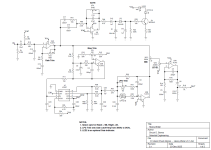
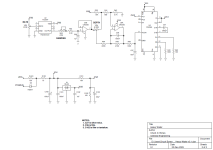
I split the schematic into two sheet for easier reading. To the extent possible, I retained the original ref des.
Everything works about the same. The DEPTH and GATE knobs have more range.
No volume change when turning the MIX knob.
With Gain Trim at zero, the end-to-end gain is 11x with LEVEL dimed.
ED2 is an optional GATE indicator. It should be a red superbright.
Running the CD4046 on higher voltage increases the VCO freq, so I increased C27 to compensate.
U5 can be any rail-to-rail FET opamp. CA3240 works well enough. I believe TLV2372 is better and it's less expensive, but I haven't tried one yet.
We don't need a precision filter for the Gate, so I went with an opto-tuned low-pass. It does the job with about 25% of the parts. The opto does not need to be fast, it just needs a large resistance range. The one I pulled at random from my stash has a light resistance under 1K and a dark resistance over 60M. It's not super fast and it doesn't need to be. The Gate opens quickly and closes slowly. R28 can be tweaked to accommodate the opto's sensitivity. Don't go under 1K.

C26 and C102 should be film for best filtering. Tantalum is also acceptable.

Heavy Water v0.1 sheet 1.png


Heavy Water v0.1 sheet 2.png
 
Last edited:
And here it is: The Heavy Water Modulator. I had considered some other names, such as Swamp Water, Mineral Water, Toilette Water and Bong Water. To really complete the Heavy Water motif, the enclosure should either be day-glo green or glow in the dark.

The parts count is significantly reduced from the Shallow Water. I touched just about every part of the circuit to some extent.
Preamp and input filter are at the lower right. The trimmer sets the gain from unity to 6x. Better than a pair of DIP switches IMHO.
BBD is bottom center with the Bias Trim next to it.
The output filter/gate and output stage are at the lower left. The LPG Trim varies the low-pass cutoff from 300Hz to 3KHz when the Gate is engaged. The filter is much simplified, I use an opto instead of an LM13700 to tune the filter.
The Randomizer and 5V reg are at the upper left. The Damping Filter is to the right of that and the Clock VCO is to the right of that. The DAMPING pot is now a single A1M. Everything except the Randomizer runs on 9V.
The Gate detector and opto LED driver are at the upper right.

View attachment 108256

I split the schematic into two sheet for easier reading. To the extent possible, I retained the original ref des.
Everything works about the same. The DEPTH and GATE knobs have more range.
No volume change when turning the MIX knob.
With Gain Trim at zero, the end-to-end gain is 11x with LEVEL dimed.
ED2 is an optional GATE indicator. It should be a red superbright.
Running the CD4046 on higher voltage increases the VCO freq, so I increased C27 to compensate.
U5 can be any rail-to-rail FET opamp. CA3240 works well enough. I believe TLV2372 is better and it's less expensive, but I haven't tried one yet.
We don't need a precision filter for the Gate, so I went with an opto-tuned low-pass. It does the job with about 25% of the parts. The opto does not need to be fast, it just needs a large resistance range. The one I pulled at random from my stash has a light resistance under 1K and a dark resistance over 60M. It's not super fast and it doesn't need to be. The Gate opens quickly and closes slowly. R28 can be tweaked to accommodate the opto's sensitivity. Don't go under 1K.

C26 and C102 should be film for best filtering. Tantalum is also acceptable.

View attachment 108257


View attachment 108258
This is great. Do I have a Shallow Water? No. Do I need to build Chuck’s Heavy Water? Nope. Will I probably put it on the pile of things to build? Likely:
 
As a NASA guy, I'm sure you know that the term 'heavy water' has additional meaning outside of music.
So to keep with the various nuclear sub-themes, perhaps one of the pots could be labeled along the lines of 'Fusion' or 'Moderator'?
Happy holidays!
 
As a NASA guy, I'm sure you know that the term 'heavy water' has additional meaning outside of music.
So to keep with the various nuclear sub-themes, perhaps one of the pots could be labeled along the lines of 'Fusion' or 'Moderator'?
Happy holidays!
I was thinking deuterium as a pedal name.
 
One of the shortcomings of my lowtide build was an annoying snare brush sound that I assume was PT2399 noise. Once I heard it I couldn't unhear it and no amount of bias twiddling could get rid of it (maybe I could have used a scope.) Any issues with noise on this one?
 
Back
Top