Parts Storage Solutions

Aldi is selling their WorkZone 32 drawer parts organizers again this week. I already have 5 or six of them, and I use them to separate and sort all my parts. one has resistors, one capacitors, one transistors and diodes, one ICs, etc.

Anybody else use these? I like them a lot. the drawers have slots for two dividers, so if you're clever and patient each bin can be a 96 part organizer. Some of the other bins ive used only have one slot per drawer.

Anybody use a different system that they like a lot? I've been curious about the Black and Decker 30 part drawers cause they seem more compact than the Aldi solution, and they're available year round.
 
Upvote 0
You see the downside of these drawer systems once you tipped over a drawer on your desk or floor.
But if you are soldering on a daily basis it is the most convenient way.
My cheapo solution: most parts come in small translucent plastic bags anyhow and I store them in
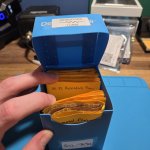
cardboard boxes like in a slip box. For example one row of resistors going from 10R, 100R, 150R, 1k, etc.
 
You see the downside of these drawer systems once you tipped over a drawer on your desk or floor.
But if you are soldering on a daily basis it is the most convenient way.
My cheapo solution: most parts come in small translucent plastic bags anyhow and I store them in
cardboard boxes like in a slip box. For example one row of resistors going from 10R, 100R, 150R, 1k, etc.
FWIW I use a plastic box but do the same for resistors, they go from low to high so you can look for the exact value. I also did some cardboard inserts (just pieces of cardboard) because putting them back where I took them from was a pain in the ass - the cardboard inserts simplify that part.
 
Trading cards organizer sheets in binders work very well for resistors, capacitors, diodes, transistors and even PCBs (I have multiple sized pockets). For the rest I use Akron Mills containers.
 
Aldi is selling their WorkZone 32 drawer parts organizers again this week. I already have 5 or six of them, and I use them to separate and sort all my parts. one has resistors, one capacitors, one transistors and diodes, one ICs, etc.

Anybody else use these? I like them a lot. the drawers have slots for two dividers, so if you're clever and patient each bin can be a 96 part organizer. Some of the other bins ive used only have one slot per drawer.

Anybody use a different system that they like a lot? I've been curious about the Black and Decker 30 part drawers cause they seem more compact than the Aldi solution, and they're available year round.
you got a link to these? I go to Aldi every week...they have the best imported chocolate
 
I have to stay organized because I’m naturally unorganized and messy. I focus on the task at hand and move to the next step before putting things back.

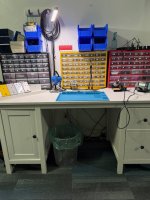
This is an older photo from one of the rare times the space was fully cleaned and organized.

Since then I’ve added a set of storage drawers above the red unit on the right. They’re all Akro-Mils drawers. They go on sale fairly often on Amazon if you’re not picky about color. I also added a desktop organizer for tools I use most.

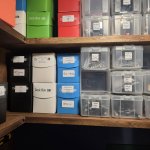
On the left are transistors and diodes. Not all of them, just the most commonly used ones are in the small drawers. The large bottom drawers hold off-board parts like footswitches, LEDs, bezels, DC and 1/4" jacks, and diodes that are used less often. Across the top, from left to right, are projects in progress, parts bins then ICs and things that are too large to fit in a drawer.

The middle is resistors. Most values have their own drawer with a few doubled up using splitters.

Bottom right holds capacitors in the small drawers, and random items in the larger ones. Things like solder wick, drill templates and sockets.

Top right (not pictured) is another dual drawer unit. The upper small drawers hold pots and the larger drawers below contain dust covers, oddball parts, and specialty items like transformers and one-off components that need to be accessible but don’t justify dedicated storage.

The top drawer unit is stacked pretty solidly, it sits well on the one below but I’d still like to find a way to make sure it can’t tip. Weight wise, I’d prefer the pots on the bottom but I reach for capacitors about ten times more often.

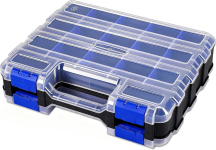
Out of sight is one of these cases I use one for knobs and just picked up a second for germanium transistors.

PCBs are stored in a three ring binder with sleeves with build docs. I use UV DTF stickers for artwork so when I’m ahead, I keep those in there as well.

I tried the baseball card box and baggie method but I was terrible about putting things back right away. It ended up being messy. Nothing wrong with it but I suck at being organized. With this, everything has its place. After a long day, drawers are everywhere but they are all easy enough to put back.

So short story long, I like bins with drawers!


1767710505007.png 1767710156202.jpeg 1767710627477.png
 
I have a couple sets of these which I like because they are configurable - the drawer housings come apart so you can set them up however you want.

I also have two of these, which take up a lot of space, but it's really nice having an entire drawer for each resistor value
 
I have to stay organized because I’m naturally unorganized and messy. I focus on the task at hand and move to the next step before putting things back.

This is an older photo from one of the rare times the space was fully cleaned and organized.

Since then I’ve added a set of storage drawers above the red unit on the right. They’re all Akro-Mils drawers. They go on sale fairly often on Amazon if you’re not picky about color. I also added a desktop organizer for tools I use most.

On the left are transistors and diodes. Not all of them, just the most commonly used ones are in the small drawers. The large bottom drawers hold off-board parts like footswitches, LEDs, bezels, DC and 1/4" jacks, and diodes that are used less often. Across the top, from left to right, are projects in progress, parts bins then ICs and things that are too large to fit in a drawer.

The middle is resistors. Most values have their own drawer with a few doubled up using splitters.

Bottom right holds capacitors in the small drawers, and random items in the larger ones. Things like solder wick, drill templates and sockets.

Top right (not pictured) is another dual drawer unit. The upper small drawers hold pots and the larger drawers below contain dust covers, oddball parts, and specialty items like transformers and one-off components that need to be accessible but don’t justify dedicated storage.

The top drawer unit is stacked pretty solidly, it sits well on the one below but I’d still like to find a way to make sure it can’t tip. Weight wise, I’d prefer the pots on the bottom but I reach for capacitors about ten times more often.

Out of sight is one of these cases I use one for knobs and just picked up a second for germanium transistors.

PCBs are stored in a three ring binder with sleeves with build docs. I use UV DTF stickers for artwork so when I’m ahead, I keep those in there as well.

I tried the baseball card box and baggie method but I was terrible about putting things back right away. It ended up being messy. Nothing wrong with it but I suck at being organized. With this, everything has its place. After a long day, drawers are everywhere but they are all easy enough to put back.

So short story long, I like bins with drawers!


View attachment 108949View attachment 108948View attachment 108950

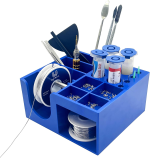
Do you actually own that little desk organizer / solder holder thingy? I found it on EveryMarket but I am hesitant to pull the trigger...
 
Do you actually own that little desk organizer / solder holder thingy? I found it on EveryMarket but I am hesitant to pull the trigger...
I have that exact one, yes. Got it on Amazon for like $15. It is good, decent plastic but can't imagine it seeing too much abuse unless I loose my cool trouble shooting and throw it across the room. Behind the solder reel I have snips, needlenose and wire striper. In the round ones I have solder sucker (fits perfectly), small screwdrivers, tweezers. In the small small I have hex and that's it I think. They are shallow. Squares up front have guitar picks. Bottom cubby with the spare solder has my DCA-55 and LCR P1. Wish that was a touch deeper but it works
 
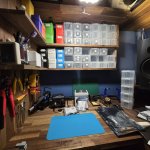
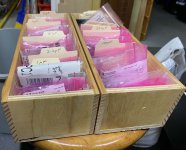
My storage solution consists of wood bins made from cut up scrap lumber and plywood, sorted by component type and value.
For storing passive components, I use whatever small bags I have on hand - including a lot of reused baggies.
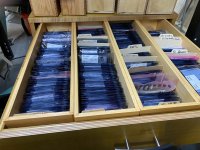
For storing semiconductors, I use conductive baggies I bought for cheap online.
I mark them by part #, manufacturer, and vendor.
Of course, most bags have a very small # of components in them.
Then, as the number of bins multiplied, I built a 4-drawer parts cabinet that fits under a basement workbench.
So now it's all sorted and easy to find ... lol.
IMG_3142s.jpg
IMG_3143s.jpg
 
If you have any decent inventory, then those small parts storage solutions rock.

It's incredibly productive to be able to just grab the parts you need. The hardest part is cutting off the components if they come in a strip..

Personally, I use the Stanley small parts magazine for the smaller stuff:
They have a larger drawer option as well which is great for pots and knobs.

I also enjoy storage boxes close on hand. Store the tools and parts you use regularly (when they aren't left on the bench!)
 
I use the cardboard boxes that I get when I order components and PCBs.

-Resistors are in order by ohm
-Capacitors are grouped by value over the range of decades.
-transistors, diodes, and mojo parts are in a small parts organizer with drawers
-pots are in 3 bags separated by taper
-jacks (audio, dc, midi, etc) get a box
-switches get a box
-CMOS chips get a box
-Other ICs get a box
-Breadboard gear gets a box
-enclosures get a box
-you get a box
-and you get a box!
 
Back
Top