Organic Aluminum Polymers for Electrolytic - do they have a place?

sn__tz

New member
I'm posting this because I've not found any sources or discussions actually on this topic.

If you shop at general electronic supplies you'll come across Aluminum Organic Polymer capacitors. They're slightly more expensive than electrolytics, but not meaningfully so. In the general sense, they're supposed to be "strictly" better. Electrochemically and physically, they're supposed to last longer, have tighter tolerances, don't drift, yada yada. Usually as I understand these are the caps you see on SMC boards. So it sound's like they're a strict improvement

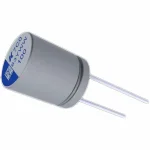
The most common and only thing I can find about them in the electrical-audio space is that people purchase them because frankly they look cool. That's why I purchased them, and because for my voltages they were basically the same price as classic electrolytic

The main things I see about these that seems like they can't just be a drop in for all traditional electrolytics is that they supposedly have bad leakage. It's not clear to me how often what we "traditionally" use electrolytic caps for in pedals (the power section namely) this is really a problem. What do y'all think

MFG_7C0_Series.webp
 
I should say - I am like half in half out in terms of just being a pedal/amp builder and learning the engineering behind them. So I don't fully understand the use cases for where leakage does and doesn't matter.

I'm vaguely understanding that:
- for power smoothing, these are way better than electrolytics
- for biasing and etc, these are no good

I'm wondering how to look at a schematic and figure out where these can be an "upgrade"
 
I should say - I am like half in half out in terms of just being a pedal/amp builder and learning the engineering behind them. So I don't fully understand the use cases for where leakage does and doesn't matter.

I'm vaguely understanding that:
- for power smoothing, these are way better than electrolytics
- for biasing and etc, these are no good

I'm wondering how to look at a schematic and figure out where these can be an "upgrade"
I think the chances you'll hear a difference between a regular electrolytic and a polymer electrolytic are slim. I've see a few IC datasheets that specifically call for them when high capacitance/high voltage/low ESR/low leakage are required, but that describes a miniscule amount of what happens in pedals, especially DIY pedals.

Short answer: you don't need these.
 
I think the chances you'll hear a difference between a regular electrolytic and a polymer electrolytic are slim. I've see a few IC datasheets that specifically call for them when high capacitance/high voltage/low ESR/low leakage are required, but that describes a miniscule amount of what happens in pedals, especially DIY pedals.

Short answer: you don't need these.
Bruh, why you being nice to the robots? 🤣
 
Man i wrote this organically. how cooked am I / are we if this sounds like ai lol. Do you want a photo for proof of my newly organized box of aluminum org poly caps I got off mouser for a total a $3


I think the chances you'll hear a difference between a regular electrolytic and a polymer electrolytic are slim. I've see a few IC datasheets that specifically call for them when high capacitance/high voltage/low ESR/low leakage are required, but that describes a miniscule amount of what happens in pedals, especially DIY pedals.

Short answer: you don't need these.
right, I know I don't necessarily need them, but I have them now and I'm curious. if you're telling me 40 years from now when someone uses my reasonably built klon clone I hawked off to them on Reverb that some of the caps won't be leaking that's kind of interesting to me considering that's the main maitenance prone part here.

Outside of the scope of this forum I'm also about to recap an amp and am curious about using them there too
 
if you're telling me 40 years from now when someone uses my reasonably built klon clone I hawked off to them on Reverb that some of the caps won't be leaking
We're talking about different things here. Electrical leakage refers to leakage current, not physical leaking of chemicals. Granted prolonged electrical failure of a capacitor can lead to physical failure which can result in chemical leakage, but "low leakage" doesn't mean "less likely to spill electrolyte all over your Klon when it fails."

Bruh, why you being nice to the robots? 🤣
If a robot politely asks for help in selecting electronic components, why wouldn't I help that robot?

Seriously though, no offence to my dude sn_tz but I thought there were enough grammatical hints in the post that it was a human, I didn't think it was a bot.
 
We're talking about different things here. Electrical leakage refers to leakage current, not physical leaking of chemicals. Granted prolonged electrical failure of a capacitor can lead to physical failure which can result in chemical leakage, but "low leakage" doesn't mean "less likely to spill electrolyte all over your Klon when it fails."


If a robot politely asks for help in selecting electronic components, why wouldn't I help that robot?

Seriously though, no offence to my dude sn_tz but I thought there were enough grammatical hints in the post that it was a human, I didn't think it was a bot.

Right sorry, I mean it in both ways. I'm trying to figure out where the high current leakage in reference to matters to prevent literal physical leakage. Pure curiosity and minmaxxing the build if the so called "strictly" better quality is true. Also I'm aware this could be potentially moot because I'm aware current production electrolytics are significantly higher quality and will probably last longer anyways.

My assumption and tl;dr question here is I'm assuming you cannot just drop them in for every electrolytic cap on a pedal schematic, but for some caps its a "better" choice. Realistically I would probably toss them into my pedals since I have them, but if I could figure out where in my amp it's better when recapping that's honestly the bigger value add

I've found basically 0 discussion on using them in this space (which makes sense, this space is built on a lot of knowledge passed down and tradition) so it's got me thinking/asking
 
Last edited:
robot-dance.gif
 

Attachments

  • 1770237254488.jpeg
    1770237254488.jpeg
    5.1 KB · Views: 1
My assumption and tl;dr question here is I'm assuming you cannot just drop them in for every electrolytic cap on a pedal schematic, but for some caps its a "better" choice
My opinion is that you absolutely can drop them in for any and every electrolytic cap on a schematic if you have them on hand. I would say if the original design has an electro in the signal path (typically a no-no) these would be a good alternative if you don't want to use tantalum. They're also good options for power filter capacitors because of their low ESR and low leakage.

In the audio path, leakage often results in crackling due to DC in the signal, in power supplies leakage can result in excess heat.
 
My opinion is that you absolutely can drop them in for any and every electrolytic cap on a schematic if you have them on hand. I would say if the original design has an electro in the signal path (typically a no-no) these would be a good alternative if you don't want to use tantalum. They're also good options for power filter capacitors because of their low ESR and low leakage.

In the audio path, leakage often results in crackling due to DC in the signal, in power supplies leakage can result in excess heat.
Awesome, I think that makes sense. I think from a signal perspective I'm totally understanding leakage there

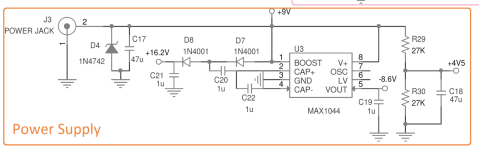
I'm curious mostly when caps are applied to supply or bias rails. Using the klon as an example and pulling out the power section:
1770237812316.png

I'm getting why every cap here leakage isn't an issue except for c18, c19, and c21. maybe I'm misunderstanding leakage but couldn't the voltage slightly drift if those caps were leaky?
 
Awesome, I think that makes sense. I think from a signal perspective I'm totally understanding leakage there

I'm curious mostly when caps are applied to supply or bias rails. Using the klon as an example and pulling out the power section:
View attachment 110492

I'm getting why every cap here leakage isn't an issue except for c18, c19, and c21. maybe I'm misunderstanding leakage but couldn't the voltage slightly drift if those caps were leaky?
The answer is, as always, "it depends."

If you're using a reasonable power supply, an extra handful of microamps of leakage are not going to bother your Cioks DC7 that's capable of supplying 660mA to a <50mA load like a Klon. This will matter a bit more if you're using a battery, as leakage current means your battery will drain faster, resulting in a lower source voltage over time. But even then, on a 9V supply, any leakage your capacitors are experiencing is going to have minimal effect in the real world.

All that being said, at higher voltages and in situations with higher heat (i.e. tube amps), leakage will become a much bigger factor and can end up being in the mA range, which can add up to a fair amount of excess heat (use Ohm's law), which can absolutely cause component failure over time.
 
I have a special place in my heart for organic polymer caps, because those are, in a way, what got me into DIY audio electronics. Before I got back into guitar, diyAudio was my regular hangout. I got my feet wet in that hobby by buying super cheap audio devices (amps, DACS) from China, and "modding" them - which usually amounted to just replacing sketchy no-name components with better brand-name components; if nothing else, it was at least good soldering practice. One of the first replacement jobs I remember was swapping the stock el-cheapo power supply decoupling caps with nice Panasonic OS-CON (organic polymer) caps on the TPA311x-based amplifier boards. At the time, I thought it really made a noticeable improvement, but looking back that very well could have been confirmation bias: pride in what, at the time, seemed like a significant amount of DIY work, and also everyone else on on the forum said it made a huge improvement. But it was fun!

I've done a few pedal builds with organic polymer caps, not because they are "better", but only because I have some leftover from my DIY hifi days. At least from a hifi perspective - and why they may have improved the tpa311x sonics - is their ultra-low equivalent-DC resistance can be helpful for "bass slam". I.e., amplifying bass at speaker level (not so much at line level) requires lots of current, so low DCR caps can help. In an analog guitar pedal, even a bass pedal, we're operating at guitar pickup level or line level - the current demands are negligible compared to those of a power amp. So my armchair analysis is they are unlikely to be of much, if any, improvement over quality electrolytics. In my experience, organic polymer caps tend to be a larger diameter than their electrolytic equivalent, so they do eat up more PCB space. But they do look cool!
 
Last edited:
Back
Top