PedalPCB Derailer/Ethos TWE-1

OD is Glorious

Well-known member
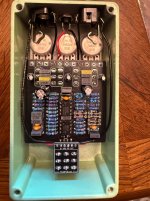
This pedal went together easily and I enjoyed the process. I am working my way through the PedalPCB offerings. Pretty wild to have four toggle switches on an overdrive! I am trying to enjoy this journey rather than rushing to complete pedals. I enjoyed this build, I did not enjoy that you need hard(er) to find Zener diodes, two odd-size film capacitors and two 13k resistors. You can see I ran two resistors in series to get to 13k (12k and 1k). I also used two film caps that were slightly higher than the build called for. FYI… that 470u EC is a rotund cylinder which barely fits.The 220u is also quite a fatty. Using ECs I am trying to keep to 25v and 16v at the lowest. It was a clean no problems build and it worked as soon as it got onto the PedalPCB Platform. I boxed it and put it through testing.

I see one Derailer user made a Youtube video and compared this to a Dumble. It does have a good selection of sounds. Mine is clipping with Zenner 2.0s because I have not ordered the 1v8s. I have all diodes socketed for swapping. I think to get the best sound you will have to spend at least an hour. The high-cut center potentiometer is interesting. Turning left for highs and right to cut the highs. This thing can get very loud and very dirty. I always like an overdrive that allows me to get lows, and this pedal does that, On the vintage toggle the pedal behaves somewhat like fuzz at times, slightly flubby unless you engage a few switches. I can say I only played with it for about twenty minutes but I imagine if you have a sound that you are looking for you may be able to find it in this pedal.

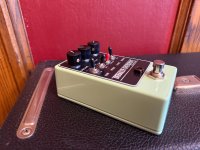
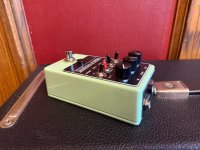
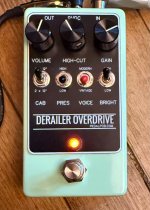
For this build I chose a beautiful powder coated light green Tayda enclosure. I tried different knobs but the black ones seemed to fit the build and I used black toggle covers for the on/off/ons and a red cover for the on/on voice switch. I used a 1kg footswitch and the Lumberg jacks. The LED is orange diffused. I used faceplates for the top jacks and pedal top. I hope PedalPCB has more faceplates made. I just love the professional look. I only do black graphics so having more plates would allow me to use dark enclosures. Because of the faceplate on this I could have used a dark enclosure. I think it is a very nice pedal and I dropped it off with some local players at Dave's Guitars in Milwaukee for testing!
 

Attachments
  • IMG_9783.jpeg
    IMG_9783.jpeg
    289.4 KB · Views: 50
  • IMG_9782.jpeg
    IMG_9782.jpeg
    515.3 KB · Views: 51
  • IMG_9785.jpeg
    IMG_9785.jpeg
    347 KB · Views: 40
  • IMG_9786.jpeg
    IMG_9786.jpeg
    342.1 KB · Views: 46
Last edited:
Good looking build inside and out.


I'm curious about the HIGH CUT...
You mention "Turning left for highs and right to cut the highs.", which describes how the ProCo Rat's TONE control works —
yet this control is wired the opposite of the Rat's, ie
this is signal > lug 3 and exiting out of lug 1
Rat [EDIT: MUROIDEA] is signal > lug 1 and exiting out of lug 3.

[EDIT ... my confusion's cleared up, see post #4]
I would think this would get more trebly as you turn the HIGH CUT clockwise, and cut highs by turning CCW.

If it cuts to the right as you mention, then I'll offboard wire mine as I do for Rats (I prefer turning a pot clockwise for more highs).
(Too lazy to breadboard it at the moment)
 
Last edited:
Thanks! I guess high Cut describes exactly what this potentiometer does.They call it high cut because when you’re at zero, you have all the highs and as you turn clockwise, you cut the out highs.
 
Thanks! I guess high Cut describes exactly what this potentiometer does.They call it high cut because when you’re at zero, you have all the highs and as you turn clockwise, you cut the out highs.

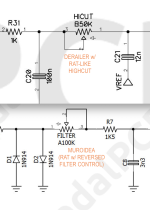
Yes, understood now — I was comparing the Derailer schematic to the PedalPCB Muroidea (Rat) schematic, but hadn't realised Robert swapped the FILTER control around for the Muroidea; then I looked at some other Rat schematics. Robert is usually quite faithful to the original circuit for most of his PCBs, this one caught me out.

So, the Derailer HICUT behaves just like a regular ol' Rat's FILTER.

DERAILER HICUT vs MUROIDEA FILTER.png

Sorry for any confusion 'caused.
 
This pedal went together easily and I enjoyed the process. I am working my way through the PedalPCB offerings. Pretty wild to have four toggle switches on an overdrive! I am trying to enjoy this journey rather than rushing to complete pedals. I enjoyed this build, I did not enjoy that you need hard(er) to find Zener diodes, two odd-size film capacitors and two 13k resistors. You can see I ran two resistors in series to get to 13k (12k and 1k). I also used two film caps that were slightly higher than the build called for. FYI… that 470u EC is a rotund cylinder which barely fits.The 220u is also quite a fatty. Using ECs I am trying to keep to 25v and 16v at the lowest. It was a clean no problems build and it worked as soon as it got onto the PedalPCB Platform. I boxed it and put it through testing.

I see one Derailer user made a Youtube video and compared this to a Dumble. It does have a good selection of sounds. Mine is clipping with Zenner 2.0s because I have not ordered the 1v8s. I have all diodes socketed for swapping. I think to get the best sound you will have to spend at least an hour. The high-cut center potentiometer is interesting. Turning left for highs and right to cut the highs. This thing can get very loud and very dirty. I always like an overdrive that allows me to get lows, and this pedal does that, On the vintage toggle the pedal behaves somewhat like fuzz at times, slightly flubby unless you engage a few switches. I can say I only played with it for about twenty minutes but I imagine if you have a sound that you are looking for you may be able to find it in this pedal.

For this build I chose a beautiful powder coated light green Tayda enclosure. I tried different knobs but the black ones seemed to fit the build and I used black toggle covers for the on/off/ons and a red cover for the on/on voice switch. I used a 1kg footswitch and the Lumberg jacks. The LED is orange diffused. I used faceplates for the top jacks and pedal top. I hope PedalPCB has more faceplates made. I just love the professional look. I only do black graphics so having more plates would allow me to use dark enclosures. Because of the faceplate on this I could have used a dark enclosure. I think it is a very nice pedal and I dropped it off with some local players at Dave's Guitars in Milwaukee for testing!


Man, that's my aesthetic right there. It's coming off as seafoam-green on my screen, and if there's any better color, I haven't seen it yet. And the knob choices and toggle-bat covers assert, "Proudly Analog," to anyone who glances in that direction. Outstanding.
 
Yes, understood now — I was comparing the Derailer schematic to the PedalPCB Muroidea (Rat) schematic, but hadn't realised Robert swapped the FILTER control around for the Muroidea; then I looked at some other Rat schematics. Robert is usually quite faithful to the original circuit for most of his PCBs, this one caught me out.

So, the Derailer HICUT behaves just like a regular ol' Rat's FILTER.

View attachment 112552

Sorry for any confusion 'caused.
I think the orientation within the schematic doesn't matter; the circuit is seeing the resistance between 1 and 2, in either case, with max resistance at CW. In both cases, the potentiometer is acting as a variable resistor, with no meaning to the orientation.

(You may already know this well, so just skip if this is old hat)
In both cases, this resistor plus the following capacitor is just a basic RC passive low-pass filter. The knob sets the LP cutoff where further CW = more filter.

Using Digi-Keys Low-Pass/High-Pass filter calculator:
The Rat puts a serial resistor in line, so the R in the RC low-pass filter ranges from 1.5K to 101.5K. The Low-Pass cut-off ranges from 32kz (1.5K at full CCW) to 475 kHz (101.5K at full CW).

The Derailer adjusts from basically no cutoff (0Ω) to 265Hz (50K at full CW), but the presence control in front of the Hi-Cut also does some filtering. In the simpler setting (I think this is off) presence adds another low-pass filter with 1K / 100nF = 1591 kHz.
 
I'm not so great at maths, so the link to the Digi-Key LP/HP Filter Calc and related frequency info is greatly appreciated, @gtfields13.

I think the orientation within the schematic doesn't matter; the circuit is seeing the resistance between 1 and 2, in either case, with max resistance at CW. In both cases, the potentiometer is acting as a variable resistor, with no meaning to the orientation.

Only one circuit will be CW, despite the total resistance for both circuits being between respective lugs 1 and 2&3.

Each pot mounted in their respective PCB are oriented the same, 321 looking into the back of the open pedals, but 123 when looking at the completed pedals on the pedalboard. The signal paths to&from each pot are, however, different — as indicated by lug-numbering on the schematics.

So while both the Derailer's HICUT and Muroidea's FILTER are performing the same rheostat-job (total resistance between lug 1 and lugs 2&3),
the orientation does matter in relation to which lugs the signal enters and exits the pot, ie the way the potentiometer is turned to achieve maximum cutting of the highs — note the small arrows on the schematics.

Looking at the finished pedals on a pedalboard, to increase resistance and thus cut highs the potentiometer has to be turned ...
CW for the Derailer (1⇨2&3) to the right = more resistance;​
CCW for Muroidea (1⇦2&3) to the left = more resistance.​
 
I'm not so great at maths, so the link to the Digi-Key LP/HP Filter Calc and related frequency info is greatly appreciated, @gtfields13.


Only one circuit will be CW, despite the total resistance for both circuits being between respective lugs 1 and 2&3.

Each pot mounted in their respective PCB are oriented the same, 321 looking into the back of the open pedals, but 123 when looking at the completed pedals on the pedalboard. The signal paths to&from each pot are, however, different — as indicated by lug-numbering on the schematics.

So while both the Derailer's HICUT and Muroidea's FILTER are performing the same rheostat-job (total resistance between lug 1 and lugs 2&3),
the orientation does matter in relation to which lugs the signal enters and exits the pot, ie the way the potentiometer is turned to achieve maximum cutting of the highs — note the small arrows on the schematics.

Looking at the finished pedals on a pedalboard, to increase resistance and thus cut highs the potentiometer has to be turned ...
CW for the Derailer (1⇨2&3) to the right = more resistance;​
CCW for Muroidea (1⇦2&3) to the left = more resistance.​
The signal path direction (1 to 2&3 vs 2&3 to 1) doesn't matter. Really. Full CW is always maximum resistance between pins 1 and 2.
You don't have to believe me, though, you can measure this for yourself to confirm what I am telling you.
You probably should, seeing is believing, because then you will believe that both circuits are using the same passive RC low-pass on the signal.

What you are likely confusing is if you reverse a potentiometer that isn't jumpered from 2 to 3, making it a variable resistor.
 
The signal path direction (1 to 2&3 vs 2&3 to 1) doesn't matter. Really. Full CW is always maximum resistance between pins 1 and 2.
You don't have to believe me, though, you can measure this for yourself to confirm what I am telling you.
You probably should, seeing is believing, because then you will believe that both circuits are using the same passive RC low-pass on the signal.

What you are likely confusing is if you reverse a potentiometer that isn't jumpered from 2 to 3, making it a variable resistor.

I BELIEVE I BELIEVE 😸 !!

I understand the relationship of pins 1&2, that therein will always be maximum resistance — what I'm not getting is why the Derailer and Muroidea behave differently ie turning CCW gets you full highs and turning CW gets cutting. Or do they...? 🤔

Okay, I promise to break out my breadboard, this week — soonest I can get to it is Wednesday.

Thank you for your continued edification and patience with me!
 

i can recommend these mods, they're helpful to dial interesting sounds more easily
 
Back
Top