Kliche Mini

Passinwind

Well-known member
Build Rating
5.00 star(s)
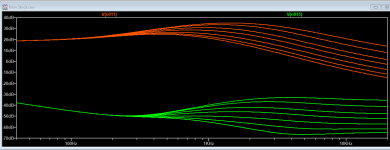
I won this board in one of @fig 's contests a couple of years ago but just finally got around to building it up. It completes my current trio of ODs: hard clipper, soft clipper, opamp. As usual I did an LTspice model first so I could visualize what component swaps might do, and although I was originally going to do this one to spec I inevitably changed my mind and went a bit rogue. My intent was to reduce overall gain a little, bump bass response up a good bit, and use a more modern opamp, OPA1642 in this case. At what turns out to be a represenative setting with my particular guitar and tube amp, here are the control sweep sims for the tone control:

Kliche_modded_vs_stock.png

That would reflect a gain matched Volume setting of 7.5 out of 10 on mine and 5 out of ten on a stock unit, with Drive at 6 out of ten on both. I modeled many other settings as well to make sure my mods were likely to make me happy. Since the only Klon I've ever played through was the model in my Spark 2 amp I had to rely more on my experience building many many preamp/EQs; at this point I have a pretty clear mental picture of how a given curve is going to sound. Distortion waveforms are trickier for me though, and this and my recent Mahayana build were an attempt to get a little smarter about that. Both pedals feel like keepers to me in any case, and the build itself was very simple over just one day. I'll probably re-house with Amplifiedfun graphics soon unless I just do my own PCB with more SMD parts, which is a strong inclination.


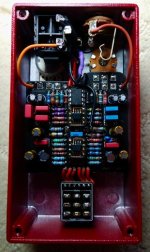
Kliche guts.jpeg


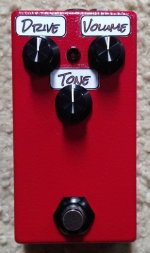
Kliche top.jpeg

I did have to put a few caps underneath as the only correct value ones I had on hand were polypropylene Kemets. I also lost the oddball 392k and 442k feedback resistors, going with 330k in both cases. I can detail the other mods if requested, but IMO there's nothing all that magic about them.
 
Last edited:
Looks cool! For distortion I've had success modelling DC transfer functions in spice then pairing it with FFTs for stepped levels. Granted it only shows relative changes between settings, not how they actually sound.
 
Looks cool! For distortion I've had success modelling DC transfer functions in spice then pairing it with FFTs for stepped levels. Granted it only shows relative changes between settings, not how they actually sound.
Waveform correlation bewtween transient sine wave modeling and my oscilloscope was pretty good, next up is recording some clean guitar WAV files and running them through LTspice, maybe with a pickup sim included. Judging from my previous clean bass preamp modeling I expect that to be a protracted process, But it certainly is easier when you already have a known good sounding device to work with!
 
What's the tone control? Dual gang sallen key?
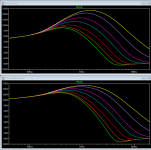
It's essentially a pretty basic Baxandall circuit, here's what's going on on both sides of the feedback resistor in that stage:

Screenshot 2026-08-09 063119.png

Wouldn't the pickup sim be implicit with the guitar?

True, but only at one pickup loading scenario unless you record multiple takes. A lot of my own bass preamps use non classical loading strategies and I'd like to start applying that to electric guitar in a smarter way as I start building more widgets for that.
 
Like medium to lo-z inpits? It's an interesting concept if so. Probably enhances the character of each instrument.

It's interesting what responses you can get from a circuit just by tapping the output at different nodes.
 
Like medium to lo-z inpits? It's an interesting concept if so. Probably enhances the character of each instrument.

It's interesting what responses you can get from a circuit just by tapping the output at different nodes.
Yep, killing/neutering the pickups natural resonant peak with a tailored Z load so you can impose a variable one with a resonat LPF, for example. It tends to take a lot of trial and error, for me at least. Audere onboard preamps leveraged that concept pretty well (sans LPF), for one.
 
Hm, quite the opposite of what I was thinking but it makes sense. Lo z lowers the q of the pickup. Granted that can come with its own territory. Lower it too much and lose highs. An impedance switch like studio preamps would be fun.
 
Hm, quite the opposite of what I was thinking but it makes sense. Lo z lowers the q of the pickup. Granted that can come with its own territory. Lower it too much and lose highs. An impedance switch like studio preamps would be fun.
My new DIY tube bass amp is actually getting a switch like that this week. Since I only play active basses I started with a 100k input impedance, but I plan to go both higher and lower once the multiway switch goes in.
 
You run uprights through as well?
Not yet, but I’d probably use one of my higher impedance open source preamp pedals as a front end, or maybe the 10meg Creation Labs Redeemer I have in a DI box. I sold off my EUB a couple of years ago and don’t currently own an acoustic one either, but I’d love to have both again if we move to a place with a bit more room.
 
They aren't cheap that's for sure. I always see 10Meg quoted for uprights but I'd bet that is overkill.
The last acoustic upright pedal I did for a friend which had a Fishman BP100 pickup system ended up sounding best to us at ~700k, which was definitely a surprise. It was a really nice carved bass that she snagged for less than half what it was worth, I really loved having a go occasionally at our weekly community house jams.
 
The last acoustic upright pedal I did for a friend which had a Fishman BP100 pickup system ended up sounding best to us at ~700k, which was definitely a surprise. It was a really nice carved bass that she snagged for less than half what it was worth, I really loved having a go occasionally at our weekly community house jams.
I just can't imagine an upright needing much treble. Maybe the upright pickup reactance is different though.
 
I just can't imagine an upright needing much treble. Maybe the upright pickup reactance is different though.
With a piezo lower Z loading tends to cut the lowest bass octave, which is not necessarily a bad thing for AUB. Especially with my resonant LPF pedals, which are pretty good at killing upper midrange quack. But as usual, it just depends. My friend was mostly playing bluegrass at that time, but later she started doing hip hop and disco sounding stuff too.
 
With a piezo lower Z loading tends to cut the lowest bass octave, which is not necessarily a bad thing for AUB. Especially with my resonant LPF pedals, which are pretty good at killing upper midrange quack. But as usual, it just depends. My friend was mostly playing bluegrass at that time, but later she started doing hip hop and disco sounding stuff too.
Yeah uprights have to battle a lot of sub. Hence the broughton high passes everywhere
 
Back
Top