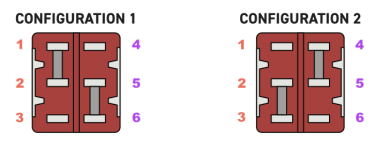
These look like a nice tidy solution. I will consider them, but first I need to actually decipher switches in my brain the hard way. By the way, your site looks to be a great resource...I will peruse in more detail when I have some time, thanks!
Thanks. I'd really like to expand on the GitHub repository and add a lot more utility boards, several of which are well vetted and good to go. But as many builders know, doing the documentation is often the hardest part to make time for.
BTW, those OSHpark prices are for three boards and include shipping.
Somehow I had the bright idea of learning electronics/pedal building as an old guy with limited brains and spare time. It's been fun, frustrating, rewarding, invigorating and maddening sometimes in series and sometimes in parallel.
Well, we seem to all call a switch a DPDT even though it's actually a DP3T;
If the bat can only move to 2 positions and there are only two poles, it's a DPDT;
If there are 3 positions it's a DualPole3Throw, DP3T...
There are many types of switches, many configurations for a given number of poles/lugs and umpteen ways to wire 'm.
I read your detailed explanation (thank you!!) and re-read the datasheet, but I'm still not clear on whether the switch I linked to is type 1 or type 2?
Look at the middle toggle position on the Datasheet and see which numbers are connected (remember, Tayda's datasheet at least has the lug numbers correct even if they go in reverse order, 6>1 — flip it round you'll see then it's in correct 1>6.
SO, knowing that and looking at the datasheet it says in the middle toggle position 2to3 and 4to5 are connected:
So, potentially, if Tayda's DATASHEET-writer was looking at the lugs from the bottom and not "through the top" ... then it's a Type 2.
This would matter if you had a PCB that called for one type of switch or the other, but since you're (as far as I know) wiring this up on your oddy knocky then it doesn't matter because you can adapt your wiring to suit whichever switch you get.
Once you have the switch in hand, put the toggle to the middle position and check the lugs for continuity — if there's a beep when you touch the probes to lugs 2&3 and 4&5, then you have a TYPE-2 DP3T.
...
this seems straightforward. If I used a 220 pF cap across the top lugs and a 680 pF cap across the bottom lugs with a diagonal jumper, the cap values would remain at face value without any parallel summing math, correct? And just to confirm...this diagram uses a type 1 switch?
If I'm reading this correctly, the Type 1 example in this last diagram, is the same configuration as the previous diagram where the diagonal (in this case 10nF) cap could be replace with a jumper?
Well, we seem to all call a switch a DPDT even though it's actually a DP3T;
If the bat can only move to 2 positions and there are only two poles, it's a DPDT;
If there are 3 positions it's a DualPole3Throw, DP3T...
This would matter if you had a PCB that called for one type of switch or the other, but since you're (as far as I know) wiring this up on your oddy knocky then it doesn't matter because you can adapt your wiring to suit whichever switch you get.
Once you have the switch in hand, put the toggle to the middle position and check the lugs for continuity — if there's a beep when you touch the probes to lugs 2&3 and 4&5, then you have a TYPE-2 DP3T.
Yes, for this project, Oddy Knocky is the way. I will order some switches and warm up my multimeter....
Thanks again for the generous gift of time, energy and patience helping me with this. This forum is such a great resource for beginners. Much appreciated!
All this talk about Type 1 and Type 2. Has anyone here actually looked for a Type 1 switch? I did recently and only found them at Tayda, everyone else has Type 2. This included reaching out to several vendors on Ebay.
When I first started building pedals, as stated before, all I could find were TYPE-1.
EVERY time I bought something claiming to be TYPE-2, it turned out to be a TYPE-1.
I still have quite a few TYPE-1s from then, and finally found a TYPE-2 supplier — so I've not bought on-on-on switches for a few years now. Might need to source some more in 2027.