Adding a passive (no battery) fuzz circuit to an electric bass

andare

Well-known member
Hi, I'm not sure this is the right forum for this but here it goes.

I have a Bronco bass that is shell pink and sounds like garbage. It's begging for some crazy/useless mods. I want to put a passive (I don't want to route the bass for a battery clip) fuzz circuit in it. Of course someone's already done it, The Grand by Serek:


Question is how to do this? All I know is the Black Ice circuit, which is just two Schottky diodes. The bass in the video does have a diode symbol on the pickguard. I suppose any other circuit would require power?

The Black Ice apparently has a volume drop, though I can't hear it in the video.
Anyway, to deal with it, I was thinking of putting a resistor on the switch to lower the volume in the OFF position.

Cheers for any help you can offer.
 
My guess as to how they do this is by implementing a coil tapped pickup, and having the tapped output as the default mode, and when the skuzz serkit is engaged, it also engages the full output of the pickup, as a sorta pre-recovery stage
 
My guess as to how they do this is by implementing a coil tapped pickup, and having the tapped output as the default mode, and when the skuzz serkit is engaged, it also engages the full output of the pickup, as a sorta pre-recovery stage
Makes sense! I guess using parallel as default and series with the fuzz would also compensate for the volume drop.
I have a dual blade HB in the Bronco now and parallel is significantly quieter than series.
 
The only one? Not by a long shot.

There are/were a number of ciruits similar to the B.I.

It’s been a long time since I was infatuated with the concept, so I don’t remember them all — but I do remember a shootout between about 5 of them (commercial ones).

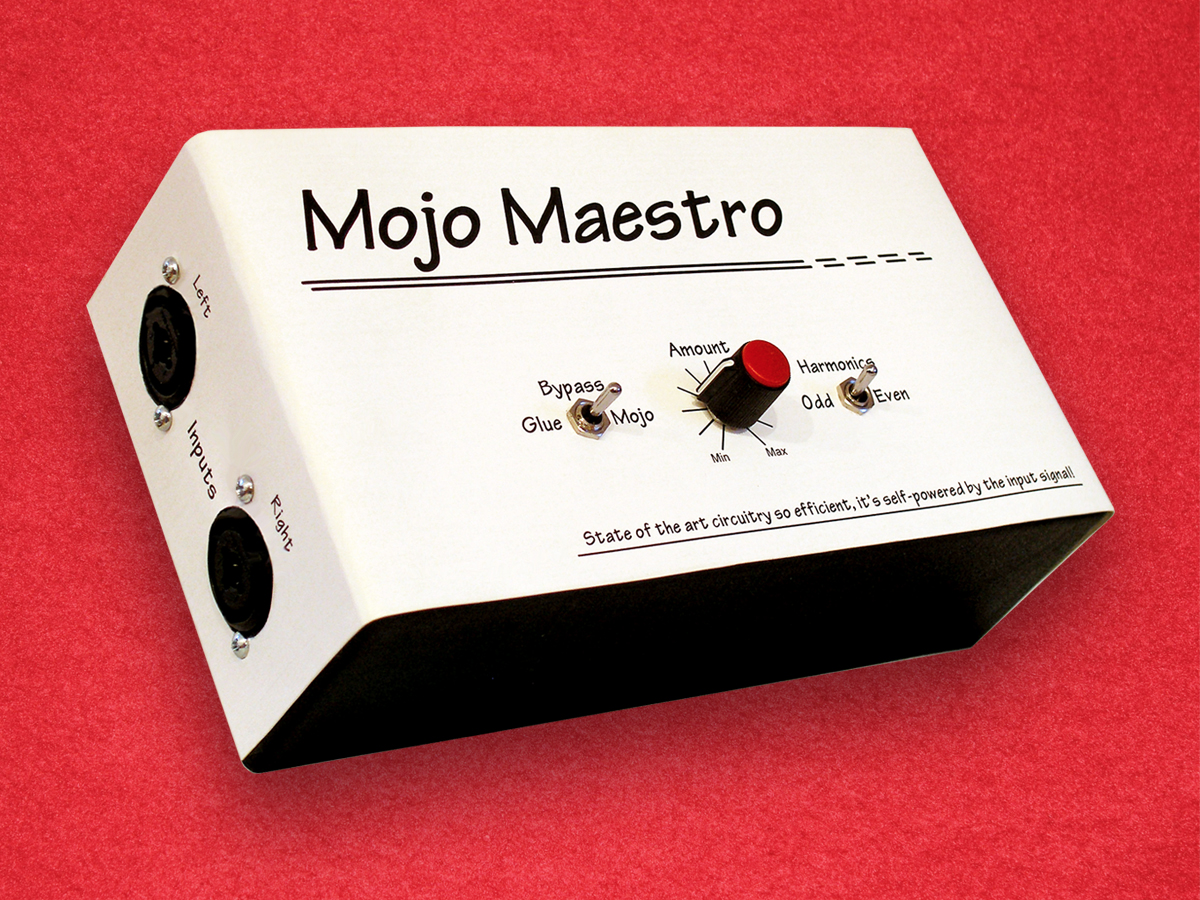
In DIY-land, Here’s what I settled on and built for a friend:
.
Highly recommend it.

Search for the Mojo Maestro online and you can find clips from DIYRE.


Another option would be to run a stereo cable, one channel for signal and the other for power, but that’s a whole other can of worms.
 
@Feral Feline said: Another option would be to run a stereo cable, one channel for signal and the other for power, but that’s a whole other can of worms.
You could make a helluva floor lamp with it that way.
🤪
 
I tried the diodes trick on my Chelecaster. Does NOT work very well. Germanium diodes are so leaky that they soak up most of the signal before they get a chance to turn on. Schottkys are not much better because they are leaky too. Unless you have extremely hot pickups, there's not enough signal to turn on silicon diodes. Remember when we were kids and we stuck playing cards in the spokes of our bicycles? Maybe some paper or foil on the strings would make a nice fuzz tone.
 
Yeah, there’s good reason why a simple set of clippers isn’t more widely used — what Chuck said.

Even the Mojo Maestro is better with some clean make-up gain after it.


PS…


1645177871136.jpeg
 
I tried the diodes trick on my Chelecaster. Does NOT work very well. Germanium diodes are so leaky that they soak up most of the signal before they get a chance to turn on. Schottkys are not much better because they are leaky too. Unless you have extremely hot pickups, there's not enough signal to turn on silicon diodes. Remember when we were kids and we stuck playing cards in the spokes of our bicycles? Maybe some paper or foil on the strings would make a nice fuzz tone.
The Serek bass I posted uses TV Jones thunder blades

Bridge: DCR - 4.8k / Inductance - 2.79H

Neck: DCR - 4.0k / Inductance - 1.74H

I don't know if that means they're hot. My dual blade HB is around 10k and is a bit quieter than my P bass.

I'll try the diodes, it's a cheap experiment.
 
Back
Top