apierz
Active member
- Build Rating
- 4.00 star(s)
My main overdrive sound is the green side of a Protein, and then using the blue side if I want a louder, more open tone or using a Kliche in front of it for a more compressed, fatter sound. I haven't built a pedal in a while so I figured I'd audition some new builds to see if anything tops the Kliche. I've mostly been looking at lightly dirty boosts that sound good on their own to add volume and compression without adding in too much grit . I've been playing it for a few days now and it's growing on me. With the gain maxed it gets a little splatty but when dialed in I dig it, especially as a boost into another overdrive. I'm going to keep it on the board for now (other contenders yet to be built are the Blue Yonder and Fumble Boost).
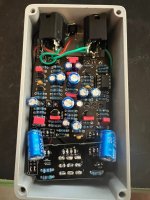
Build-wise, this is a pretty packed pcb with all the weird part values you would expect in a Cornish clone so I got to see a whole bunch of resistor band colors for the first time. It doesn't show in the gutshot very well, but it is pretty colorful in there. Also I got some too-big electrolytic caps for the main filters but they ended up just barely fitting. I give the build out of five, mostly because the lack of ground pads at the top of the PCBs on @aion pedals. Having to wire all the grounds together and get it in the power jack always gives me fits. I think I have a better strategy for the next one, but every time I do an Aion build I am reminded how glad I am @Robert adds those ground spots in. I hate internal switches so I hardwired it for the buffer to be always on.
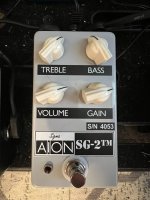
This is also my first time doing any kind of design on a pedal, and thanks to @Fingolfen 's helpful UV printing tutorial I was able to figure out how to get a successful PDF design starting in Inkscape and importing/finishing in Affinity designer. I've always liked the way Cornish does his gray box pedals in a so ugly it wraps around to being beautiful way, so I tried to ape him as best I could. I'm happy with the level of detail and accuracy Tayda can do and, now that I know I can get it right, I've got some more complicated designs for the next ones.
Here's an audio sample with a telecaster bridge pickup that will probably be in no way relavant to your guitar/rig. First its clean, then Sigma engaged with guitar volume at 7, then guitar volume at 10, and then the green side of the Protein engaged too.
Build-wise, this is a pretty packed pcb with all the weird part values you would expect in a Cornish clone so I got to see a whole bunch of resistor band colors for the first time. It doesn't show in the gutshot very well, but it is pretty colorful in there. Also I got some too-big electrolytic caps for the main filters but they ended up just barely fitting. I give the build
out of five, mostly because the lack of ground pads at the top of the PCBs on @aion pedals. Having to wire all the grounds together and get it in the power jack always gives me fits. I think I have a better strategy for the next one, but every time I do an Aion build I am reminded how glad I am @Robert adds those ground spots in. I hate internal switches so I hardwired it for the buffer to be always on.This is also my first time doing any kind of design on a pedal, and thanks to @Fingolfen 's helpful UV printing tutorial I was able to figure out how to get a successful PDF design starting in Inkscape and importing/finishing in Affinity designer. I've always liked the way Cornish does his gray box pedals in a so ugly it wraps around to being beautiful way, so I tried to ape him as best I could. I'm happy with the level of detail and accuracy Tayda can do and, now that I know I can get it right, I've got some more complicated designs for the next ones.
Here's an audio sample with a telecaster bridge pickup that will probably be in no way relavant to your guitar/rig. First its clean, then Sigma engaged with guitar volume at 7, then guitar volume at 10, and then the green side of the Protein engaged too.