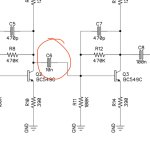
I think the R in that filter is not just R11. Let me take a deep breath here and try to remember my first year of college… the signal at Q3’s base “sees” an input impedance that’s determined mostly by circuit topology (it’s a common emitter with feedback resistor - don’t know the formula for the input resistance off the top of my head) and by the choice of bias and feedback resistors (R11, R12, R14). I suspect the actual input resistance is much higher than R11 so the cutoff frequency much lower, which probably makes sense since 160Hz would cut a ton of bass (although I don’t know what this circuit is so maybe a bass cut is needed). You could work out a good approximation of the input impedance and cutoff frequency by doing the math. Or you could use SPICE to simulate it.
Edit: I looked up the formula. The input resistance of the common emitter with degeneration is basically the product of HFE and the emitter resistor. For the BC549 we are probably looking at an HFE over 3-400 so the input impedance is around 120K or more. That is in parallel with R11. A bit trickier to calculate how R12 plays into it but since its value is higher, we can probably ignore it to start with. The parallel is around 60K or higher if the HFE is higher. So your initial cutoff frequency is probably twice 160Hz. I’m sure I got some of this wrong but it should be in the ball park. Somebody smarter than me can correct me.



 . I had an assumption of what constitutes as one based on looking at standalone examples. Now I can pull out some printed schematics and fill it out like a crossword puzzle.
