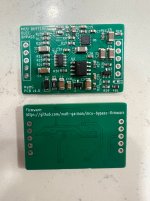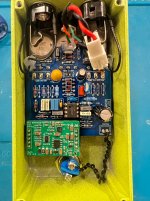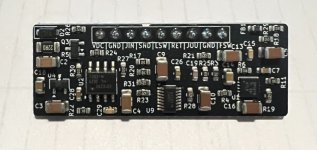
So I finally had this design fabricated - and it works! Here's a build report where I used it.
I actually ended up changing the design considerably from what I initially posted. The overall concept is the same. But the main difference is that I decided to use a microcontroller for switch debounce, state management, LED lighting/dimming, and switching control. This turned into quite a detour, see mcu-bypass-firmware on GitHub. I have firmware for AVR Classic (ATtiny13a, 45 and 85), AVR XT (ATtiny202), PIC10F32x, and PIC10F675. I support three different switching schemes: simple CD4053/TMUX4053, x4053 with muting, and using a TQ2-L2-5V mechanical relay. I put a tremendous amount of effort into creating an exhaustive validation and test suite. This version 1.0 of the quasi-IC uses the firmware for ATtiny13a and the TMUX4053 with muting scheme switching.
I switched the intput/output buffer opamp to a OPA1678, and I gave up on having a dedicated IC for the VREF buffer.
You can see from the build report I had some self-inflicted pain just getting it installed and running correctly, but once my I got past my own bone-headed mistakes, the module works great!