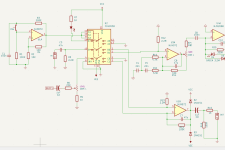

Buffered Electrical Bypass Module

A combination of 22k and 4u7 gives you a high pass of 1.6Hz which is good for guitar signals, and you're correct 100k with 1u does the same.

Ahh, so good ol' fc = 1/(2piRC). So really anything with a cutoff frequency below 20 Hz ought to be good, right?

I'm actually using 1uF coupling caps when I do this with through-hole components, because 1uF film is readily available (and not terribly expensive). But I use 4.7uF in the SMD version because those are ceramic caps, so my thinking was to make them bigger since their capacitance value is de-rated when DC is applied. And by "bigger", I mean in all dimensions: physical size, voltage rating and capacitance value. Admittedly, 4.7uF wasn't chosen as a precise value, just a "hopefully this is big enough to compensate for any de-rating".

BTW you should be able to drop C5 (4u7) and R10 (1M) from your design. The output from the buffer is already biased at Vref and therefore R10 is not needed if you take out the coupling capacitor C5. The TL072 in the buffer is at unity gain and it's good engineering practice to add a 47R resistor in the output path to avoid oscillation resulting from a capacitive load. The on-resistance of the 4053 100-150R should already take care of that but it doesn't really hurt to add the resistor anyway.

Thanks! I've always had a hunch that C5 and R10 weren't really necessary. (And dropping C5 is particularly handy for the through-hole version, since those 1uF film caps eat up a lot of board space.)
 
I never looked up the actual derating for ceramics in the specs.... I assumed this is less than 10% for the low voltages in these circuits. Also, I never designed for SMD and typically use film for audio. As you said these become very bulky, but for thru hole this was never a problem for me. If you use ceramics in audio paths C0G (NP0) is strongly preferred but that's impractical for higher values. So I guess better option is to use audio grade electrolytics like Nichicon.
 
I never looked up the actual derating for ceramics in the specs....

I haven't studied ceramic cap datasheets exhaustively, but from what I've gathered, it's generally pretty rare for the manufacturer to actually publish the voltage de-rating specs.

So I guess better option is to use audio grade electrolytics like Nichicon.

That's definitely an option, but not one I really considered for my SMD designs. The main reason is cost: I'm using JLCPCB to do the SMD assembly. They basically have two categories of parts, "basic" and "extended": the basic parts have no feeder fee, whereas extended parts have a $3 feeder fee for each part number. Even in simple circuits it's hard to avoid at least a few extended parts, and for small hobbyist quantities, those feeder fees start to add up. They have a "basic" 1206 4u7 50V X7R cap for 2 cents. They have very few basic electrolytic caps in general, so a nice audio-grade Nichicon electrolytic is pretty much guaranteed to be an extended part, and likely has a much higher unit cost as well. Even ignoring the cost, the electrolytics would still be physically larger, and I did SMD to get the module as small as possible.

If I was doing much larger production quantities (e.g. intended to sell at scale), then the feeder fees get amortized pretty quickly. But no so much at the minimum order quantity of five. ;)
 
My physics gut feeling tells me that if you put two of these 1206 4u7 50V X7R in series current leakage and some of the non-linear behavior will be less. The fc increase to 3 Hz but that should not really be an issue and you need more board space. I also need to look this up if this really makes sense. Life of an engineer you always need to make compromises cost, space, quality....
Don't know about the details of assembly at JLPCB (or anywhere else) but $3 extra feeder fee quickly adds up.
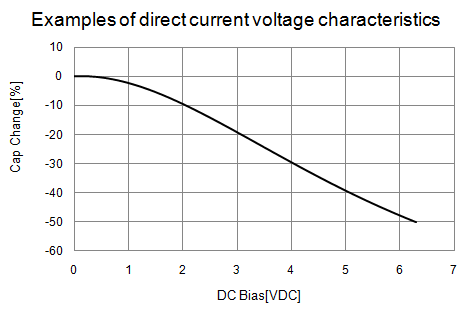
I found the graph below on the Murata site for X7R. The derating effect is much larger than I expected.

05_01en.PNG
 
Back
Top