
Capacitor on a Strymon Flint V1

maxinesparlour

New member
Hey y'all I'm new here so sorry if this is posted in the wrong section.

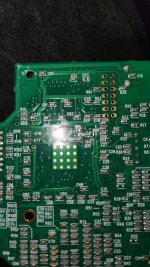
I received a non-functional Flint pedal and, after some inspection of the PCB, found a spot where a capacitor was broken off (C43, top middle of attached pic)

Does anybody have access to a Strymon Flint V1 schematic? I'm not sure what the capacitor value is for that missing part. Also, any advice on attaching a new one? These pieces are tiny af and I feel like I'm gonna have a hell of a time trying to solder it in there.
 

Attachments

  • 20260402_142235.jpg
    20260402_142235.jpg
    464 KB · Views: 20
It's possible that you have worse problems - I can't tell for sure but it looks like whatever broke the cap off might've taken the solder pad with it. I might see
a tiny tear up through the 'C' of C43 where the trace vacated the premises.
The good news is that it looks like that pad connects to the large bus trace
above it, so it'd be fairly easy to bodge a trace on there - but that's another
skill you get to learn.

When you say the pedal is non functional, how non functional is it?
My shot in the dark guess is that capacitor is not the problem if
it straight up won't turn on and make noise. It looks
like it either connects to ground or VCC based on the big bus trace
above it, so it's probably part of a low pass filter, or it's a bypass
cap for power -- so it would WORK without that cap, but maybe not
optimally. (You could try to measure with a multimeter)

That said, that bus could be an audio path, too, so I
suppose it's possible that if it were broken off that it would no
longer pass audio. If you have an audio probe you could try to
see if the sound disappears on either side of that broken cap.
If you can hear audio on one side and not the other, I'd get
something like a 10nf cap and solder if on and see.


Based on the physical size, I'm guessing it is 0603 size.
Usually folks will use C0G / NP0 type capacitors for stuff in the audio
path, and they don't get much bigger value than 10nf in that size.


Soldering it will be a semi-pain if you've never worked with SMD
before. You can do 0603 with a regular soldering iron and a steady
hand. A magnifying visor or microscope will help a lot too. You
might buy an SMD practice soldering kit and practice for a bit
before you try on the real thing. And watch some videos about
trace repair -- if that trace is really torn off you'll have to deal with
it.
 
Back
Top