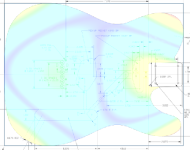
I started look designing a 7 string archtop acoustic (same 28.625” scale lengh). Played modelling the archtop modes etc but freecad it used to design kept crashing. Still on the to make list once the job situation is sorted.
I have a friend that has an Eastwood 7 string arch top. Great guitar! (His is about the same vintage as my Eastman 6 string, 2008; they were just being introduced to the US market, and were still largely based on the designs that Bob Benedetto had sent them to see if they could build viable guitars.) I absolutely see the advantage in having a 7 string, but I think it's more than I can handle as a player. In any case, if just playing for my own fancy (which is 95% of the playing I do), I don't need to get any higher than my Baritone does. I don't just love the lower 4th (my old one was 28 5/8 scale, tuned to B, 14-68) and the newer is the same, except 14-64—I love the slightly darker deep voice that it has—like a viola compared to a violin. Assuming you build the 7th string as the bottom, you could probably get somewhere around F with a thick enough string. (Or since I read about people tuning their regular guitars with 11-52 down to B... I guess one could go a lot lower. I need stiff strings.)
By the way—your 7 string (above) is pretty damn awesome! Beautiful slab of wood! And those even look like the EVO frets I love.
Have been playing Baritone for about 5 years, and in early 2023 had the great idea that what I wanted was a hollow body baritone, so I started searching out who made them. After not finding any already built ones, I found a man not too far from where I live who could build one, and decided to bite the bullt. IOrdered in feb of 23, it was going to be ready in October. 24, but didn't get finished until early last month. Pretty much exactly what I wanted!
I have a friend that has an Eastwood 7 string arch top. Great guitar! (His is about the same vintage as my Eastman 6 string, 2008; they were just being introduced to the US market, and were still largely based on the designs that Bob Benedetto had sent them to see if they could build viable guitars.) I absolutely see the advantage in having a 7 string, but I think it's more than I can handle as a player. In any case, if just playing for my own fancy (which is 95% of the playing I do), I don't need to get any higher than my Baritone does. I don't just love the lower 4th (my old one was 28 5/8 scale, tuned to B, 14-68) and the newer is the same, except 14-64—I love the slightly darker deep voice that it has—like a viola compared to a violin. Assuming you build the 7th string as the bottom, you could probably get somewhere around F with a thick enough string. (Or since I read about people tuning their regular guitars with 11-52 down to B... I guess one could go a lot lower. I need stiff strings.)
By the way—your 7 string (above) is pretty damn awesome! Beautiful slab of wood! And those even look like the EVO frets I love.
Electrics are an odd one. There's alot of internet research on how 'tone woods' don't have impact and the where the tone comes from. I would subscribe to 'it matters less' in an electric guitar, I would argue that it still has an effect.
The electric 7 string in the picture is a through neck laminate that has the bridge sat on a pillar of that neck through. It's specifically designed to have both ends of the vibrating string on the same laminate wood, unlike normal capped top guitars where the bridge sits on the cap.
The woods in the laminate are hard maple, wenge, walnut, thick purple heart, walnut, wenge, hard maple. The hard maple also gives the neck a smoother edge feel (it's oiled rather than nitro/poly) but leaves the rougher grain of the other. The neck is an over thick D provide to fit my hand size, vs my MIJ 1988 strat that has a ridiculously thin neck it feels like a toy. The fretboard is possibly wide enough for an 8 string but it's string spacing is pretty standard later strat at the nut and 10.5 at the bridge which works for me in both finger style (my preferred) an pick (heavier stuff).
So the combination of laminate and thick neck means it naturally has sustain and the body resonates at the lower note. The body is alder but the cap is a 20mm thick flame maple. The glues used - tight bond but the fretboard and cap are glued with tight bond cold liquid hide because it doesn't sheer or creep which means a better transfer of vibration at the cost of needing attention for warps in extreme environments. The other glues are tb3 for the laminate - this gives a little over time, and tb original for the rest which is a good alternative to the hide glue. All the wood and everything all from scratch planks from the timber yard/specialist. The 2.4m long maple plank lived in the house to observe the warps and see if it was good enough for the neck, thankfully the second of straight grain I'd noted didn't move, but the rest of the log had some warps and twists that appeared. The bubinga fretboard started the whole concept of dunes, and mirages that steered the selection of the cap. I deliberately didn't make any fret markers to break any habitual playing, this is a guitar purposely designed in look and feel (including weight) to muse and experiment with (it sounds pretentious but that's the idea).
Frets are Jescar 57110 jumbo stainless steel. Jumbo frets are an interesting subject - they offer both protection for the fretboard but also expression with finger pressure. Inversely they are a pain to test fret tuning due to the same expressive finger pressure results in large cent deviations.
I was thinking for the archtop - a little simpler given the build and design is more complex, especially as I'm not following a standard design. I was thinking of a modified telecaster, thicker, with an about a 16" lower bout. To really get sounds and the mode one vibration for the low B string (62Hz) the body starts getting larger - I'd get the vibration along the body but not in the traditional bout position.
Here's one of the upper modes, it show the vibrations.
In terms of woods etc it would be plainer - the key for acoustic is not stunningly figured caps but rather the grain direction and the design working together to support the vibration modes to make the notes. After lots of gnashing of teeth, I think it would probably gravitate towards a European spruce top and maple sides, the back I'm considering spruce but at the same time maple.. I hadn't finished deciding - getting the woods is also a time/availability thing too. The idea was to use up some of the left overs of the electric build.
The 'issue' with the tele design is that it's not particularly friendly for supporting notes etc so the design was slowly evolving with some modifications. The body would be deeper than a tele - around 3" or so.
To make things more interesting the bridge is positioned toward the tail, causing all sorts of interesting design changes such as the bracing being very different to support that. The design also had a neck through, with the neck supporting the string tension through to the tail allowing the bridge to only bear the vertical and transitory force changes when playing. This allows for some flexibility of the arch top profile.
I'd not finished the design as life got in the way, but it's on my todo list