First Guitar Amp Finished

Blooze

Well-known member
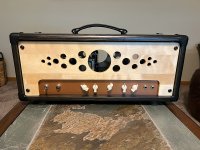
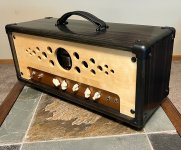
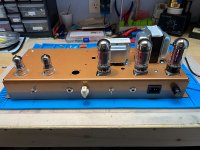
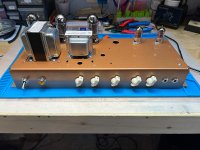
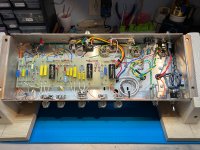
Finally got my first guitar amp build done. I've done a few other HiFi tube amp/preamp/headphone amp builds over the years, but never bothered to do a guitar amp.

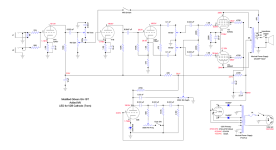
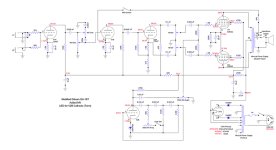
This is based on a Gibson GA-16T/18T Explorer. 12-14W of tweediness. Added a master volume, impedance selector, toggle switch for the tremolo, feedback switch, and changed the trem cathode cap/resistor to a LED. All built in a JTM45 chassis.

IMG_1712w.jpg
IMG_1714w.jpg IMG_1715w.jpg IMG_1406w.jpg IMG_1407w.jpg IMG_1409w.jpg Gibson GA18T Mine schematic with LED.png
 

Attachments

  • Gibson GA18T Mine schematic with LEDw.jpg
    Gibson GA18T Mine schematic with LEDw.jpg
    128 KB · Views: 18
Wow, congratulations! That's a nice clean build. I've been building for over 20 years.

It's fairly standard practice to ground the preamp power supply cap(s) with the preamp circuit and the power tube power caps on the other side. This helps to avoid grounding loops. If you have any humming, you may be able to reduce it by clipping the ground buss and grounding the PS side close to the transformer or earth ground.

This is a Fender Tweed deluxe I just finished laying out, in a hammond 17x8x3 chassis instead of the tiny original chassis. I've made several other changes to components that work better than standard, and put the tubes on top. You can see how I split the ground buss at the preamp cap. My very first amp, a 5e3 buzzed and hummed like crazy, this one mod made the difference between that and a perfectly silent amp.....

5e3 Tweed Deluxe 2022.jpg
 
Last edited:
Finally got my first guitar amp build done. I've done a few other HiFi tube amp/preamp/headphone amp builds over the years, but never bothered to do a guitar amp.

This is based on a Gibson GA-16T/18T Explorer. 12-14W of tweediness. Added a master volume, impedance selector, toggle switch for the tremolo, feedback switch, and changed the trem cathode cap/resistor to a LED. All built in a JTM45 chassis.

View attachment 48264
View attachment 48265View attachment 48266View attachment 48267View attachment 48268View attachment 48269View attachment 48271
Damn,,, thats a sexy cab....
 
Wow, congratulations! That's a nice clean build. I've been building for over 20 years.

It's fairly standard practice to ground the preamp power supply cap(s) with the preamp circuit and the power tube power caps on the other side. This helps to avoid grounding loops. If you have any humming, you may be able to reduce it by clipping the ground buss and grounding the PS side close to the transformer or earth ground.

Thanks! I thought about that in case there was any serious hum. I'd looked at Rob Robinette's optimized 5E3 layout which inspired this layout. It'd be as easy as a quick snip and solder. I don't really have much hum with it so far. At least not anymore than I get with any of my factory built amps.
 
Thanks! I thought about that in case there was any serious hum. I'd looked at Rob Robinette's optimized 5E3 layout which inspired this layout. It'd be as easy as a quick snip and solder. I don't really have much hum with it so far. At least not anymore than I get with any of my factory built amps.
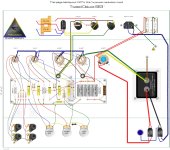
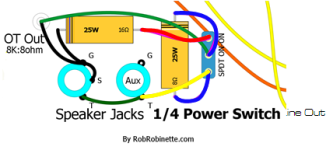
Rob's site is where I got the 1/4 power layout, but I moved it around to fit better. I copied the Line Out from a Matchless Lightning....
1683754604953.png
 
Wow, congratulations! That's a nice clean build. I've been building for over 20 years.

It's fairly standard practice to ground the preamp power supply cap(s) with the preamp circuit and the power tube power caps on the other side. This helps to avoid grounding loops. If you have any humming, you may be able to reduce it by clipping the ground buss and grounding the PS side close to the transformer or earth ground.

This is a Fender Tweed deluxe I just finished laying out, in a hammond 17x8x3 chassis instead of the tiny original chassis. I've made several other changes to components that work better than standard, and put the tubes on top. You can see how I split the ground buss at the preamp cap. My very first amp, a 5e3 buzzed and hummed like crazy, this one mod made the difference between that and a perfectly silent amp.....

View attachment 48273
where are your ground buses actually going?
just curious cos i like to see (gather consensus on) how people do their ground schemes....

assuming the preamp ground bus tied to chassis near the input with a star washer/tag thing?
what about the power ground bus? just tied to the chassis near the PT?

(on my SLO build i initially had everything on a single bus tied to a switched open-frame 12A jack on a star washer against the chassis. didn't have any issues with it, wasn't noisy or anything. but then i noticed robrob updated his layout to a split bus with the power bus tied to the chassis (near the PT), so i tried that to see what benefit could be had, but not sure i noticed much difference..)
 
where are your ground buses actually going?
just curious cos i like to see (gather consensus on) how people do their ground schemes....

assuming the preamp ground bus tied to chassis near the input with a star washer/tag thing?
what about the power ground bus? just tied to the chassis near the PT?

(on my SLO build i initially had everything on a single bus tied to a switched open-frame 12A jack on a star washer against the chassis. didn't have any issues with it, wasn't noisy or anything. but then i noticed robrob updated his layout to a split bus with the power bus tied to the chassis (near the PT), so i tried that to see what benefit could be had, but not sure i noticed much difference..)
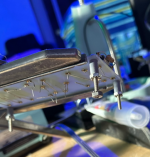
My standoffs are #6 stainless steel machine screws that have nylon spacers to keep the circuit board off the chassis. There is a kep nut holding that spacer on, with the lock washer pointing towards the chassis not the spacer. Then I have a kep nut on the outside of the chassis holding the nut in place. So a double kep nutted #6 screw doubles as the ground and the stand offs. I use 1/8" epoxy board, so the circuit board is built like a brick commode. :sneaky:

Because there are kep nuts on both sides, the nylon spacer isn't subjected to a lot of torque and doesn't deform.

1683786839416.png
 
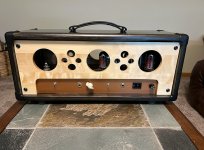
Finally got my first guitar amp build done. I've done a few other HiFi tube amp/preamp/headphone amp builds over the years, but never bothered to do a guitar amp.

This is based on a Gibson GA-16T/18T Explorer. 12-14W of tweediness. Added a master volume, impedance selector, toggle switch for the tremolo, feedback switch, and changed the trem cathode cap/resistor to a LED. All built in a JTM45 chassis.

View attachment 48264
I just can't say enough about how wonderful your artwork is on the front panel!!! This is so 'Art Deco', which is characterized with repeating patterns of diminishing size, usually in 3's.

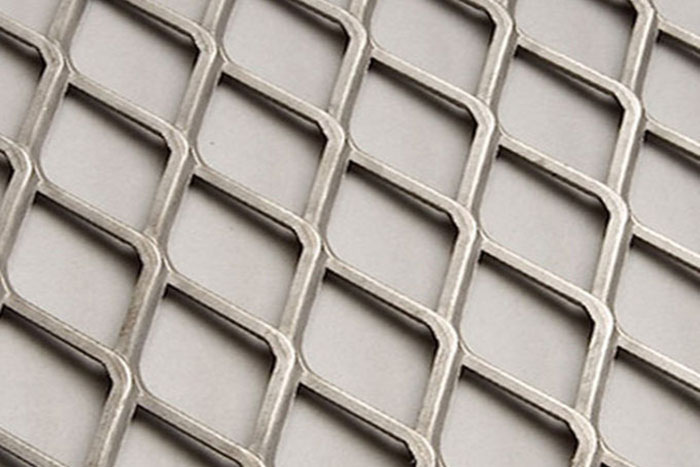
Do you have any plans on putting some stretched diamond wire mesh screen in there to prevent unwanted objects from entering? LED lighting?

Heavy-duty-aluminum-screen-02.jpg
 
I just can't say enough about how wonderful your artwork is on the front panel!!! This is so 'Art Deco', which is characterized with repeating patterns of diminishing size, usually in 3's.

Do you have any plans on putting some stretched diamond wire mesh screen in there to prevent unwanted objects from entering? LED lighting?
Thanks. I thought about putting some stainless 10 mesh painted copper (same color as the chassis) behind it. Copper mesh is expensive. The aspen board I used for the front plate is fairly soft though and I'm not sure how I'd attach it. The stuff wants to split pretty easily so I think staples would not be an option.

Really, it's just me and the wife now so unless I purposely push something in there it should be OK.
 
And standoffs are kinda expensive, spacers are much cheaper. I buy the machine screws and kep nuts on line in bulk at Marsh fasteners. I like using stainless steel as it's much less likely to strip when tightening, and I have cats. Cat pee is very corrosive.
Ah yes, cat pee!

I used nylon standoffs with brass inserts because I got the turrets too close to the corners and they have a little more strength to torque things down without stripping the threads like with straight nylon. That let the board remain insulated, especially where the B+ connects. The standoff bolts were just a little too close for my comfort for metal standoffs.
 
Wow. For a first amp that is fabulous. And yes, those of us who build amps do get quite fanatical about grounding! Some amps I have been able to get the noise floor so low it's difficult to tell just by listening if the amps is even on or not. And if I can, then amp manufacturers should be able to as well. But no...
 
Back
Top