FPGA in your pedal

KreoPensas

Well-known member

I'll start the discussion with that link. I'm having a lot of fun with it so far.

I am developing devices that use FPGA chips.

If you think an FV-1 is interesting, you might want to jump in and start blinking LEDs.

You don't even need to know Verilog, but you might need to understand digital logic.

Eventually, you'll be able to download code blocks and get happy with them without having to understand *why* they work. That time is coming pretty fast. My head spins trying to keep up with the developers.

I hate to mention the T word, I'm trying to think forward. US people can still get development boards from stock in US warehouses. The Ice Sugar board is a low cost starter. Tindie has some options as well, I have one of these https://www.tindie.com/products/oakdevtech/rpga-feather-rp2040-ice40/
 
Last edited:
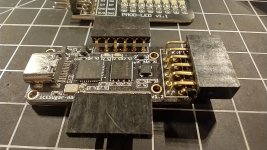
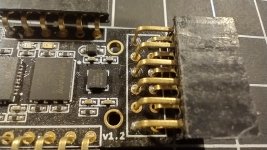
Ice Sugar Nano... routine abuse mule.

The FPGA itself is the small chip on the right.
A board like this is good for learning concepts but too small for any complex dsp.

Behind it is a 'pmod' LED module. Just a bunch of blinkenlites.

How do you get audio in? Use any i2s ADC.

Will this card run i2s? Damnfino. People are doing some seriously whacked video synth stuff with end-of-life chips that do not even have open source toolchains.

I haven't even tried to do i2s on it, I'm just using it to learn to apply concepts

1000001694.jpg 1000001696.jpg
 
If anyone remembers the Digitech GSP2101, that used a Xilinx fpga as the secret sauce that allowed real time user placement of an effect anywhere in the chain until you used up all of your "patch points" or whatever they called the resource. Best I can tell, it is what made the device cost so much. ( had one, ran it *in* *to* *the* *ground*, sold for parts )

The small fpga I pictured above has more than enough logic cells to be a "smart multiplexer" like Digitech implemented.
 
Last edited:
Man I haven't touched an FPGA in years. They're certainly a neat tool and they can do some things that microcontrollers can't, but I'm not good enough at Verilog (never even touched VHDL) to do anything super cool with them like audio processing. It doesn't look like you can get them anymore, but this is what I used to play around with. They were basically trying to make FPGA as easy to set up and code as an Arduino, and I did some neat projects with it. I think I still have it in a box somewhere.
 
I went for the DE0 Nano from Adafruit at that time. Still have it.

The relevant development is the graphical interface that covers many boards and the community effort that has already contributed a lot of ready-to-use ( and examine ) modules. This is all still in active development, and maturing pretty quickly.

The power to construct application specific integrated circuits *at whim* is tantalizing for the hobbyist, the environment does a good job of showing why things work. A surprising number of rudimentary DSP functions are simply logic functions.
 
I went for the DE0 Nano from Adafruit at that time. Still have it.

The relevant development is the graphical interface that covers many boards and the community effort that has already contributed a lot of ready-to-use ( and examine ) modules. This is all still in active development, and maturing pretty quickly.

The power to construct application specific integrated circuits *at whim* is tantalizing for the hobbyist, the environment does a good job of showing why things work. A surprising number of rudimentary DSP functions are simply logic functions.
Oh neat, the DE0 Nano looks like a cool board. Yeah I dig the "module-based" interface for putting FPGA projects together, it definitely makes it easier for hobbyists to get into something that would otherwise have a pretty steep learning curve.
 
Man I haven't touched an FPGA in years. They're certainly a neat tool and they can do some things that microcontrollers can't, but I'm not good enough at Verilog (never even touched VHDL) to do anything super cool with them like audio processing. It doesn't look like you can get them anymore, but this is what I used to play around with. They were basically trying to make FPGA as easy to set up and code as an Arduino, and I did some neat projects with it. I think I still have it in a box somewhere.
I think they can definitely do audio. Antelope Audio audio interfaces have onboard FPGA powered plugins (like UAD, but not Sharc) if I remember correctly.
 
I do, thank you.

Edit : Honestly, I was hoping to get your attention, Digital Larry, because this is likely "square in your wheelhouse".

Vast overkill is an understatement. However the form factor raises a point: FPGA's can't do *everything* by themselves and boards like those do a fine job of trying to anticipate the unknown. Even the little board I pictured above is dominated by the support hardware.
If anyone wonders, nearly any ARM or RISCV chip can be the bitsream loader and helper, provide rudimentary ADC, etc.

You do not have to commit to recreating the complete hardware of a development board in a product. ( sorry if that is obvious )

Regarding the Faust/Syfala information : relevant and parallel.

And there's the real difficulty keeping strong forward movement from happening... proprietary tools resist such cooperation by design, how dare you shop the competition.

Not that this thread is exclusively about ICE fpgas or open source solutions, open source is where I am concentrating my attention because the proprietary tools for Xilinx and Altera are as busy, stuffy and stodgy as development softwares can get. You know, kind of like working in Spin ASM vs SpinCAD.

However it stands to reason that if it works on one family of chips it is likely to work on others, the concepts can be ported. I have to wonder if anyone is working on Faust and any ICE toolchains. Can't much see trees for the forest.
 
Last edited:
One of the reasons I bought the Oak DevTech board with the combination of the RP2040 chip and an FPGA because the programmable IO in the RP2040 is so ridiculously useful, each an independent state machine, albeit of limited capability...it's *really* malleable limited capability.
 
Regarding Faust, keep in mind it's mostly an academic tool, although I'd guess it's shown up in some commercial products. Is "someone" working on developing the architecture to map to different FPGAs? I don't know, although as I keep track of these things it seemed that the FPGA effort was sort of an offshoot. Faust does have a Discord channel you could get involved in.

See:

My perspective has shifted a bit in recent years.
#1 I do not spend much if any spare time any more inventing DSP algorithms for musical effects, whether SpinCAD on FV-1 or anything else.
#2 I'm not very interested in hardware design, soldering or coding low level drivers.
#3 I now work at DSP Concepts, who also offers a graphical development environment with the ability to target different SoCs. But it's for commercial development. While there's a 30 day evaluation, beyond that you need to pay for an annual license, and unless you have a lot of money, I don't see any DIY-er doing that. The point being is that, somewhat like using Faust, I don't typically care what the hardware is and someone else takes care of that part of it. The beauty of the graphical tools is the elevation above the mundane, allowing you to focus more of your time on the "artistic" aspect of what you are doing, if that makes any sense.

Different things are available for the DIY crowd, obviously... various things have come and gone, like the Axoloti.

I'll be interested to see what you come up with.
 
Last edited:
@KreoPensas

I finally looked at the ICE tool. It does look interesting. When I first came across the "ElmGen" FV-1 Java simulator library, after I got it working, I thought, "somebody should really put a UI on this thing and create some reusable blocks and...." then I realized that somebody was going to be me. So regarding ICE, "somebody" needs to develop a bunch of useful DSP blocks, right? Maybe that somebody will be you. I'm pretty sure it's not going to be me unless I get reincarnated without losing everything I know.
 
Back
Top