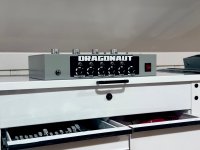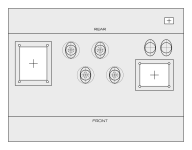
High Voltage Hijinks

Rough component placement and laying out for my project are done. I need to fine tune all component placement and follow it up by carefully retracing with width and creepage on point. Not far out now. Will anyway order the components before sending this to print, as there are a few iffy things (Mouser contradicting manufacturer specs on some caps, the inductor for the depth is very poorly documented etc). I have learned a LOT on component placement and general voltages tracing this one out. Once this is done I will gladly submit it here for scrutiny, right @NickKUK ;)

1757883513900.png

You know what to do. That's going to be bad ass! I'm going do a 5 tube X88R build (lead and crunch channels only) after these next two I am working on.

My current status is I finished chassis layout, drilled, etc. I only have two band aids on my fingers.

6 knob Laney MV AOR:
View attachment 102883

Deliverance:
View attachment 102884

I plan to get the art on the two chassis tomorrow.
Some nice progress right there! I am curious tho... why do you never include a power section?
 
Some nice progress right there! I am curious tho... why do you never include a power section?

Good question!

There’s lots I want to build and full transformer sets and power tube quartets add up quick. So amps that are preamp focused (nearly anything with a master volume) I’d be satisfied with just the preamp as long as it’s voltage correct etc. These are relatively cheap - chassis is $35, transformer with mounting hardware is around $35, the biggest expense is the tubes.

The other factor is ease of use. My setup is 3 amps with ability to directly connect to the power amp (GT120, Model T, and Dumble ODS w/ Park 75 power amp) going into two UA OX Boxes, and a Suhr RL w/ Ox Stomp. Being able to just plug into a pre and grab it’s output and connect it to one of the full amps just feels faster and safer than juggling speaker outs.

I’m sure I’ll build a few more full amps. I have a JTM50 transformer set for something. I kind of want to build a 100w John Mayer Wonderland. Also Pacific Audio Magnetics has OEM Trainwreck sets that caught my eye. I don’t have anything that’s single ended either.

Smart to wait for components, that has caught me. I have done stupid stuff like when ordering cathode bypass caps I’ll be like fuck it - I’m getting film, and then when doing layout my internal autopilot is thinking small electros.
 
Good question!

There’s lots I want to build and full transformer sets and power tube quartets add up quick. So amps that are preamp focused (nearly anything with a master volume) I’d be satisfied with just the preamp as long as it’s voltage correct etc. These are relatively cheap - chassis is $35, transformer with mounting hardware is around $35, the biggest expense is the tubes.
What chassis and what transformer, please? My expenses have always been quite a bit higher than that!

Now that the weather is cooling down and I can finally get back in my shop, time to put together that 100 watt bass amp I mentioned.

Proof of concept power amp build, which I ran for around six months with a wide variety of tube and SS preamps:


PW100B_IP.JPG

Basic Europly case config:

1757958028683.jpeg

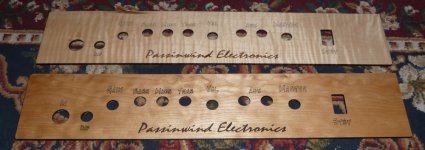
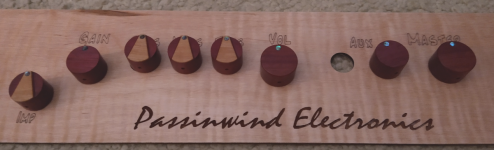
I have a grill screen from Reliable Hardware and some matching bocote side pieces, and then a variety of laser etched test front panels:

1757958252064.jpeg

1757958329868.jpeg


1757958392995.png

I think my luthier friend still wants to take another crack at the front panel and probably do something more uptown than plywood for the shell though. He will probably end up owning this build in any case, assuming he comes through with the acoustic guitar we've discussed building.

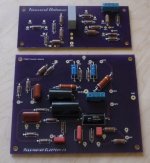
Preamp PCBs:

PW100B_preampboards.JPG
 
Last edited:
What chassis and what transformer, please? My expenses have always been quite a bit higher than that!

All that that looks beautiful.

The chassis I've settled on for anything with 4 or more tubes (or just complicated) is this one here:

Steel and very roomy for a preamp at 16x8x3".

I misspoke, $36.07 each. That's the price break for 5, but it does include shipping (drop shipped directly from Hammond).

I also have used some of the 17x4x3" ones too, but re-work is not fun in them. I have a couple left, I might just put some SS preamps in them (Sunn Beta? Music Man?).

This is the transformer I've been using for the high voltage high gain preamps to match what's in the amp:

Likely a little overkill but they don't have smaller ones at that high of voltage.

Mounting options here:

They are on Ebay too but the direct website is cheaper.
 
All that that looks beautiful.

The chassis I've settled on for anything with 4 or more tubes (or just complicated) is this one here:

Steel and very roomy for a preamp at 16x8x3".

I misspoke, $36.07 each. That's the price break for 5, but it does include shipping (drop shipped directly from Hammond).

I also have used some of the 17x4x3" ones too, but re-work is not fun in them. I have a couple left, I might just put some SS preamps in them (Sunn Beta? Music Man?).

This is the transformer I've been using for the high voltage high gain preamps to match what's in the amp:

Likely a little overkill but they don't have smaller ones at that high of voltage.

Mounting options here:

They are on Ebay too but the direct website is cheaper.
Thanks, and all familiar stuff actually. The chassis in mine is from these guys: https://landfallsystems.com/index.php

Their website looks to be useless right now, but they make really bomber aluminum cases and do CNC machining at pretty reasonable rates. I've used Front Panel Express in Seattle quite a bit as well, not cheap but very very good for old school powder coating, etching, and engraving.

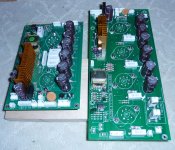
The board on the right is what I'm using for the power amp section, the left one is the 60 watt version:

1757961846569.jpeg

They have regulated +/- 15VDC outputs as well as 12VDC filament supplies, which suits my bass amp needs really well. Super low noise floor too. All JST connectors, so easy to interface via Digitech sourced DIY wiring breakouts.
 
Last edited:
What chassis and what transformer, please? My expenses have always been quite a bit higher than that!

Now that the weather is cooling down and I can finally get back in my shop, time to put together that 100 watt bass amp I mentioned.

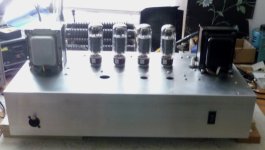
Proof of concept power amp build, which I ran for around six months with a wide variety of tube and SS preamps:


View attachment 102977

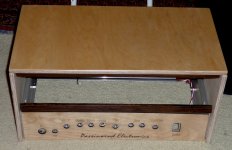
Basic Europly case config:

View attachment 102978

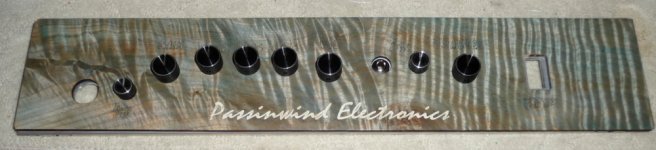
I have a grill screen from Reliable Hardware and some matching bocote side pieces, and then a variety of laser etched test front panels:

View attachment 102980

View attachment 102981


View attachment 102982

I think my luthier friend still wants to take another crack at the front panel and probably do something more uptown than plywood for the shell though. He will probably end up owning this build in any case, assuming he comes through with the acoustic guitar we've discussed building.

Preamp PCBs:

View attachment 102983
Not to sound awkward, but nice knobs, bro. :)
 
Photo Sep 15 2025, 7 44 31 PM.jpg

Artwork done for one. The metal Brutalist knobs... that's my knob of the decade. Feels good, looks good.

It's rewarding to see this stuff come together but man some of this hobby of ours is what I would call Fun Type 2 (tm). Like winter camping on the North shore of Lake Superior. In the moment, painful, but the experience and end result is worth it (mostly haha).
 
Artwork looks good!

It's rewarding to see this stuff come together but man some of this hobby of ours is what I would call Fun Type 2 (tm). Like winter camping on the North shore of Lake Superior. In the moment, painful, but the experience and end result is worth it (mostly haha).

Hey they look good! I have been using mostly the same knobs on everything. Small version for pedals, large for amp. They are pretty cheap, are made from Aluminium and have a hex screw lock. But these might be calling my name for my next build.
 
Well, I just blew up my deliverance 🤣 I had an attenuator and was alone in the building. Apparently, high gain and past 7 on the MV palm muting isn’t a good time. I thought “fuck this is loud enough to play with a drummer no problem even with -20dB attenuation” and… crackles, no sound. Time to diagnose but I have probably fried a resistor somewhere. And hopefully not the power tubes, kt88 are expensive.
 
Artwork looks good!


Hey they look good! I have been using mostly the same knobs on everything. Small version for pedals, large for amp. They are pretty cheap, are made from Aluminium and have a hex screw lock. But these might be calling my name for my next build.
I use those LMS knobs a lot. But for amps I still have a stash of these that I bought a big surplus lot of from a studio electronics vendor:


PinkLED.jpg

I got over 500 from him and sold off enough on eBay to keep a few hundred for myself for free. No tubes in that 700 watt bass head, but initial B+ is around 300 volts in the ICEpower switchmode supply on the power amp module.
 
Last edited:
Well, I just blew up my deliverance 🤣 I had an attenuator and was alone in the building. Apparently, high gain and past 7 on the MV palm muting isn’t a good time. I thought “fuck this is loud enough to play with a drummer no problem even with -20dB attenuation” and… crackles, no sound. Time to diagnose but I have probably fried a resistor somewhere. And hopefully not the power tubes, kt88 are expensive.

About a month ago when I playing the the VH4 preamp through my GT120 (no master volume) all of a sudden I saw some magic smoke come out. I burned up a 5W screen resistor. I guess it's not completely uncommon for EL34s, they put a lot of stress on the the screen resistors. I had a replacement on hand and I took the time to go through my work on the power tube sockets too.

I always wondered about that tube as the silver getter stuff on top of the tube was like not symmetrical. I put that tube away, and put another I had on hand (I have individual bias controls). I did buy a set of 10w screens for if it happens again in the future.

I am going to put cathode fuses on each KT88 in the Model T clone. I couldn't find space for them in the GT120.

Good luck and god speed!
 
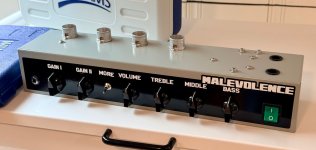
I finished up the art work for the Deliverance preamp yesterday, I actually had to start over after I couldn't recover from it being miss aligned when applying it to the chassis. It was a bummer. Anyway, the final result makes me excited. I love the how the stealth chicken head knobs and green power switch look.

Photo Sep 17 2025, 1 51 13 PM.jpg

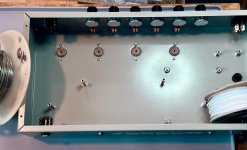
Anyway, now ready for the soldering iron again! Starting on the AOR preamp today. This is my favorite part. I love seeing the interior chassis in this state, doing the heaters, wiring up the transformer etc.

Photo Sep 18 2025, 11 40 34 AM.jpg
 
Isn’t this not so good practice which could bring more harm as cathode is suddenly lifted with voltage on plate?

Tubes are cheaper than transformers :p

You parallel the fuse with circuitry that leaves the valve in a fail safe state.

This article touches on it under "Cathode circuit fusing"

And then also https://dalmura.com.au/static/Output transformer protection.pdf
by the same author (Tim Robbins). This one has a set of schematics on page 4, one shows a 150V Zener paralleled with the fuse and bias sensing resistor.

I've seen some modern arrangements with led and resistor that will light up when the fuse has blown. RG mentions complicated arrangement in this thread: https://ampgarage.com/forum/viewtopic.php?p=405668#p405668 Although as you read along the thread questions the value of fusing the cathode may be questionable.

On my GT120 I have MOVs protecting over voltage on mains and OT primary. In addition to the mains fuse, I fused each side of the B+ secondary before the rectifier and then another fuse after on the B+ prior to the choke. The only fuses that have blown are pre rectifier fuses, but I started those low and have raised the rating after determining everything was OK until they don't blow any more. When my screen resistor burnt up, no fuses blew.

I guess my thought is when the screen resistor died would a cathode fuse saved it? Because I'd rather replace a fuse than a resistor.
 
You parallel the fuse with circuitry that leaves the valve in a fail safe state.

This article touches on it under "Cathode circuit fusing"

And then also https://dalmura.com.au/static/Output transformer protection.pdf
by the same author (Tim Robbins). This one has a set of schematics on page 4, one shows a 150V Zener paralleled with the fuse and bias sensing resistor.

I've seen some modern arrangements with led and resistor that will light up when the fuse has blown. RG mentions complicated arrangement in this thread: https://ampgarage.com/forum/viewtopic.php?p=405668#p405668 Although as you read along the thread questions the value of fusing the cathode may be questionable.

On my GT120 I have MOVs protecting over voltage on mains and OT primary. In addition to the mains fuse, I fused each side of the B+ secondary before the rectifier and then another fuse after on the B+ prior to the choke. The only fuses that have blown are pre rectifier fuses, but I started those low and have raised the rating after determining everything was OK until they don't blow any more. When my screen resistor burnt up, no fuses blew.

I guess my thought is when the screen resistor died would a cathode fuse saved it? Because I'd rather replace a fuse than a resistor.
I’ve read some links you mentioned. Was it on EL34world or diyaudio where RG had a good conversation about the real purpose of extra fusing? But that was a good talk and lead me reconsidering and easen up with so called protective mods. After last years tube (+screen resistor) failure I’ve been lucky, but I bias on colder side and reduce low end before input with hpf. Maybe I’ll look into f.ex. Flyback spike catch diodes ax84-style if these tubes fail too fast or something other drastic happens. Until then I’m keeping it simple.
 
I’ve read some links you mentioned. Was it on EL34world or diyaudio where RG had a good conversation about the real purpose of extra fusing? But that was a good talk and lead me reconsidering and easen up with so called protective mods. After last years tube (+screen resistor) failure I’ve been lucky, but I bias on colder side and reduce low end before input with hpf. Maybe I’ll look into f.ex. Flyback spike catch diodes ax84-style if these tubes fail too fast or something other drastic happens. Until then I’m keeping it simple.

I hear you. I bias medium but also I run my GT120 hard. #1 for me is protect the transformers, especially ones made by Mercury Magnetics lol.

I feel like the MOVs on the mains and OT primary is a no-brainer. Flyback diodes on the OT serves the same purpose as a couple of MOVs there so one or the other. Also fusing both sides of the B+ AC is recommended by both RG and the Valve Wizard, so a no brainer as well. I likely got it right with the GT120 in terms of level of protection but I stopped because I ran out of room haha.

All that said I'll likely still fuse the power tube cathodes on the Model T like in the Tim Robbins articles. I have a bunch of chassis space devoted to each power tube:
Model T Chassis rev 3.png

I'm 3.5" center to center there. Which is less than GEC recommends on the datasheet(4") but likely more space than most guitar amps. For each power tube I'm going to have have a top of the chassis mounted bias pot, bias reading banana style jack, and external fuse. Girthy 10W non-inductive wire wound screen and plate resistors.

On the preamps I am just fusing the mains. If something blows up it won't be the end of the world.
 
I'm 3.5" center to center there. Which is less than GEC recommends on the datasheet(4")
Yeah those datasheet spacing things seem to be pretty conservative. When you look at actual amps or even HiFi, they are never respected. The only thing to actually pay attention to is distance to the transformers really.

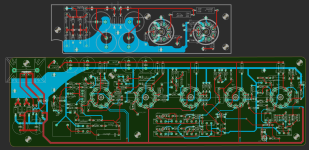
Also, I think I am done with my PCB for the VH1+3 thingie now.
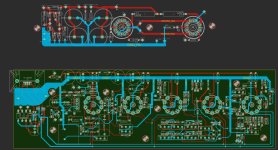
1758486073947.png

All traces are generously dimensioned for what they will actually carry and the creepage is fairly conservative everywhere (read: 3mm+, high voltage is 5+). Long tail PIs are not fun to layout, and selecting to have one tone stack per channel could have spelled the end. But it fits. As last time, that's one board for the Poweramp (5x20 cm) part and one board for the preamp (33x10 cm). Should fit in a small headshell. Criticism welcome!

Next steps are ordering the Farnel RED inductor to make sure I have the right data on it for the footprint, figure out some details for the parts (which switches etc) so I can order everything to be able to double check footprint before ordering PCBs at JLCPCB (and receiving 5 because that's the minimum order size.

Also I barely had time to find out why my Deliverance blew up (I heavily suspect power tubes, the resistors measure fine everywhere, all caps look fine, DC voltages seem ok and there is no burns on the PCB). I am not doing that with two small kids running around on the weekend :p
 
Imma reply to myself :ROFLMAO:

I fixed my Deliverance. After two hours of probing, validating DC voltages, resistances and continuity, I decided to simply check AC voltages with a signal. Turns out, the amps works with not issues! I must have had a lose connection somewhere, or something when the amp is really hot? I cannot reproduce it though. So I re-secured all the Faston connectors and it works fine. I redid the bias to make sure, and lowered it a bit while playing. Turns out I really like it at 55%. Much less harsh while still remaining gritty. So there is that.
 
Back
Top