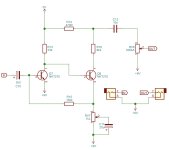
hiss/static positive power PNP fuzz face

analog_bham

Well-known member
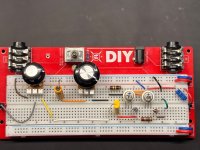
hi everyone. i breadboarded a PNP FF to positive power and have a question:

when the guitar volume is rolled all the way off, there is quite a lot of static/hiss that comes through but isn't otherwise present when the volume is up. i was wondering if this is something related to the powering and if there are suggestions for power filtering that i could do to improve this, or if this is simply related to it being on a breadboard instead of in an enclosure.

the circuit works otherwise and sounds good.

thanks!
John
 

Attachments

  • IMG_1708.jpeg
    IMG_1708.jpeg
    613.4 KB · Views: 8
Are you connecting the positive and ground rails to the DC jack directly? It looked like that at first glance. If that's the case, try connecting a 100Ω resistor in between the DC jack's negative lead and the negative rail or a 100Ω in between the DC jack's positive lead and the positive rail—I've found that the former works better with PNP Fuzz Faces—and then place a 100µF capacitor across the rails. That should make a big difference.
 
Last edited:
If it's wired per the schematic, then there should be no problem.

The convention is to refer to the signal returns (input & output jack sleeve) as GND. In which case, what you call +9V is actually GND and what you call 0V would be -9V. Call it what you like, but as drawn, you're running a positive ground. If you want to run a negative center power jack and a positive ground, then you need a charge pump to invert the voltage. But that is not the only way to do it. It is possible to run a negative ground with a PNP Fuzz Face. For an example, look at the input stage of the Lovepedal 200lbs of Gold.

As an aside, there is nothing magic these days about a PNP Fuzz Face. In the beginning, the only commercially available transistors that were usable in a guitar pedal were Germanium PNP. So that's what Arbiter and the others used. As the semiconductor technology matured, the performance of NPN transistors improved to the point that they matched or exceeded PNP performance. With the advent of Silicon transistors, PNP & NPN transistors could have similar performance and there was no longer a reason to prefer one polarity over the other. These days, pedal design is more about Mojo that it is about engineering. And no, I am not throwing shade on Mojo.
 
If it's wired per the schematic, then there should be no problem.

The convention is to refer to the signal returns (input & output jack sleeve) as GND. In which case, what you call +9V is actually GND and what you call 0V would be -9V. Call it what you like, but as drawn, you're running a positive ground. If you want to run a negative center power jack and a positive ground, then you need a charge pump to invert the voltage. But that is not the only way to do it. It is possible to run a negative ground with a PNP Fuzz Face. For an example, look at the input stage of the Lovepedal 200lbs of Gold.

As an aside, there is nothing magic these days about a PNP Fuzz Face. In the beginning, the only commercially available transistors that were usable in a guitar pedal were Germanium PNP. So that's what Arbiter and the others used. As the semiconductor technology matured, the performance of NPN transistors improved to the point that they matched or exceeded PNP performance. With the advent of Silicon transistors, PNP & NPN transistors could have similar performance and there was no longer a reason to prefer one polarity over the other. These days, pedal design is more about Mojo that it is about engineering. And no, I am not throwing shade on Mojo.
Thanks! I have a stash of PNPs I was just finding uses for. I have NPNs as well but was intrigued by being able to wire the PNPs for a normal (isolated) power jack. Mostly just wanting to learn and understand what is going on…
 
It could be that you input cap, c10, is leakey. Especially if it's an electrolytic. Simple check. Plug in a cable to the input and measure for DC at the other end between tip and sleeve.
 
Back
Top