How is this board meant to be used?

Perfboard has its own skill set. You should probably build something more simple before doing a boneyard circuit. You can always desolder it.

 
Oh I've done strip boards and breadboards before, as well as PCBs from PedalPCB. I learned to solder with QC inspectors at a job decades ago. I'll be fine :)
 
I have a list of Boneyard schematics I want to try. There was a thread where Chuck listed some of his favorite circuits, going to pick one of those for some perf board fun. It seems like it might be better than strip boards, no cutting involved.

Like anything, each has its merits, though vero less so. 😸


+1 for DIYLC, as phi1 suggested, LOVE that program.
 
Thanks, I had seen that while downloading. I am looking to see if there is a video showing best practices. I can search but was asking if someone here has seen a good tutorial.
 
Perf/proto board feels like the next step up in between PTP and actual PCB and it’s only as ugly as you make it. For me it’s easier to translate a schematic into perf than Vero but that’s just me and I may just be dumb that way. Perf also offers a little more stability over PTP
 
Perf/proto board feels like the next step up in between PTP and actual PCB and it’s only as ugly as you make it. For me it’s easier to translate a schematic into perf than Vero but that’s just me and I may just be dumb that way. Perf also offers a little more stability over PTP
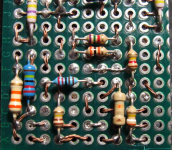
I would say this isn't totally accurate. PTP in my experience is very stable and easy to fix. And I definitely wouldn't put it in an evolution that goes PTP>perf>PCB. I think there's also turret board, but I don't mess with that.

Each assembly mode has it's own virtues and vices, and PTP's big downside is time and mental effort.

It does vibrate, though, which might unnerve some people.
 
In my experience, using perfboard vs stripboard greatly depends on the circuit we want to do.

For small circuits the stripboard will work fine but for anything a bit complex with more parts we will need the perfboard and do all the traces ourselves.
It's also a matter of which layout can do the job in the most compact way.
For something like a BD-2 circuit, i guess the perfboard layout is much smaller than the vero layout, for example.

Over at diystompboxes.com, a very experienced builder from Australia taught me a few things about building circuits on perfboards, and i realized it can become a very impressive work of craftmanship with lots of attention to details.

Many specific skills are required to do everything from scratch.
Using some software to help with creating the layouts, being very neat and tidy with the traces, using exacly 3 or 4 pieces of stripped wire and braid them together to perfectly fit the holes and secure the best possible connections in the circuit, doing something close to sewing with the wires, using the free holes between parts, to make sure the wires wont get loose, creating neat angles on the wire path to get it where it's needed, etc.

Circuits on perfboards can be real pieces of art, or at least some very impressive craftmanship only possible after years of experience and practice.

In my opinion a well-made perfboard circuit is the peak of diy builds.
We do everything ourselves, no pcb to make our work fast and easy. It's surely the most satisfying way of building circuits if we enjoy creating things with our own hands.
Vero builds arent always easy but it's less impressive and requires much less efforts because they are usualy simpler circuits with fewer components.

Here is an example from Duck_arse from diystompboxes :

1784963168653.png
 
Last edited:
My first build I tried using that.... It didn't work lol. It should've though lol but I tried strip board for the first time the other day finally and loved it.
 
Hell yeah
And oh also even though it's not as difficult as perfboard, I think it's still a nice little handmade touch with the saltine board and the potentially freestyled layout or hand drawn.
 
Back
Top