Joben Magooch
Well-known member
2022 has been a bit of an adventure for me. It's about to come to a close and I think (with the exception of one or two small tweaks to be mentioned later) my gear situation should be relatively wrapped up for now, so I thought it might be fun to walk back through and review.
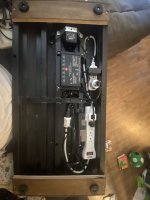
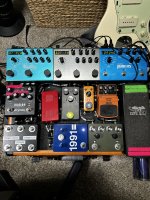
So I don't remember if I ever posted about it or not but I was pretty well out of commission to start the year. I had a surgical procedure done the first week of January which ended up having some major complications that kept me in the ICU for a week and then the step-down unit for a week further before finally getting sent home. Then I was out of work recovering until March and honestly didn't really feel back to "normal" until like late April, early May. I pretty much didn't touch any gear at all during this period, so this story more or less starts around the middle of the year. Here's how things looked around then:

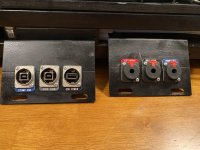
You can't really see it too well, but there's a little "interface" box beneath the DI in the top-right corner. It's completely passive, more or less just a glorified patch bay - guitar goes in, out the other side to pedals. "Dry" pedals go to a send/return switched loop and then back out to "wet" pedals. Last pedal in chain then returns to the patch box and here it's connected to an SGI box for an amp offstage. I think it was a Morgan AC20 in this.
First in line then is my trusty Mooer Yellow Comp. It's a clone of the Diamond Comp; honestly at this point I think it's my longest-standing pedal I've got. I love it and doubt it will ever leave. It's always on.
From there we go to the PedalPCB Minidrive. The Fulldrive has always been one of my favorite takes on the TS-circuit and this has been around for me for quite some time too. I think it might have been my first PPCB build actually. Out to the Protein Blue; I really like Bluesbreakers as well and this is one of my favorite versions I've tried.
Then it's to the HX stomp. At the time I had the stomp set up with two basic patches - one for an all-in-one with amp sims and all and another for use with a real amp, which is what's happening here. So practically speaking it's being used for Delay, modulation, and the Bigsky is in its send/return loop for control.
The Stomp and Bigsky are being controlled here by the Morningstar MC6 (the little box to the right is an additional expansion footswitch for it). I have tried quite a few midi controllers and in my estimation Morningstar makes the very best out there.
All powered by the small but mighty Truetone CS7 - Stomp, Bigsky, and all.
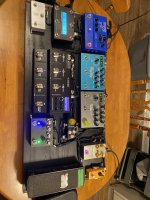
But, I often had issues with the FX loop in the stomp and it never seemed to play just right with my delays and reverbs. I don't love the stomp's delays either, so shortly after I went back to the trusty Timeline. I've owned probably half a dozen Timelines (and Bigskys, for that matter) at this point and pretty much every time I tell myself "I don't need this" or "it's more delay than I can use" or "I only use one or two settings anyways" and sell it...then inevitably come back to it. It's stayed about 6 months now so hopefully it just sticks for good. I do find myself missing my El Cap, though...
Not much else has changed here; I've installed a riser on the pedalboard which has both the Stomp and Bigsky on it. My little Yellow comp and CS7 are hidden underneath. In the past I have been able to power all of this off of a CS7 as well, but for some reason this particular timeline is much more picky about how it gets its power. It really seems to want to just use its own dedicated PSU, so that's hiding under the riser as well. Oh, and you can see the Mosky Black Rat added. It's a really nice little Rat clone, thru-hole, LM308 and everything. Was like 25 bucks. Hard to beat.
I really like a lot about the flat board style. I like the aesthetic and it's nice to get those really neat and organized cable runs. But this one was getting a bit full and making it hard to keep clean and organized. I had started running a lot in stereo too which doubles half my cables so I decided at this point I'd build an angled board that would allow me to keep my cables hidden underneath. It's at this point that things got a bit messy...
I am a decent woodworker in all honesty. Most of our furniture around the house was built by me and I've done more cabinets and vanities and islands than I care to count. I'm not an absolute master and I don't make a living off of it but I say all that just to clarify that I'm not a total noob who doesn't know which end of a hammer to hold.
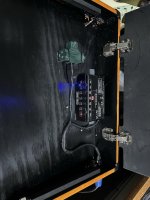
It may sound a little weird but the basis for my build-design was actually working off of a case I already had. Probably seems backwards. I have a nice Pelican-type case that's waterproof and wheeled and it's almost an exact fit for a Temple Audio Trio 21 board (I had one a while back but got tired of the plates and found it was a bit too low of an angle), so about 21x16". That's the size of the flat board(s) above too, which also used that same case. I quite like this size and really like having a case that seems bomb-proof and wanted to be able to continue with it.
So the plan was to do a wooden angled frame with a hinged top that would allow me to flip up and route the cables as needed as well as store my power supplies underneath. At the same time, I was wanting to add some modulation on its own rather than relying on the Stomp for this; I wanted to use the stomp just for amps as this made signal routing easier (as above I had some issues with the Stomp FX loop so didn't want to use it. And without using the loop it meant either running delay and reverb post-amp which I don't like, or modulation post delay/reverb which was not the move either).
I suppose it is also worth mentioning at this point that I have a new ~3 month old in the picture here...in addition to my ~18 month old. So life is pretty hectic for me and I don't get a lot of shop time. This was pretty much all going to be done during spare time on my lunch breaks at work.
Plans were drafted up and I made a prototype out of some scrap plywood to make sure everything was fitting correctly. I have a dovetail jig for my router which I NEVER use because it's honestly more trouble than it's worth, but I thought it'd be nice to get some nice hardwood and do dovetail joints. I had it all dialed in on scrap and it was fitting quite nicely. I wanted to do one final test on scrap to make sure it was 100% perfect...For reasons unknown to me to this day, the height-adjustment screw for the router straight up snapped mid-cut. The bit slammed into the jig-fingers, shredded a couple of them up, ruined my guide bushing, and the bit itself was totally mangled - bent and chipped and useless. Luckily I avoided injury myself, but my jig was more or less toast and I hated the d*mn thing already so I just pitched it all and washed my hands of it and moved on. Total freak thing; I would understand if I hadn't adequately tightened it down or didn't have my jig set right but everything was good...it just snapped on its own, lol.
So instead of messing with dovetails I figured a simple box joint would still look nice. I made up a jig for my table saw with a dado stack and it was also cutting quite nicely. I made another scrap prototype, and this time also got a piece of birch ply for my top laid out with some slots cut on the router table.

As you can see there's a bit of burning but no matter. The whole top is getting painted so it won't be visible. I was honestly really happy with this piece. It's a perfect fit for the frame and the slots came out really clean overall. They were going to work great....
So I finished up with my prototypes and went ahead and started with my "good" wood. It's nothing too fancy, just some red oak I had laying around. Here's the frame cut and getting glued up:
And it was shortly after this that disaster struck again, but we'll save that for part two...
So I don't remember if I ever posted about it or not but I was pretty well out of commission to start the year. I had a surgical procedure done the first week of January which ended up having some major complications that kept me in the ICU for a week and then the step-down unit for a week further before finally getting sent home. Then I was out of work recovering until March and honestly didn't really feel back to "normal" until like late April, early May. I pretty much didn't touch any gear at all during this period, so this story more or less starts around the middle of the year. Here's how things looked around then:
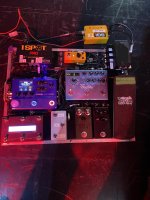
You can't really see it too well, but there's a little "interface" box beneath the DI in the top-right corner. It's completely passive, more or less just a glorified patch bay - guitar goes in, out the other side to pedals. "Dry" pedals go to a send/return switched loop and then back out to "wet" pedals. Last pedal in chain then returns to the patch box and here it's connected to an SGI box for an amp offstage. I think it was a Morgan AC20 in this.
First in line then is my trusty Mooer Yellow Comp. It's a clone of the Diamond Comp; honestly at this point I think it's my longest-standing pedal I've got. I love it and doubt it will ever leave. It's always on.
From there we go to the PedalPCB Minidrive. The Fulldrive has always been one of my favorite takes on the TS-circuit and this has been around for me for quite some time too. I think it might have been my first PPCB build actually. Out to the Protein Blue; I really like Bluesbreakers as well and this is one of my favorite versions I've tried.
Then it's to the HX stomp. At the time I had the stomp set up with two basic patches - one for an all-in-one with amp sims and all and another for use with a real amp, which is what's happening here. So practically speaking it's being used for Delay, modulation, and the Bigsky is in its send/return loop for control.
The Stomp and Bigsky are being controlled here by the Morningstar MC6 (the little box to the right is an additional expansion footswitch for it). I have tried quite a few midi controllers and in my estimation Morningstar makes the very best out there.
All powered by the small but mighty Truetone CS7 - Stomp, Bigsky, and all.
But, I often had issues with the FX loop in the stomp and it never seemed to play just right with my delays and reverbs. I don't love the stomp's delays either, so shortly after I went back to the trusty Timeline. I've owned probably half a dozen Timelines (and Bigskys, for that matter) at this point and pretty much every time I tell myself "I don't need this" or "it's more delay than I can use" or "I only use one or two settings anyways" and sell it...then inevitably come back to it. It's stayed about 6 months now so hopefully it just sticks for good. I do find myself missing my El Cap, though...
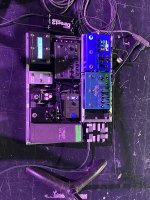
Not much else has changed here; I've installed a riser on the pedalboard which has both the Stomp and Bigsky on it. My little Yellow comp and CS7 are hidden underneath. In the past I have been able to power all of this off of a CS7 as well, but for some reason this particular timeline is much more picky about how it gets its power. It really seems to want to just use its own dedicated PSU, so that's hiding under the riser as well. Oh, and you can see the Mosky Black Rat added. It's a really nice little Rat clone, thru-hole, LM308 and everything. Was like 25 bucks. Hard to beat.
I really like a lot about the flat board style. I like the aesthetic and it's nice to get those really neat and organized cable runs. But this one was getting a bit full and making it hard to keep clean and organized. I had started running a lot in stereo too which doubles half my cables so I decided at this point I'd build an angled board that would allow me to keep my cables hidden underneath. It's at this point that things got a bit messy...
I am a decent woodworker in all honesty. Most of our furniture around the house was built by me and I've done more cabinets and vanities and islands than I care to count. I'm not an absolute master and I don't make a living off of it but I say all that just to clarify that I'm not a total noob who doesn't know which end of a hammer to hold.
It may sound a little weird but the basis for my build-design was actually working off of a case I already had. Probably seems backwards. I have a nice Pelican-type case that's waterproof and wheeled and it's almost an exact fit for a Temple Audio Trio 21 board (I had one a while back but got tired of the plates and found it was a bit too low of an angle), so about 21x16". That's the size of the flat board(s) above too, which also used that same case. I quite like this size and really like having a case that seems bomb-proof and wanted to be able to continue with it.
So the plan was to do a wooden angled frame with a hinged top that would allow me to flip up and route the cables as needed as well as store my power supplies underneath. At the same time, I was wanting to add some modulation on its own rather than relying on the Stomp for this; I wanted to use the stomp just for amps as this made signal routing easier (as above I had some issues with the Stomp FX loop so didn't want to use it. And without using the loop it meant either running delay and reverb post-amp which I don't like, or modulation post delay/reverb which was not the move either).
I suppose it is also worth mentioning at this point that I have a new ~3 month old in the picture here...in addition to my ~18 month old. So life is pretty hectic for me and I don't get a lot of shop time. This was pretty much all going to be done during spare time on my lunch breaks at work.
Plans were drafted up and I made a prototype out of some scrap plywood to make sure everything was fitting correctly. I have a dovetail jig for my router which I NEVER use because it's honestly more trouble than it's worth, but I thought it'd be nice to get some nice hardwood and do dovetail joints. I had it all dialed in on scrap and it was fitting quite nicely. I wanted to do one final test on scrap to make sure it was 100% perfect...For reasons unknown to me to this day, the height-adjustment screw for the router straight up snapped mid-cut. The bit slammed into the jig-fingers, shredded a couple of them up, ruined my guide bushing, and the bit itself was totally mangled - bent and chipped and useless. Luckily I avoided injury myself, but my jig was more or less toast and I hated the d*mn thing already so I just pitched it all and washed my hands of it and moved on. Total freak thing; I would understand if I hadn't adequately tightened it down or didn't have my jig set right but everything was good...it just snapped on its own, lol.
So instead of messing with dovetails I figured a simple box joint would still look nice. I made up a jig for my table saw with a dado stack and it was also cutting quite nicely. I made another scrap prototype, and this time also got a piece of birch ply for my top laid out with some slots cut on the router table.
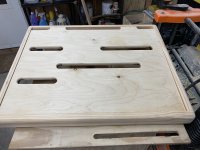
As you can see there's a bit of burning but no matter. The whole top is getting painted so it won't be visible. I was honestly really happy with this piece. It's a perfect fit for the frame and the slots came out really clean overall. They were going to work great....
So I finished up with my prototypes and went ahead and started with my "good" wood. It's nothing too fancy, just some red oak I had laying around. Here's the frame cut and getting glued up:
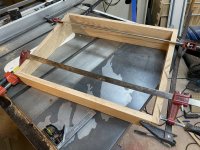
And it was shortly after this that disaster struck again, but we'll save that for part two...