
JohnnyCreepy
Well-known member
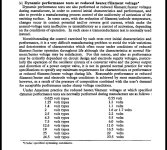
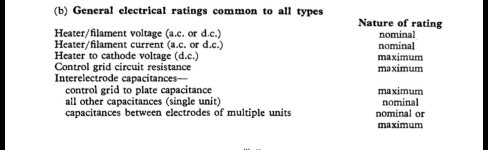
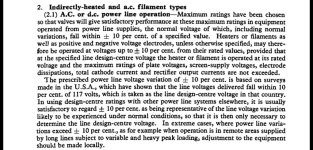
Heater voltage mentioned as nominal. These pages are from RCA: Radiotron Designer’s handbook IV, 1953.

Gemini hallucinated that number. I've never seen a datasheet call the filament/cathode breakdown voltage "Vhk", and especially in JJ datasheets they use 'U' for voltage instead of 'V'. If you read the JJ ECC83S datasheet, you will see that Uk/f is spec'd at 180V, well above where it runs on Lab Rat or Bassdude. I would also like to point out that JJ ECC83S does not have lower transconductance than a standard 12AX7. 1.6 mA/V is the "standard," and that's exactly what JJ calls out for the ECC83S.I just looked into Labrat schematic and started to wonder if exceeding cathode-heater voltage limit is causing premature wear on certain tubes. This might not happen with all variants of 12ax7/ecc83 tubes, but usual thing to avoid it on amplifiers is referencing heater CT (artificial or transformer ct) to 40-50VDC via voltage divider from HV supply. I’m now bumping you @vigilante398 to shed some light to this how you’ve taken C-H limit in account on your circuits or is this not thing to worry here?
First I was like ”wtf, I read books”, but then went back to first page on this thread and noticed OP was using statistic-search-engine-on-steroids aka AI. Yeah, cathode to filament limit is usually mentioned as 180V. I realized some time after my message that I didn’t even consider Labrats cathode follower plate and cathode resistors voltage drop. Went to sleep, forgot to fix it. Sorry!Gemini hallucinated that number. I've never seen a datasheet call the filament/cathode breakdown voltage "Vhk", and especially in JJ datasheets they use 'U' for voltage instead of 'V'.
Or just bad tubes and luck? I’ve came across forum lore people stating some new tubes don’t like cathode follower positions. Folklore or consideration, cannot say for sure.If you have tubes consistently failing after only a few hours, something else is wrong.
I confirm 180V for JJ and 150V for TAD. Far more than needed in our case.Gemini hallucinated that number. I've never seen a datasheet call the filament/cathode breakdown voltage "Vhk", and especially in JJ datasheets they use 'U' for voltage instead of 'V'. If you read the JJ ECC83S datasheet, you will see that Uk/f is spec'd at 180V, well above where it runs on Lab Rat or Bassdude. I would also like to point out that JJ ECC83S does not have lower transconductance than a standard 12AX7. 1.6 mA/V is the "standard," and that's exactly what JJ calls out for the ECC83S.
If you have tubes consistently failing after only a few hours, something else is wrong.
From what I can gather from this document, there is a 10% tolerance on the filament voltage to compensate for variations in the supply voltage. For a filament that is supposed to be powered at 12.6V, the tolerance allows for approximately 11V.View attachment 125652View attachment 125653View attachment 125654
Heater voltage mentioned as nominal. These pages are from RCA: Radiotron Designer’s handbook IV, 1953.

Hi @vigilante398. Thanks for the reply. Is there any validity to the idea of the tubes degrading quickly in some instances since the tube isn't heating up to the same temp when running at 9V instead of at 12V (or within the 10% tolerance)? The two tubes did not fail outright, they lost some volume and gain in my case, but I was able to get one of them back to what sounds like the original gain by letting it "heat up" at 12V while in the Lab Rat for a few hours. I did not test what would happen if I let the tube heat up for 2 hours running at 9V. Maybe the result would be the same. I think I still have the other tube that I thought was a bad tube that I can test on. I'll have to check if I still have it later.Gemini hallucinated that number. I've never seen a datasheet call the filament/cathode breakdown voltage "Vhk", and especially in JJ datasheets they use 'U' for voltage instead of 'V'. If you read the JJ ECC83S datasheet, you will see that Uk/f is spec'd at 180V, well above where it runs on Lab Rat or Bassdude. I would also like to point out that JJ ECC83S does not have lower transconductance than a standard 12AX7. 1.6 mA/V is the "standard," and that's exactly what JJ calls out for the ECC83S.
If you have tubes consistently failing after only a few hours, something else is wrong.
I will say that I run my pedals at 9V at the heaters and have done so for years, and have not noticed any impact on tube lifetime. This is anecdotal, but that is why all of my "commercial" pedals say 9-12VDC on them. When I first moved from submini tubes up to full-size I had originally planned for them all to run at 12V, but was curious what would happen if I ran them at 9V. I found that they sounded the same, and didn't notice any negative results, so I let them go at 9V.Hi @vigilante398. Thanks for the reply. Is there any validity to the idea of the tubes degrading quickly in some instances since the tube isn't heating up to the same temp when running at 9V instead of at 12V (or within the 10% tolerance)? The two tubes did not fail outright, they lost some volume and gain in my case, but I was able to get one of them back to what sounds like the original gain by letting it "heat up" at 12V while in the Lab Rat for a few hours. I did not test what would happen if I let the tube heat up for 2 hours running at 9V. Maybe the result would be the same. I think I still have the other tube that I thought was a bad tube that I can test on. I'll have to check if I still have it later.