
You are using an out of date browser. It may not display this or other websites correctly.
You should upgrade or use an alternative browser.
You should upgrade or use an alternative browser.
Low Gain Silicon Transistors
- Thread starter Ginsly
- Start date

Ginsly
Well-known member
I think he’s referring to the piggybacked transistor pairs in the Silica Fuzz.What do you mean by "pair"?

yes... in the Silica fuzz there are two transistors - lower gain - with a trimmer to adjust the HFE.... I am wondering how is this measured to get to the desired HFE?
I think you would treat the composite like this, using the marked point as Bass, Collector, and Emitter for the test.
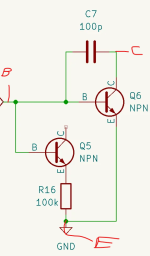
I've been experimenting with piggybacked transistors the last couple days.
2N2369, 2N4123, 3903s (hfe 70-90) etc of course all work in a FF, but I think I am hearing something 'different with mid-gain devices dialed in with piggybacking. Something maybe more complex with the texture, especially in Q1.
But at the same time, I've read on other forums that the very pioneers of this technique (RG Keen, "Brett" ?, and a couple others contributors) lost interest in it once the aforementioned low gain devices were identified.
Have you guys found piggybacking to be something significantly different / useful vs run of the mill low gainers?
2N2369, 2N4123, 3903s (hfe 70-90) etc of course all work in a FF, but I think I am hearing something 'different with mid-gain devices dialed in with piggybacking. Something maybe more complex with the texture, especially in Q1.
But at the same time, I've read on other forums that the very pioneers of this technique (RG Keen, "Brett" ?, and a couple others contributors) lost interest in it once the aforementioned low gain devices were identified.
Have you guys found piggybacking to be something significantly different / useful vs run of the mill low gainers?

jessenator
Well-known member
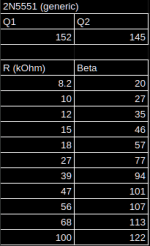
necro. Here's a chart from some piggybacking silicon NPNs (using the example schematic I linked long ago). Unmarked (probably Central) 2N3904s, initial gain listed in the chart, but generally mid-200s. Final beta/gain dependent on R resistance. General flow: lower resistance, lower beta, follows a log curve. 4k7 is around 16, 10k is around 50.
I can't do the math in my head, so I just made a chart to have a visual on approx. values.


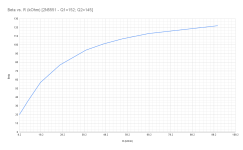
Then I thought to try another band of gain, this time 2N5551 (easily gotten at Tayda and elsewhere), gain levels in the mid-100s. Anything below 8k2 wasn't registering as a transistor. But as expected you have finer control the lower your Q1 and Q2 initial beta is:


I can't do the math in my head, so I just made a chart to have a visual on approx. values.
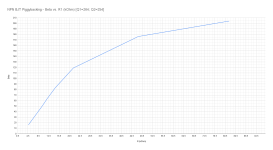
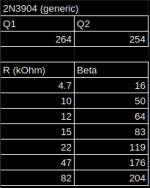
Then I thought to try another band of gain, this time 2N5551 (easily gotten at Tayda and elsewhere), gain levels in the mid-100s. Anything below 8k2 wasn't registering as a transistor. But as expected you have finer control the lower your Q1 and Q2 initial beta is:

MichaelW
Well-known member
This is a necro bump but I'm building this pedal and I don't get an HFE reading using the above method. My DCA75 gives me back 2 diodes.I think you would treat the composite like this, using the marked point as Bass, Collector, and Emitter for the test.
View attachment 99918
Have you tried this?

Chuck D. Bones
Circuit Wizard
Why not just buy low-HFE transistors? They are neither expensive nor hard to find. High-voltage, high current or high freq transistors all have reduced HFE because they are optimized for something other than HFE. 2N2369 is an example of a high-freq transistor. 2N6517 is a high-voltage transistor that sells for $0.22 in quantities of 10 at Mouser. 2N3019 is metal-can medium power transistor that sells for $1.67 in quantities of 10 at Mouser. MPS6531 sells for $0.86 in quantities of 10 at Mouser. We have options.
This "composite transistor" architecture is a solution for a non-existent problem in my book.
My $0.02 ±5%
This "composite transistor" architecture is a solution for a non-existent problem in my book.
My $0.02 ±5%
MichaelW
Well-known member
cuz it's....um.....kinda cool?Why not just buy low-HFE transistors? They are neither expensive nor hard to find. High-voltage, high current or high freq transistors all have reduced HFE because they are optimized for something other than HFE. 2N2369 is an example of a high-freq transistor. 2N6517 is a high-voltage transistor that sells for $0.22 in quantities of 10 at Mouser. 2N3019 is metal-can medium power transistor that sells for $1.67 in quantities of 10 at Mouser. MPS6531 sells for $0.86 in quantities of 10 at Mouser. We have options.
This "composite transistor" architecture is a solution for a non-existent problem in my book.
My $0.02 ±5%

I'd never seen it before so was curious. (yah, I hear you, I should have just breadboarded it......working on that....still, heh.)

Robert
Reverse Engineer
We have options.
You're never going to believe this but there are still folks out there using freakin' tubes of glass with all the air sucked out to boost signals.... and they like it that way.


Nostradoomus
Well-known member
You're never going to believe this but there are still folks out there using freakin' tubes of glass with all the air sucked out to boost signals.... and they like it that way.
how does sound exist in a vacuum?!?! HOW!?!??!!??1


Feral Feline
Well-known member

JohnnyCreepy
Well-known member
I’ve just read 3 hours ampgarage, diyaudio and various application notes/datasheet to land here seeing this. Thank you for making my train trips tube study session worth it. Now Im not gonna worry about Va being same as Vg2.