Alan W
Well-known member
I’ve actually had this for a few weeks now, but wanted to play it through some other speakers before posting. A few months ago, I began to want an octal preamp based amp; ideally smaller and purposed for lower volume playing. My first thought was looking at schematics for a Harvard, and building one. Somehow, during my searches, I became aware of Vintage47 Amps. They (currently Steve and his wife) build amps based on the old Valco (and one Gibson) designs. I was intrigued.
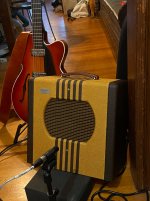
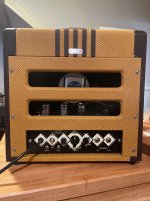
The amp that most appealed to me was their Oahu Suitcase amp. It uses a low gain octal cascaded into a medium gain octal, then either a 6L6 or 6v6 power tube. (It can max out with a 7581A power tube). Interactive volume and tone controls, plus a high/low bias switch, and a boost switch.
The hitch was, it could only fit an 8 inch speaker, and I’m playing baritone (tuned to B) about as often as a regular guitar lately. He made another model that used a 10 inch speaker, and I asked him to morph the two together into a new creation. This gave him a few small problems, which he found great solutions for. The one issue was that in this configuration, to get to the speaker jacks, you really have to remove the back panel, which was a pain. (I didn’t think of this earlier, and I don’t think he realized it either.)
So yesterday I added a small box to the inside, with a switched extension speaker jack on it. Just played it through a 2x12 cabinet… (well, really a combo amp).
This poplar ply box with its Weber 10A125, weights about 25 pounds. It took a bit to get a feel for the way the volume and tone interact. Until it starts to distort, it has that lovely single ended class A (into Alnico) clarity to it. I’ve been preferring it with a 6v6 and 5y3gt rectifier; but have to experiment again now that I can push more volume out. It breaks up (with the 6v6 / 5y3 especially) in a fairly gradual, but soonish, way, that makes me realize why I just don’t get along with dirt pedals. (My two other amps have a lot more clean headroom.) So this is a hand wired, point to point amp, lacquered and hand striped cabinet, with top quality parts (Switchcraft etc.). Made to order. For less than a baseline Princeton.
And Steve couldn’t have been nicer to work with.

The amp that most appealed to me was their Oahu Suitcase amp. It uses a low gain octal cascaded into a medium gain octal, then either a 6L6 or 6v6 power tube. (It can max out with a 7581A power tube). Interactive volume and tone controls, plus a high/low bias switch, and a boost switch.
The hitch was, it could only fit an 8 inch speaker, and I’m playing baritone (tuned to B) about as often as a regular guitar lately. He made another model that used a 10 inch speaker, and I asked him to morph the two together into a new creation. This gave him a few small problems, which he found great solutions for. The one issue was that in this configuration, to get to the speaker jacks, you really have to remove the back panel, which was a pain. (I didn’t think of this earlier, and I don’t think he realized it either.)
So yesterday I added a small box to the inside, with a switched extension speaker jack on it. Just played it through a 2x12 cabinet… (well, really a combo amp).
This poplar ply box with its Weber 10A125, weights about 25 pounds. It took a bit to get a feel for the way the volume and tone interact. Until it starts to distort, it has that lovely single ended class A (into Alnico) clarity to it. I’ve been preferring it with a 6v6 and 5y3gt rectifier; but have to experiment again now that I can push more volume out. It breaks up (with the 6v6 / 5y3 especially) in a fairly gradual, but soonish, way, that makes me realize why I just don’t get along with dirt pedals. (My two other amps have a lot more clean headroom.) So this is a hand wired, point to point amp, lacquered and hand striped cabinet, with top quality parts (Switchcraft etc.). Made to order. For less than a baseline Princeton.
And Steve couldn’t have been nicer to work with.