I like this one the best so far. The sweeping turns and 180* turns off the resistors are really pleasing. This was on my radar to maybe do ptp so I'm happy someone did it!
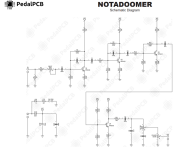
Well, the easiest is to literally follow the schematic. You can see that on the OK Doomer above. and I make sure to think about what needs to see what first etc. Here it is for reference:
You can get as creative as you want as long as you respect the connections, and keep in mind that the grounds are agnostic about order as long as they get to ground. Like you can tie them all together in one point if you want. Some PTP styles actually just have a copper ground plane that they plop the ground side of components onto.
As usual, something low parts count and low tie-in is easiest, so yes, a Bazz Fuss is good. Electra/Golden Fleece distortion, Rangemaster, Fuzz Face, Meathead are all very good candidates. I would definitely recommend breadboarding beforehand as these are all very flexible circuits that depend a lot on auditioning components to get a sound that you like. Or not!
The biggest planning you have to do is think about where to situate your potentiometers so that it's not too much of a pain in the butt to tie in. You can essentially situate them anywhere you want and run leads to wherever, but I try to keep things less complicated. Visualize the circuit, think about how you are going to have it flow in the space. Try to make the circuit as small as you care to. You should be able to assemble the above nominated circuits outside the box (much easier). I usually trace the 125b lid on a piece of paper and lay the components out.
In somewhat of an opposite order to PCB pedal assembly, paint/graphic up your enclosure and drill. Install the "off board" elements first and lay down the bottom layer, which will be: 3PDT to in/out jacks and LED, volume out, and you can also go ahead and install the power section, which is usually 5817, 100u cap, and the other end of the LED.
Coat the ends of the things you want to join with solder flux. This is KEY. Get a bead of solder on the iron, and touch it to the joint, not for long. Just TSST. You can position components for soldering with blutac or whatever. I'm lazy so I just use fingers/pliers to hold things down.
The worst that happens is you have some disassembled components with a solder coat. Nothing bad will happen, even to transistors, if you go with a light touch and a fair amount of flux. Nothing to be nervous about at all.
Trust me, if old man hands me can do it, you can do it!