

eh là bas ma
Well-known member
- Build Rating
- 5.00 star(s)
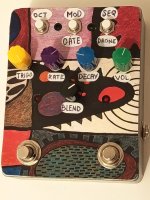
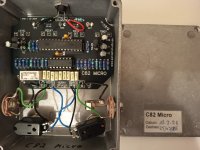
C82 is probably built around the AVR32DB28 chip.
It features a square wave fuzz and a note generator.
Both can be used separately or blended together.
The note generator can be scaled on every guitar's notes we are currently playing, or we can record a note and have the note generator scaled only on that note.
For example we select the P1+P2 (fuzz+generator) channel with the Select footswitch, we play a D note with our guitar, an LED will light up showing the device received and sampled the signal.
Then we select the P1 channel (fuzz), hold the SEQ push button for a second (which turns the drone mod on), and the D note is now the base note for the patterns generated by the sequencer.
The drone mod activated by holding the SEQ control allows the P2 channel to be activated when the P1 channel (fuzz only) is selected.
So now we can play various notes on the guitar, but the sequencer generates patterns based on the D scale.
We can use the octaver and the modulations on the note generator only, and play with the clean fuzz channel mixed with patterns affected by modulation and octaver
There are 3 different kinds of scales : pentatonic, minor and blues, all sound very different from each other.
And a 4th setting with no scales which allows to use the sequencer channel as octaver only.
The octaver has 3 settings, octave up, octave down and unison.
There are 3 modulations available : vibrato, pwm (flanger i guess) and alternating octaves (which sounds very singular and musical in some 8-bit-video-game way).
The Decay control allows to set the length of the note generated by the sequencer channel.
We can separate every notes with a short decay, or get an infinite stream of notes with decay on high values.
And the speed control allows to simultaneously set the rate for the note generator and the modulations.
Very surprising effect, and it sounds great, just as shown in the youtube demo from Parasit studio.
We dont even need a guitar to use the note generator, if we plugg a cable in the input and touch the tip of the jack, it will trigger the sequencer.
There are some randomization going on with the sequencer patterns, so it doesn't feel like we only have 3 patterns, it's randomizing notes inside a scale and it never sounds the same.
All the controls can feel a bit complex to handle at first, but after a few trials it's quite simple to figure how everything works.
I didnt try hard enough to get the all 3mm leds perfectly inside their bezels, i guess we need to drill the holes a bit wider to avoid any resistance that could bend the led legs. Here there isnt enough room in the enclosure to try and push the top leds inside their plastic bezels with some small screwdriver.
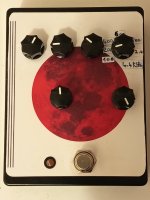
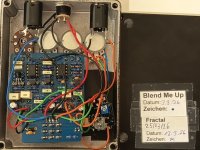
This one is much more straightforward, a simple overdrive with a built-in parametric equalizer
allowing to cut or boost up to 15dB in a range from 100 Hz to 4 KHz.
I added an extra blender circuit to have a wet/dry control, so i can use the circuit with a bass.
I've been tempted to build this circuit for years, but i used to tell myself : "i have enough tubescreamers based circuits"
The extra Blender idea helped me to move forward on this project and im not disappointed, it's a good working tool.
On their latest version of this circuit, Aion added a Tone control to restore some highs by acting on the fixed post-clipping trebble cut.
It's very helpful, they had a great idea there, it's working very well and significantly expands the range of usable sounds.
I'll probably have to find a new idea for the frequence control design, because these stickers arent looking so good, the ink doesnt really hold on them.
Last edited: