Post your other electrical/electronic projects...

Stickman393

Well-known member
Let's see em!

Honestly, this is really mostly an excuse for me to post this thing, but hell, strut your stuff.

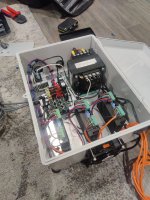
I built this thing as a fully enclosed linear power supply & microstep controllers for the stepper motors on my CNC.

LOTS of this stuff was salvaged from the trash at work. 500va 24v transformer into a 35 amp bridge rectifier, mounted on a heat sink pulled from a VFD. 15A breaker, Nine 4,700uF caps in parallel to smooth out the DC, no regulator because why bother, a pair of 1k 1/2 watt resistors in series across the + and - to slowly bleed the caps when power is disconnected.

I've got three 22/6 shielded cables going out to my CNC controller, and three 18/4 cables going out to my stepper motors.

Goddamn thing took me three days to build. By the end of it I got a little impatient and stopped caring quite so much about the details. Buttttttt...it's fukkin done, son.

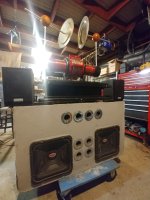
Now to build the 600 watt PS and controller enclosure for my spindle... IMG_20220125_171359_copy_1363x1817.jpg
 
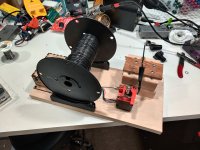
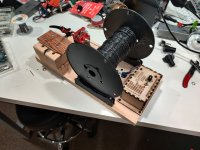
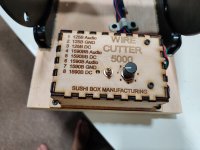
It's not pretty, but I'm proud of it. I always wished I was fancy enough to have cut-to-length wires ready to go for builds, so I designed this little machine to measure them for me. Basically it's an Arduino Uno with a custom motor controller shield on it, and I use a stepper motor with a 3D printer extruder to pull wire through to a certain length.

The original plan was to have a pair of wire cutters crudely attached to the base and attached to a second motor that would close them to cut the wire, but the stepper motors don't have enough power to cut the wire, so I still have to do the cutting part by hand, this just measures it for me.

I use the rotary to choose the length of the wire (per each application) then flip the switch, and it spits out that length of wire every 3 seconds (have to give me time to cut it). The wire spool sits on 3D printed rollers so it can spin freely, everything else is more or less crudely hot glued to a scrap of wood, apart from the box housing the arduino, which is laser cut plywood crudely screwed down. Nothing too glamorous, but saves me loads of time measuring length for each wire.

Also please disregard the mountain of garbage that is my bench.

236929934_577246997021322_663539167591271142_n.jpg 240376973_208751167937701_611911988637963711_n.jpg 240543576_370576671302836_5727853665402980104_n.jpg
 
It's not pretty, but I'm proud of it. I always wished I was fancy enough to have cut-to-length wires ready to go for builds, so I designed this little machine to measure them for me. Basically it's an Arduino Uno with a custom motor controller shield on it, and I use a stepper motor with a 3D printer extruder to pull wire through to a certain length.

The original plan was to have a pair of wire cutters crudely attached to the base and attached to a second motor that would close them to cut the wire, but the stepper motors don't have enough power to cut the wire, so I still have to do the cutting part by hand, this just measures it for me.

I use the rotary to choose the length of the wire (per each application) then flip the switch, and it spits out that length of wire every 3 seconds (have to give me time to cut it). The wire spool sits on 3D printed rollers so it can spin freely, everything else is more or less crudely hot glued to a scrap of wood, apart from the box housing the arduino, which is laser cut plywood crudely screwed down. Nothing too glamorous, but saves me loads of time measuring length for each wire.

Also please disregard the mountain of garbage that is my bench.

View attachment 22113View attachment 22114View attachment 22115
What? No adjustable stripper?
 
What? No adjustable stripper?
Alas no, that would have made it the absolute luxury tool. Push a button, grab something to eat, come back to a hundred pieces of precision cut and pre-stripped wires. I know more or less how I would do automatic stripping on something like this, but not sure how I could get it to work on both ends of the wire. Also I would still need to get a beefier motor to run the cutting part.
 
A few years ago we painted the interior of our house and each and every light switch and outlet looked like they had been smoking nonstop for decades and only drinking strong black coffee. They looked really awful, so I swapped out every one of those yellowed monsters and to my surprise, they all worked, even the three-way switches that had me confused and running to youtube to research. I got pretty good at it by the end...just at the point where I may never have to use the skill again! A good set of bullnose pliers and a solid working knowledge of the circuit breaker in the basement made the job much easier.

I'm also building a PLL Organ from Arcadia with my son and teaching him how to solder. It's been pretty straightforward except for sourcing a few connector parts. Nearly finished with it too. Here's a demo I found on Youtube:


My only gripe is not so much for me, but I woke early one morning in December and scrolled through Instagram and saw their pre-order come up. It was in the $30 range for the board and some parts. I jumped on it and they sold out immediately. Now, because of demand, they are charging nearly twice the price. Glad I pulled the trigger on this cool impulse buy!
 
Alas no, that would have made it the absolute luxury tool. Push a button, grab something to eat, come back to a hundred pieces of precision cut and pre-stripped wires. I know more or less how I would do automatic stripping on something like this, but not sure how I could get it to work on both ends of the wire. Also I would still need to get a beefier motor to run the cutting part.
Yours is brilliant as is, I just happened to have seen a video of one a few weeks back.

The other one I saw makes a shallow cut (to the bone) then another at the other end...then cuts. I guess it would be a matter placing 2 stops, and another function/measurement (casing thickness) for the shallow cut? I've never done any motor stuff though.
 
A few years ago we painted the interior of our house and each and every light switch and outlet looked like they had been smoking nonstop for decades and only drinking strong black coffee. They looked really awful, so I swapped out every one of those yellowed monsters and to my surprise, they all worked, even the three-way switches that had me confused and running to youtube to research. I got pretty good at it by the end...just at the point where I may never have to use the skill again! A good set of bullnose pliers and a solid working knowledge of the circuit breaker in the basement made the job much easier.

I'm also building a PLL Organ from Arcadia with my son and teaching him how to solder. It's been pretty straightforward except for sourcing a few connector parts. Nearly finished with it too. Here's a demo I found on Youtube:


My only gripe is not so much for me, but I woke early one morning in December and scrolled through Instagram and saw their pre-order come up. It was in the $30 range for the board and some parts. I jumped on it and they sold out immediately. Now, because of demand, they are charging nearly twice the price. Glad I pulled the trigger on this cool impulse buy!
That looks like a LOT of fun, both to build AND play. Nice!
 
Yours is brilliant as is, I just happened to have seen a video of one a few weeks back.

The other one I saw makes a shallow cut (to the bone) then another at the other end...then cuts. I guess it would be a matter placing 2 stops, and another function/measurement (casing thickness) for the shallow cut? I've never done any motor stuff though.
That's an interesting thought, strip before cutting. And actually if I just strip twice as much as I need then cut in the middle, it's already stripping both ends, it just strips the "outside" end of the next wire at the same time as the "inside" end of the current wire. Looks like I have some work to do for Wire Cutter 5001.

Stepper motors are easy because the amount the motor turns is directly determined by the electrical signal sent to it. I'm not super mechanically inclined, but if I can translate from mechanical to electrical then I can get things done.
 
A few years ago we painted the interior of our house and each and every light switch and outlet looked like they had been smoking nonstop for decades and only drinking strong black coffee. They looked really awful, so I swapped out every one of those yellowed monsters and to my surprise, they all worked, even the three-way switches that had me confused and running to youtube to research. I got pretty good at it by the end...just at the point where I may never have to use the skill again! A good set of bullnose pliers and a solid working knowledge of the circuit breaker in the basement made the job much easier.

I'm also building a PLL Organ from Arcadia with my son and teaching him how to solder. It's been pretty straightforward except for sourcing a few connector parts. Nearly finished with it too. Here's a demo I found on Youtube:


My only gripe is not so much for me, but I woke early one morning in December and scrolled through Instagram and saw their pre-order come up. It was in the $30 range for the board and some parts. I jumped on it and they sold out immediately. Now, because of demand, they are charging nearly twice the price. Glad I pulled the trigger on this cool impulse buy!
money.jpg

I gotta get me one of those when they are back in stock. Thanks for sharing! @SYLV9ST9R might dig this as well.
 
The original plan was to have a pair of wire cutters crudely attached to the base and attached to a second motor that would close them to cut the wire, but the stepper motors don't have enough power to cut the wire, so I still have to do the cutting part by hand, this just measures it for me.

Have you considered attaching a planetary gearbox to the stepper motor? You'd be able to run that thing balls-out and trade all that speed for torque. Hell, even a cheap reversible gearbox motor might do the trick...

I suppose it also depends on the blade geometry. But as Archimedes said: hand me a lever, and a pivot on which to place it, or the bunny gets it.
 
Did a fun project tonight and remembered this thread, so it's getting a bump.

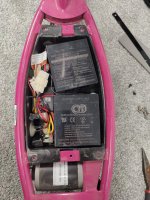
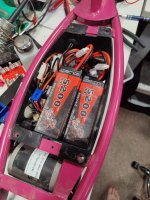
We got our oldest daughter an electric scooter last fall and she loves the look and feel, and it's the perfect size for her, but she complained it felt slow. With one of my previous "fun dad" projects I discovered that most electric motors can be overvolted a bit to get additional speed at the expense of lifespan, so I figured if I overvolted it a little bit it should give her plenty of speed and the motor would probably die by the time she outgrew the scooter anyway. Pulled out the 2x 12V lead acid batteries and put in 4x 7.4V LiPo batteries. Enough juice to run the motor faster, but not enough to fry the control board.

Absolutely night and day difference. Way more get-up-and-go and a higher max speed, and that's with an adult on it. I'll have my daughter try it tomorrow, she weighs less than half what I do, so she's going to freaking fly. Next step is going to be wiring up the charge port so I can charge the batteries without taking apart the scooter, parts for that should be here wednesday.

IMG_20220321_210828.jpg
IMG_20220321_221549.jpg
 
@vigilante398 does it have a low voltage shutoff or an alarm? (To prevent a lipo fire)
The controller has a shutoff, but I would be more comfortable designing my own controller for it so I'm more confident in it. It's probably going to happen anyway as my daughter tried it this morning and she likes the speed, but she still has some notes. The main one is that the stock controller has a safety feature where you need to manually push the scooter up to 4-5 mph before the motor kicks on, and she doesn't like how much effort that takes. So a new controller without that feature so it can take off from a standstill, plus a battery level indicator and a custom low-voltage shutoff are things I plan to add in the next month or so.

I pulled the fire extinguisher from my workshop to the garage for the testing, I know the risks of LiPo :P
 
Back
Top