Power Filter Section

zelcanada

Member
Hello All,

As I continue to grow my skills in pedal design, I have a question about the power filtering section. I understand it's importance for protecting the circuit from reverse polarity and reducing noise (...?), however I seem to see a lot of different schematics in the power filtering section of a pedal schematic. I'm starting to get lost a little... Is there a "best practice" for this? Do certain kinds of pedals "prefer" certain kind of power filtering?
Any advice would be greatly appreciated!
Thanks!
 
(I realize you're focusing more on filtering than polarity protection, but I had this ready to post in another section)

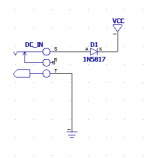
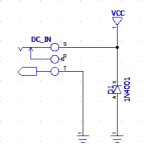
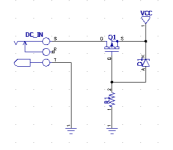
The three most common methods of polarity protection I see are:

Series - The diode is in series with the load/circuit and blocks any reverse voltage/current. No current flows so no damage is done to the circuit, it simply doesn't work until the correct polarity is applied. The negative is that the series diode drops a small amount of voltage (forward voltage of the diode). This is generally not an issue. A schottky diode can be used to reduce the voltage drop, however these typically have a lower current capability and reverse breakdown voltage. (It takes less current / voltage to damage it)
1771420119113.png

Parallel / Shunt (Diode to ground)- The circuit receives the full applied voltage, no loss of voltage (forward voltage drop) across the diode. If reverse polarity is applied the diode typically shorts to ground, making the pedal effectively "broken" to the average consumer who can't replace it.

1771419940891.png

MOSFET - Similar to series, but a MOSFET is used instead due to it's lower forward voltage drop at the cost of a slightly more complex/expensive circuit.

1771420776490.png


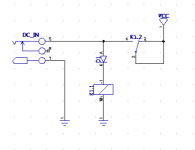
A much less common method is to use a relay. I've never seen this done in a pedal, it's more of an industrial / consumer electronics thing. I've seen this done in a few arcade / pinball machines over the years as well.

Relay - Higher current consumption but no voltage drop. The relay only applies power to the circuit if the proper polarity is applied. D1 protects the relay coil from reverse current.

1771420550854.png
 
Filtering depends on the expected power supply, and requirements of the circuit.

A DC powered, low current, purely analog circuit typically requires less filtering than a circuit that consumes high current or has digital circuitry.

Most modern power supplies already provide a fair amount of filtering ahead of the pedal.


(Contractors just showed up, I'll elaborate a bit more shortly unless someone beats me to it)
 
A much less common method is to use a relay. I've never seen this done in a pedal, it's more of an industrial / consumer electronics thing. I've seen this done in a few arcade / pinball machines over the years as well.

Relay - Higher current consumption but no voltage drop. The relay only applies power to the circuit if the proper polarity is applied. D1 protects the relay coil from reverse current.

View attachment 111610
Effectrode is the only pedal company I'm aware of that uses a relay for polarity protection.
 
Filtering depends on the expected power supply, and requirements of the circuit.

A DC powered, low current, purely analog circuit typically requires less filtering than a circuit that consumes high current or has digital circuitry.

Most modern power supplies already provide a fair amount of filtering ahead of the pedal.


(Contractors just showed up, I'll elaborate a bit more shortly unless someone beats me to it)
Many designs I've seen have a 100uf electrolytic cap placed from the pos rail to ground. Is this called a filter cap or a bypass cap? (Trying to clarify terminology)

Sometimes there is also a 100nf film or MLCC in parallel with the 100uf, and sometimes the electrolytic value is smaller, like 47uF, or larger, like 220uF.

One circuit I'm tracing (deadendfx mangel wurzel) places an additional 100nf cap right next to the 9v pin of an op amp. I've read placing the filter cap very close to the op amp is best, but is it overkill to have two 100nf filter caps, for example, one at the power input and another at the op amp?

It seems to me that the variance in values from one filter cap to another is up to the electronic background of the designer rather than a hard fast set of rules. Is this true?
 
Filtering at the opamp is generally considered a best practice. But, it's a pedal not a medical device/aviation equipment etc.
Added filtering at the opamp would be good in circuits with say clock signals. The considerations made in a TS clone vs a BBD delay can/should be different. A sloppy layout and minimal filtering in a TS will likely work. A sloppy bbd layout will likely yield clock noise or oscilations in the audio.
The caps at the input do 2 things,
1)filter hf noise to ground
2)smoothe DC ripple
 
Back
Top