

Ginsly
Well-known member
Like Fuzzrites? Well, here's a new one: The Pyrite Germanium Fuzz by Julius Audio (pcb design by @PedalBuilder).
It kinda flew under the radar, but in 2024 Ed Sanner - at 88 years old - made a couple small batches of his first Ge Fuzzrite. He reconfigured things to accommodate a third germanium transistor since the ones he was working with had super low gain. He did it in a way that not only boosted the volume but thickened the sound to create a more aggressive Fuzzrite. I like the 3xSi Merkin and Tequila Buzz well enough, but I have to say, this really has a special edge to it.
Do I know definitively that this is a clone of Ed's 3xGe Fuzzrite? Nope! I've never held the pedal in my hands, and there's really only one audio sample to reference. Some helpful owners shared photos of the board and I did a lot of zooming and brightening to see resistor bands and whatnot. I built a couple prototypes.
It worked, and was unmistakably a Fuzzrite! I didn't know what potentiometers were used, so I chose B50k for Volume and C500K for Depth when building a prototype. I actually prefer Volume at 50k for lower Depth positions, but you certainly lose some overall volume compared to 500k. It's a trade off. I eventually deduced that both controls were B500k (although I recommend C500k for Depth).
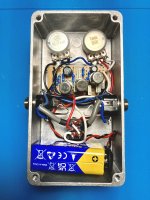
Speaking of the prototypes, I had never done a stripboard layout from scratch. @BuddytheReow's articles were a great resource, and although it's not quite as compact as something Anders of DBL might cook up it fit comfortably in a 1590b. No LED, battery only - just like Ed's.

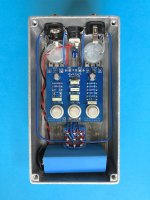
I love stripboard but I had the idea that this would make a nice pcb. Plus, some fellow musicians want em and working with a pcb is much easier than cutting vero. I'm not quite at the point of laying out pcbs, but I wanted to get this out there sooner than later. I reached out to @PedalBuilder and luckily he was enthusiastic about it! He doesn't mess around, so that told me this was probably worthwhile. The original circuit was positive ground and we discussed the option of including an inverter chip; he cleverly found a way to make this work on a normal power supply without an IC, though. Pretty impressive. Power filtering and a protection diode were also added.
So how does it sound? Like a hot-rodded germanium Fuzzrite, pretty much! Although the three MP40A (or similar) transistors are super low gain (20-40 hFE, about the same leakage), they cascade in a way that can create a more compressed, aggressive version of the familiar Ge Fuzzrite filth. The "middle" Depth position has such nasty texture and fully counterclockwise gives you a pleasantly low-gain fuzz tone. Full-up is pretty wild stuff! Here's a super quick demo (cab sim pedal>interface) of Full Depth/Medium Depth/Lowest Depth:
View attachment JuliusAudioPyriteHighMedLow.mp3
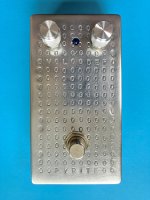
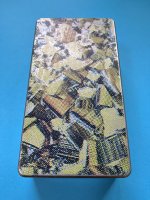
Here's Pyrite #1. @PedalBuilder's board layout is excellent as always, and is a breeze to work with. Apparently hammering the ever loving snot of out an enclosure will uh, leave its mark - even with bench blocks! Still, I was happy with the raw industrial look. Maybe I'll play with some enamel fills next time. As a printmaker I'm also toying with ways to screen print some enclosures without gassing myself using One Shot and mineral spirits... I did a four-color CMYK separation of pyrite and tested it on an enclosure with some textile inks I had. I chose big ol halftone dots because hey, why hide it? Gonna clear coat it this weekend and see how durable it is. Work in progress.
Seemed like it was time to choose a "building name", so Julius Audio it is. I called it the Pyrite since it's not a real Fuzzrite, but a reasonable facsimile. I plan on building some more and trying some excessive crap (I actually did a 1590b version that included a Bias pot on Q3 and a switchable resistor across the Volume pot that helped thin out lowest Depth to my liking...).
That being said, I have some boards available if you're interested - just send me a message! This is a great opportunity to use those really low gain germanium transistors that were destined for Diode Duty! It's a super easy build and @Robert has MP40A's in ye olde shoppe. PNP Silicon will work in this too, but takes on a bit of a different character - when initially breadboarding I even tried some ~50hFE Si power transistors that sounded pretty nice.
Huge huge thanks to @PedalBuilder for collaborating with me on this, and it was a pleasure every step of the way. He has a calming, reassuring demeanor that helped me understand things when I started building just a couple years ago, and it was very cool to have reached a point where we could actually work on something together.
Enjoy!
It kinda flew under the radar, but in 2024 Ed Sanner - at 88 years old - made a couple small batches of his first Ge Fuzzrite. He reconfigured things to accommodate a third germanium transistor since the ones he was working with had super low gain. He did it in a way that not only boosted the volume but thickened the sound to create a more aggressive Fuzzrite. I like the 3xSi Merkin and Tequila Buzz well enough, but I have to say, this really has a special edge to it.
Do I know definitively that this is a clone of Ed's 3xGe Fuzzrite? Nope! I've never held the pedal in my hands, and there's really only one audio sample to reference. Some helpful owners shared photos of the board and I did a lot of zooming and brightening to see resistor bands and whatnot. I built a couple prototypes.
It worked, and was unmistakably a Fuzzrite! I didn't know what potentiometers were used, so I chose B50k for Volume and C500K for Depth when building a prototype. I actually prefer Volume at 50k for lower Depth positions, but you certainly lose some overall volume compared to 500k. It's a trade off. I eventually deduced that both controls were B500k (although I recommend C500k for Depth).
Speaking of the prototypes, I had never done a stripboard layout from scratch. @BuddytheReow's articles were a great resource, and although it's not quite as compact as something Anders of DBL might cook up it fit comfortably in a 1590b. No LED, battery only - just like Ed's.
I love stripboard but I had the idea that this would make a nice pcb. Plus, some fellow musicians want em and working with a pcb is much easier than cutting vero. I'm not quite at the point of laying out pcbs, but I wanted to get this out there sooner than later. I reached out to @PedalBuilder and luckily he was enthusiastic about it! He doesn't mess around, so that told me this was probably worthwhile. The original circuit was positive ground and we discussed the option of including an inverter chip; he cleverly found a way to make this work on a normal power supply without an IC, though. Pretty impressive. Power filtering and a protection diode were also added.
So how does it sound? Like a hot-rodded germanium Fuzzrite, pretty much! Although the three MP40A (or similar) transistors are super low gain (20-40 hFE, about the same leakage), they cascade in a way that can create a more compressed, aggressive version of the familiar Ge Fuzzrite filth. The "middle" Depth position has such nasty texture and fully counterclockwise gives you a pleasantly low-gain fuzz tone. Full-up is pretty wild stuff! Here's a super quick demo (cab sim pedal>interface) of Full Depth/Medium Depth/Lowest Depth:
View attachment JuliusAudioPyriteHighMedLow.mp3
Here's Pyrite #1. @PedalBuilder's board layout is excellent as always, and is a breeze to work with. Apparently hammering the ever loving snot of out an enclosure will uh, leave its mark - even with bench blocks! Still, I was happy with the raw industrial look. Maybe I'll play with some enamel fills next time. As a printmaker I'm also toying with ways to screen print some enclosures without gassing myself using One Shot and mineral spirits... I did a four-color CMYK separation of pyrite and tested it on an enclosure with some textile inks I had. I chose big ol halftone dots because hey, why hide it? Gonna clear coat it this weekend and see how durable it is. Work in progress.
Seemed like it was time to choose a "building name", so Julius Audio it is. I called it the Pyrite since it's not a real Fuzzrite, but a reasonable facsimile. I plan on building some more and trying some excessive crap (I actually did a 1590b version that included a Bias pot on Q3 and a switchable resistor across the Volume pot that helped thin out lowest Depth to my liking...).
That being said, I have some boards available if you're interested - just send me a message! This is a great opportunity to use those really low gain germanium transistors that were destined for Diode Duty! It's a super easy build and @Robert has MP40A's in ye olde shoppe. PNP Silicon will work in this too, but takes on a bit of a different character - when initially breadboarding I even tried some ~50hFE Si power transistors that sounded pretty nice.
Huge huge thanks to @PedalBuilder for collaborating with me on this, and it was a pleasure every step of the way. He has a calming, reassuring demeanor that helped me understand things when I started building just a couple years ago, and it was very cool to have reached a point where we could actually work on something together.
Enjoy!
Last edited:


