Question about building a subwoofer

eh là bas ma

Well-known member
Hello,

Every year I go work in the fields during summer, at the same place. We are 50 or 80 people, camping for 3 weeks near an old ruined house, far from our bosses and far from any neighbors. We often play loud music with cheap amps.

I am considering building a subwoofer for this place. I am not sure how this is done...

I know I need a speaker, large enough to be effective in open spaces. This one with 18'' would probably be fine :
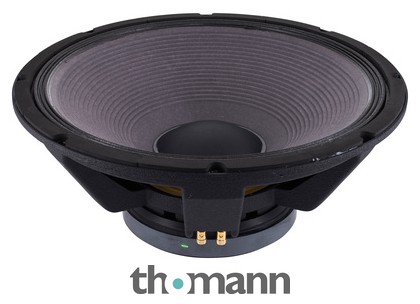

I see 8 ohm impedance, like many amps. Would it be as simple as finding a cabinet large enough, connecting this big speaker to a preamp, (for exemple salvaged from an old bass combo amp with 8 ohm impedance) then connecting the preamp to a wall outlet ?

I see 500W on this speaker, does it mean that I can use any preamp device, as long as it is 8 ohm impedance and 500W power rating or anywhere under 500W power rating ?

Could it be as simple as this ? Am i missing something ?
 
Last edited:
Do you want this as a full range speaker, (bass heavy), or as a sub woofer? If as a sub woofer, you’ll want a low pass filter in front of it. That speaker should be pretty rolled off by the 1.5KHz upper frequency limit anyway, so the LP filter may not matter that much. I once added a pair of similar speakers to a theaters sound system so we could have better thunder effects during a storm scene; I’m pretty sure I just ran them without a filter, but all I wanted from them was deep rumble, not music.
 
PS—what a lovely tradition! It sounds pretty ideal!
I like this place, but it's not always easy. We work all day in the trees, picking apricots, it gets hot and many of us aren't reasonable enough to go to sleep early in the evening to restore some strength... It's ideal because we are isolated, our employers aren't around.
Do you want this as a full range speaker, (bass heavy), or as a sub woofer? If as a sub woofer, you’ll want a low pass filter in front of it. That speaker should be pretty rolled off by the 1.5KHz upper frequency limit anyway, so the LP filter may not matter that much. I once added a pair of similar speakers to a theaters sound system so we could have better thunder effects during a storm scene; I’m pretty sure I just ran them without a filter, but all I wanted from them was deep rumble, not music.
I guess it won't hurt to have a full range speaker that can also be really effective on low frequencies.

To be clear, and sorry if my questions are really basic : a diy subwoofer (or a full range speaker cabinet heavy on bass) can just be a speaker connected with 2 wires to a preamp, which must have the same impedance and similar or inferior watt numbers ? The electric power comes from the preamp i choose, no need to build anything else ?
There isn't any dedicated power section for the speaker itself, it can be a pretty simple job ?
 
Last edited:
I like this place, but it's not always easy. We work all day in the trees, picking apricots, it gets hot and many of us aren't reasonable enough to go to sleep early in the evening to restore some strength...

I guess it won't hurt to have a full range speaker that can also be really effective on low frequencies.

To be clear, and sorry if my questions are really basic : a diy subwoofer can just be a speaker connected with 2 wires to a preamp, which must have the same impedance and similar or inferior watt numbers ? The electric power comes from the preamp i choose, no need to build anything else ?
There isn't any dedicated power section for the speaker itself ?
Subwoofers often come with a built in power amp, but otherwise a preamp will barely drive it at all, at best. You'll typically need an integrated amp (preamp plus power amp in one box), and another speaker for the rest of the audio spectrum as a suboofer by itself sounds extremely dull and undefined. Then a crossover and a separate power amp for the subwoofer.
 
Subwoofers often come with a built in power amp, but otherwise a preamp will barely drive it at all, at best. You'll typically need an integrated amp (preamp plus power amp in one box), and another speaker for the rest of the audio spectrum as a suboofer by itself sounds extremely dull and undefined. Then a crossover and a separate power amp for the subwoofer.
I knew it couldn't be so easy...

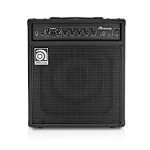
So i can forget about salvaging some preamp section from an old combo amplifier ? There isn't any power amp section in the usual combo amplifier ?

index.jpg
Edit : Maybe i am confused with the words : in this exemple above, is it an integrated preamp above the speaker ? That's what i intended to salvage.

I thought it was a question of wattage : a 50W preamp won't work great on a 500W speaker, but maybe some 200W preamp could be enough for a small place outdoor ?

I understand that some other speaker cabinet around 12'' will be needed to have more precision. What is a "crossover" ?
 
Last edited:
I knew it couldn't be so easy...

So i can forget about salvaging some preamp section from an old combo amplifier ? There isn't any power amp section in the usual combo amplifier ?

View attachment 50508
Edit : Maybe i am confused with the words : in this exemple above, is it an integrated preamp above the speaker ? That's what i intended to salvage.

I thought it was a question of wattage : a 50W preamp won't work great on a 500W speaker, but maybe some 200W preamp could be enough for a small place outdoor ?

I understand that some other speaker cabinet around 12'' will be needed to have more precision. What is a "crossover" ?
Preamp never put out more than a few watts, usually far less. That's an integrated amp paired with a speaker in one box, we'd call that a combo amp.

No worries on the language thing. I deal with a Brazilian luthier and his Brazilian-Japanese wife a lot, we always manage to figure things out soon enough.;)


Preamp never put out more than a few watts, usually far less. That's an integrated amp paired with a speaker in one box, we'd call that a combo amp.
Ok, so i meant integrated amp instead of preamp from the start.

Looks like i will be able to use some salvaged part to pair it with the 18'' speaker, after all.

About the crossover, i guess i can go around this with 2 integrated amps paired with one 18" and one 12" speaker, as two "diy"combo amps, use a simple splitter and set the EQ on both integrated amps according to the speaker size (cut the bass on the 12" speaker cabinet, for exemple) ?
 
Last edited:
Ok, so i meant integrated amp instead of preamp from the start.

Looks like i will be able to use some salvaged part to pair it with the 18'' speaker, after all.

About the crossover, i guess i can go around this with 2 integrated amps paired with one 18" and one 12" speaker, as two "diy"combo amps, use a simple splitter and set the EQ on both integrated amps according to the speaker size ?
Yes, this will work OK but something with a 12 and a tweeter will probably sound better. You could probably also build a simple crossover yourself, someone was asking about that a few days ago.
 
I thought it was a question of wattage : a 50W preamp won't work great on a 500W speaker, but maybe some 200W preamp could be enough for a small place outdoor ?
The 500w rating on a speaker refers to its maximum power as a constant input, over 2000 watts might damage it. A 50 watt amp may drive it just fine. (Depends a lot on the amp, a typical “50 watt” tube based power amp would be pretty loud.)

The specification that would be helpful (and I don’t see it on the Thomann site for this) would be the efficiency, typically given as decibels at 1 meter with 1 watt input. To be honest, this spec does get affected a bit by the box the speaker is mounted in. And ideally, you’d want a pretty big box for this, if you want to maximize the output. (If you’re planning on building a box, there are some other specs that would help idealize the volume, like the speakers resonant frequencies. I can either send you links, or help you figure out dimensions for a build, if needed.) (And there are ways to make a smaller box seem much bigger to a speaker.)
 
if you want to maximize the output.
I don't plan on hosting huge free parties, or play in large aeras like stadiums with this project. It would be nice to have something effective precise and powerful enough to suit the needs of small non-commercial bands, playing for 100 or 200 people maximum, located in a clearing on a hill, surrounded by trees.

Our employers have already agreed to give us a bit of money, to invite and pay two or three small bands, and create a small local event at our camp, with a few concerts.

Just having a subwoofer available next year would be a good start. We can always find some equipment elsewhere, and build some other speaker cabinets for high frequencies later, in two years.
 
I can either send you links, or help you figure out dimensions for a build, if needed.) (And there are ways to make a smaller box seem much bigger to a speaker.)
Thanks !

I found some diy enclosure project matching this particular speaker from thomann :


I guess it covers the enclosure subject correctly ?
 
Thanks !

I found some diy enclosure project matching this particular speaker from thomann :


I guess it covers the enclosure subject correctly ?
Yes. The one change I would make to either of the options would be to add a good bit more bracing than they’ve done, certainly on the back panel if no where else—the idea is to make the box have no dominant panel frequency, which will sing along with the speaker, reinforcing several notes over others. If you can build it from void free plywood that is best. Roughly figure out the amount of volume your extra bracing takes up, and add that volume back by slightly adding to the depth of the box. When it’s built, and up and running, experiment with how it’s placed; outdoors can really suck up sound. My gut tells me that having reflective surfaces near it may acoustically amplify it some.
 
Yes. The one change I would make to either of the options would be to add a good bit more bracing than they’ve done, certainly on the back panel if no where else—the idea is to make the box have no dominant panel frequency, which will sing along with the speaker, reinforcing several notes over others. If you can build it from void free plywood that is best. Roughly figure out the amount of volume your extra bracing takes up, and add that volume back by slightly adding to the depth of the box. When it’s built, and up and running, experiment with how it’s placed; outdoors can really suck up sound. My gut tells me that having reflective surfaces near it may acoustically amplify it some.
Yep, hence the utility of band shells. You can look up the specifics of half and quarter space loading, but the gist is that a two wall corner on the floor greatly enhaces low frequency projection efficiency. We don’t always want that inside, but it can often be a huge help outdoors.
 
Back
Top