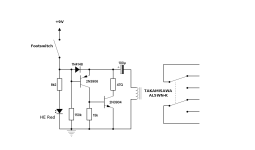
Most relay bypass designs draw lots of current. A few years ago, I decided to experiment with small bistable relays. These have a mechanical latching system, so just require a brief pulse to change state. They're available in dual coil (one for "set" and the other for "reset") or in single coil (a pulse in one direction "sets", and in the other, "resets"). After some experimentation, I came up with this simple circuit. It allowed me to use up the huge stash of "Carling" footswitches I'd built up when converting Wah Pedals (especially "Cry Baby" types) to "True Bypass". The current drain is minimal (predominated by the consumption of the LED!), and the relay coil is given a pulse one way when the switch is closed, and back again when the switch is opened. Bear in mind that the specified relay must be used (or another one with very similar specifications) and the coil voltage should be 5V (even though the supply is 9V), since the "set" and "reset" pulses are both brief and small, since they are created by charging and discharging the 100µ capacitor.
This was the simplest circuit I could come up with, and it's worked reliably in many pedals over the years. The only minor problems I've had have been with very high gain pedals, where the switching pulse could get impressed on to the sensitive audio stages. That said, an effective or increased supply filtering capacitor cured the "pop" in every case.

This was the simplest circuit I could come up with, and it's worked reliably in many pedals over the years. The only minor problems I've had have been with very high gain pedals, where the switching pulse could get impressed on to the sensitive audio stages. That said, an effective or increased supply filtering capacitor cured the "pop" in every case.