genXslacker
Well-known member
I've exhausted the limits of my knowledge and fortitude, and I'm begging for help now. I'll try to be brief.
I boxed and then attempted to rock. No joy. Bypass mode, however, worked perfectly.
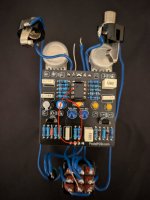
I pulled the lid and noticed the D2 clipping LED was solid on... and bright at that. D3 was solid off. Brief inspection and DMMing. No problems obvious to me.
Unboxed and re-flowed all solder joints. Tried it again, before boxing this time, and everything appeared and sounded great. D2 and D3 were varying dimly on when passing signal.
Re-boxed and was right back to the condition where D2 is solid on, D3 is off, and it's only passing sound in bypass.
Unboxed again, but it didn't change anything.
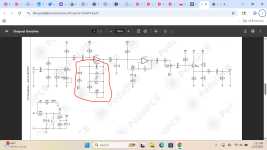
An audio probe indicates signal going in on IC1 pin 3, but not coming out of pins 1 or 2.
Voltages:
VREF (added in edit to post)
at positive leg of C101: 4.28V
D100
A) 9.22
K) 8.92
IC1
1) 3.624
2) 0.486 - 0.542
3) 4.168
4) 0.0
5) 3.741
6) 3.742
7) 3.745
8) 8.92
BS170
D) 7.23
G) 2.492
S) 1.62
2N3904
E) 2.933
B) 3.354
C) 8.92
D1
A) 0.0
K) 2.495
I've swapped out ICs and BS170s. I can't remember if I've swapped out the 2N3904, but it seems pretty far removed schematically from the IC and the clipping diodes in the feedback circuit, and anyway, things did work briefly after I re-flowed the joints. I did check the 2N3904 on a DCA75, and it indicated that it's functional.
It's a tight squeeze into a 1590B, and I'm thinking I might be knocking something loose when I box it up. But does anyone have a guess on what it might be based on the brain dump above? IC1 Pin 2 voltage seems suspect to me, but I know just enough about dual opamps to embarrass myself.
The next thing I can think of is to de-solder the gain pot to verify its resistance out of circuit, but I hate de-soldering PCB-mounted pots and I'm hoping some kind soul will spare me that agony by pointing out something that I've overlooked.
I boxed and then attempted to rock. No joy. Bypass mode, however, worked perfectly.
I pulled the lid and noticed the D2 clipping LED was solid on... and bright at that. D3 was solid off. Brief inspection and DMMing. No problems obvious to me.
Unboxed and re-flowed all solder joints. Tried it again, before boxing this time, and everything appeared and sounded great. D2 and D3 were varying dimly on when passing signal.
Re-boxed and was right back to the condition where D2 is solid on, D3 is off, and it's only passing sound in bypass.
Unboxed again, but it didn't change anything.
An audio probe indicates signal going in on IC1 pin 3, but not coming out of pins 1 or 2.
Voltages:
VREF (added in edit to post)
at positive leg of C101: 4.28V
D100
A) 9.22
K) 8.92
IC1
1) 3.624
2) 0.486 - 0.542
3) 4.168
4) 0.0
5) 3.741
6) 3.742
7) 3.745
8) 8.92
BS170
D) 7.23
G) 2.492
S) 1.62
2N3904
E) 2.933
B) 3.354
C) 8.92
D1
A) 0.0
K) 2.495
I've swapped out ICs and BS170s. I can't remember if I've swapped out the 2N3904, but it seems pretty far removed schematically from the IC and the clipping diodes in the feedback circuit, and anyway, things did work briefly after I re-flowed the joints. I did check the 2N3904 on a DCA75, and it indicated that it's functional.
It's a tight squeeze into a 1590B, and I'm thinking I might be knocking something loose when I box it up. But does anyone have a guess on what it might be based on the brain dump above? IC1 Pin 2 voltage seems suspect to me, but I know just enough about dual opamps to embarrass myself.
The next thing I can think of is to de-solder the gain pot to verify its resistance out of circuit, but I hate de-soldering PCB-mounted pots and I'm hoping some kind soul will spare me that agony by pointing out something that I've overlooked.
Last edited: