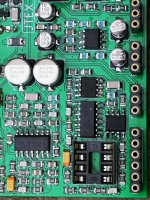
SMD. Not for me.

That's what I should use. I just ordered a few 0805 boards and am having second thoughts.

They look like tiny little bugs.

View attachment 53094
0805 to me is on the limit of what I can handle. With age my eyes are losing focus, so I need magnifying glasses to work with SMD components. But the problem with components smaller than 0805, like 0603 or 0402, is that they're impossible to handle and keep steady. They're too small! If they're not held by solder paste, sigh and you lose half the board...
I only plan to use smaller components if I do assembly too.

That looks like a nice board! Why the though-hole diodes? Are those germaniums or something? I use Schottkys for clipping. No germanium for me, no... :P
 
I watched a few youtube videos before I started SMD. Those really helped.

Process I settled on was: do all SMD first, apply copious amounts of flux to all the pads, let dry, add some solder to one pad (passinwind's suggestion), tack the part down while holding with tweezers, put solder on the iron tip, tack a second pad, put more solder on the iron tip, rake the rest of the pins (if it's an IC), clean and examine. Also, I use a magnifying glass for everything anyways, if you don't have one, that might be something to consider. As a bonus, it keeps the solder fumes out of your face.
 
Some SMD parts should only be soldered in a reflow oven. SMD ceramic caps are very fragile and can easily be wounded by a soldering iron. The circuit might work for a while, then mysteriously die. I'm ok with SMD ICs. The trick is to tape them down with kapton tape, then tack solder the corner pins. Remove the tape and use the drag method to solder the rest of the pins and clean up the corner pins. I'll use SMD transistors when there is no other option. For now, I have a sufficient stock of thru-hole JFETs.
 
Please, please, for the love of everything that is holy: if you're thinking seriously about working with SMD, get yourself a (used) Metcal MX series iron with the proper STTC tip. There is no going back after you use one. It feels like like holding a Sharpie pen, as opposed to a hair curler. All the big scary defense, satellite and aerospace companies, Raytheon, Harris etc, swear by them, and for good reason. They're expensive, but you can still get a used one for $100-150, and they last forever. Except for the tips, which have a very finite lifetime, so just reserve them for SMD, not general Weller-grade stuff.

Cry only once, and thank me later if you want.

Oh, and also get either a magnifying glass lamp, or some magnifying goggles. Or if you're really serious, a $300 or so, stereoscopic zoom microscope. You don't need more than 10x magnification. Usually somewhere between 3x-6x.

100% hand soldered with my Metcal (I'm 50+ and wear glasses) :
IMG_20210521_191814-edit-20230729202930.jpg
 
Last edited:
What model do you suggest looking at?
At home, I use an MX500 soldering station, which has dual handpiece outputs. Very nice, since you can switch back and forth between two handpieces with different tips in about a second. Not that it takes long to change just the tip on one handpiece, though. Maybe 5 seconds :) Which, BTW, is also about the time it takes for the tip to reach nominal temperature from a cold start.

At my day job, I have an even older STSS series. Those can be had pretty cheap on eBay. Single output. I used the exact same model 30 years ago when I was working for Harris Corp. They last absolutely forever.

Both MX and STSS series use the same handpiece and tips. The power supply is often sold separately from the handpiece and tips. It's quite special. The output is about 40 watts of RF, not DC. 14MHz, if memory serves? Inductive tip heating.

 
Back
Top