PedalBuilder
Well-known member
This is my first build in a while. I tried a few new things with this build, and I'm rather pleased with how it turned out. As with pretty much all of my builds, I couldn't have done this without some of the people on this forum. I'm a longtime fan of @andy-h-h's blog Vero-P2P blog. It's an amazing repository of information, including this compilation of Tone Bender Mk. III/IV variants and their component values. As with many vintage fuzz pedals, the component values changed frequently from one build or batch to another, sometimes for better, sometimes for worse. Using Andy's table, I played around with a bunch of variants, For this build, I went with the Sola Sound/D*A*M Mk. IV named "Son of the Green Bastard," and aimed for the bias measurements of the late 60's Sola Sound Tone Bender listed on the third tab of the spreadsheet.
Outside

Inside

This one has a couple interesting departures from most of the other Mk. III and IV Tone Benders. First, it uses a 15k collector resistor, rather than an 18k. The smaller Q3 collector resistor increases the prominence of the bass side of the tone control and bumps the output up a little. Second, it uses a 3n3 treble capacitor, which shifts the treble high pass filter down a bit and gives a nice upper midrange response. It's a nice middle ground between the D*A*M-style 220n/4n7 tone control and the 100n/2n2 that was commonly used in vintage units.
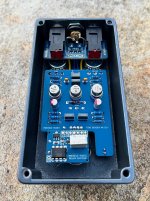
For transistors, I used a pair of Motorola MA287s for Q1 (hFE 77, leakage 23µA) and Q2 (hFE 97, leakage 43µA). For Q3, I used a really cool Motorola 2N526 that @jwin615 sent me as part of the 2025 Hit Me PIF (it's one of the transistors in its original styrofoam packaging towards the top left of the picture here). The diode is an OA1154 from the same PIF box. With VCC = 9.18, Q1/Q2 collector = 4.92v and Q3 collector = 2.47v.
The diode plays a critical role in biasing Q3. Other than the resistors (which should be kept at their original values), Q3 is biased by a combination three factors: (1) Q3's hFE; (2) Q3's leakage; and (3) the diode's leakage. Increasing the hFE of Q3 lowers Q3's collector voltage; decreasing the hFE of Q3 raises Q3's collector voltage. Increasing Q3's leakage raises Q3's collector voltage; decreasing Q3's leakage lowers Q3's collector voltage. Increasing the diode's leakage raises Q3's collector voltage; decreasing the diode's leakage lowers Q3's collector voltage. My approach to building a Mk. III/IV is to find a transistor that has leakage >150µA, and then try it out on the breadboard with different diodes and see what sounds best.
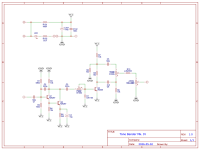
You might notice that even though the transistors are PNP, there isn't an LT1054 or similar voltage inverter. You would notice correctly. Voltage inverters are expensive and noisy. As it turns out, you can have a positive ground circuit that uses VCC as DC ground and ground as the negative supply rail. I've included a schematic below for reference. I've tested it daisy-chained to a bunch of other pedals, and it's significantly less noisy than my not-particularly-noisy Tone Bender Mk. III. The power supply filtering plays a big role here; you will get noise and oscillation if you don't have a big RC filter at the DC input; try 100Ω/100µF as a starting point, and increase the resistor, capacitor, or both as needed. This particular circuit draws about 870µA, so you can get aggressive with the resistor size if necessary, especially if you're using MOSFET-based polarity protection and haven't had to drop 200mV across a 1N5817.
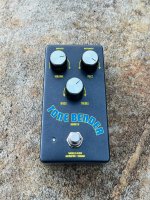
Other notes—the red and silver capacitors are aluminum polymer capacitors from LCSC; the enclosure is a 125B in Pearl Gray, UV printed by Tayda.
Schematic

Outside
Inside
This one has a couple interesting departures from most of the other Mk. III and IV Tone Benders. First, it uses a 15k collector resistor, rather than an 18k. The smaller Q3 collector resistor increases the prominence of the bass side of the tone control and bumps the output up a little. Second, it uses a 3n3 treble capacitor, which shifts the treble high pass filter down a bit and gives a nice upper midrange response. It's a nice middle ground between the D*A*M-style 220n/4n7 tone control and the 100n/2n2 that was commonly used in vintage units.
For transistors, I used a pair of Motorola MA287s for Q1 (hFE 77, leakage 23µA) and Q2 (hFE 97, leakage 43µA). For Q3, I used a really cool Motorola 2N526 that @jwin615 sent me as part of the 2025 Hit Me PIF (it's one of the transistors in its original styrofoam packaging towards the top left of the picture here). The diode is an OA1154 from the same PIF box. With VCC = 9.18, Q1/Q2 collector = 4.92v and Q3 collector = 2.47v.
The diode plays a critical role in biasing Q3. Other than the resistors (which should be kept at their original values), Q3 is biased by a combination three factors: (1) Q3's hFE; (2) Q3's leakage; and (3) the diode's leakage. Increasing the hFE of Q3 lowers Q3's collector voltage; decreasing the hFE of Q3 raises Q3's collector voltage. Increasing Q3's leakage raises Q3's collector voltage; decreasing Q3's leakage lowers Q3's collector voltage. Increasing the diode's leakage raises Q3's collector voltage; decreasing the diode's leakage lowers Q3's collector voltage. My approach to building a Mk. III/IV is to find a transistor that has leakage >150µA, and then try it out on the breadboard with different diodes and see what sounds best.
You might notice that even though the transistors are PNP, there isn't an LT1054 or similar voltage inverter. You would notice correctly. Voltage inverters are expensive and noisy. As it turns out, you can have a positive ground circuit that uses VCC as DC ground and ground as the negative supply rail. I've included a schematic below for reference. I've tested it daisy-chained to a bunch of other pedals, and it's significantly less noisy than my not-particularly-noisy Tone Bender Mk. III. The power supply filtering plays a big role here; you will get noise and oscillation if you don't have a big RC filter at the DC input; try 100Ω/100µF as a starting point, and increase the resistor, capacitor, or both as needed. This particular circuit draws about 870µA, so you can get aggressive with the resistor size if necessary, especially if you're using MOSFET-based polarity protection and haven't had to drop 200mV across a 1N5817.
Other notes—the red and silver capacitors are aluminum polymer capacitors from LCSC; the enclosure is a 125B in Pearl Gray, UV printed by Tayda.
Schematic