Some interesting info on film caps and orange drops (they have polarity)

That makes sense maybe the word should be "preference" as some of these film caps prefer to installed a certain way. @JTEX do you go out of your way to install the film caps like this? Im taking your guys word for it that this is just cork sniffing haha
 
That makes sense maybe the word should be "preference" as some of these film caps prefer to installed a certain way. @JTEX do you go out of your way to install the film caps like this? Im taking your guys word for it that this is just cork sniffing haha
Yes. I prefer to install them in such a way that their text is on the same side when looking at the board :)

Box-type film capacitors (WIMA etc), as well as ceramics, are non-inductive. They're made of multiple flat layers of conductive stuff and dielectric. It really does not matter which way they go in - in ANY application. Only old-style, wound foil, inductive caps (cylindrical, or dipped/orange drop etc) might have a "better" orientation (for minimal noise pickup) in some touchy applications.
 
Yes. I prefer to install them in such a way that their text is on the same side when looking at the board :)

Box-type film capacitors (WIMA etc), as well as ceramics, are non-inductive. They're made of multiple flat layers of conductive stuff and dielectric. It really does not matter which way they go in - in ANY application. Only old-style, wound foil, inductive caps (cylindrical, or dipped/orange drop etc) might have a "better" orientation (for minimal noise pickup) in some touchy applications.
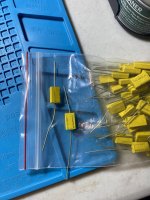
Great to know! I do the the same when it comes to text i prefer to have them facing in one direction. So im going to be starting a fuzz face build for on vero. I bought some old caps off ebay. They read 22nf im not sure if they have a preference but one leg is shorter than the other. With the shorter leg having a symbol that i can only relate to as the DC setting on the DMM. Im just confused a little lol


unnamed (13).jpg
 
I'm not an EE, but it does make a difference in amplifiers. The correct term is outer foil.

Here are a few useful quotes:

"Having the outside foil grounded tends to shunt off any such received signals to ground rather than allowing them to enter the working circuit in the form of unwanted and interfering noise."
"When properly installed, the capacitor will be oriented in such a manner that the outside foil lead is connected to the lowest impedance (usually the ground) side of the circuit."

Does it benefit pedals? Maybe.. Probably not unless you're building a higher gain device. It's definitely useful in guitar amps though! Here's a clip about readings on an oscilloscope:


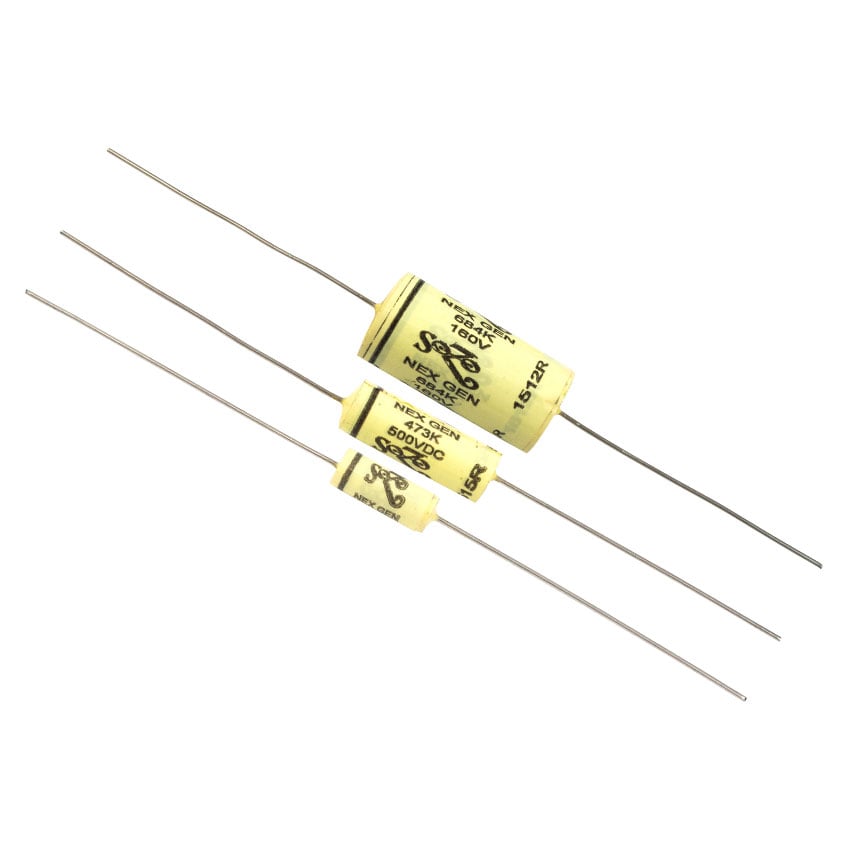
Some capacitors include a band, not for polarity, but to mark the outer foil, such as SoZo:
SoZo NexGen Yellow Mustard Caps - StewMac


Source for quotes: Nuts and Volts
 
My Amp-Sifu showed me this concept, we did a listen test and there was an audible difference under test conditions but for practical purposes ...
not so much. Some builders of Hi-Fi system will go to the trouble, he said.

Water displacement of a full bathtub in the ocean is negligible, but a drop of water can cause a bucket to overflow. 🤷‍♂️

I just have the writing on the cap follow whatever direction the silkscreen-labelling has — L>R and for PPCB boards bottom-to-top (so if you rotate the board 1/4 turn it'll read L>R).
 
"Polarity" is not the right word for this, I would streneously argue. It's similar to the markings on inductors or transformers indicating at which end the winding starts.
Agreed that "polarity" is not the right word. It does however have to do with indicating an impedance preference, where optimally the solid line side of such caps prefer to be connected so the lowest ground potential, impedance-wise. In my tenure dancing with electronics studies, I learned that the solid line marking on certain cap types is indeed where the cap film winding "starts". Also that the datasheets must be consulted to know whether the material winding "start" is in the center or on the outside of that specific manufacturer's capacitor. They are not consistent in their definitions of "start". And IIRC, the line should indicate the outer-most winding (outer layer) of the wound foil material.

Still, with regard to such markings on non-polarized/non-electrolytic caps and working with 99% of guitar & pedal circuits, I believe the orientation is of little to no consequence.
 
Last edited:
Still, with regard to such markings on non-polarized/non-electrolytic caps and working with 99% of guitar & pedal circuits, I believe the orientation is of little to no consequence.
You just reminded me that I once had to shield a larger value box film cap in a particularly delicate circuit. I used copper foil. But it had nothing to do with pedals, it was in a measurement interface where you could see some interference on the spectrum analysis down to - 110dB or so. I also had to completely shield the toroidal power transformer in mu metal, to get rid of some inductively coupled 60Hz at minus eleventy billion dB. Oh, the memories...
 
You just reminded me that I once had to shield a larger value box film cap in a particularly delicate circuit. I used copper foil. But it had nothing to do with pedals, it was in a measurement interface where you could see some interference on the spectrum analysis down to - 110dB or so. I also had to completely shield the toroidal power transformer in mu metal, to get rid of some inductively coupled 60Hz at minus eleventy billion dB. Oh, the memories...
Yeah, pedal building can actually get to the point of rocket science - even more so with higher power/frequency circuits. Sooooo many details depending on the circuit.
 
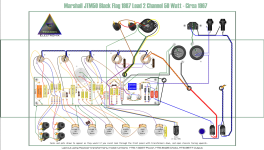
Super old knowledge. Easy to test by turning your amp on, plugging in a cord and hooking up a capacitor. Then get it next to a noisy power source like a neon light. One side will induct interference from that source, the other won't. The foil end is directed towards the part of the circuit with the least impedance. Like this layout I made for a Marshall 1987 JTM50, note the silver lines on the Mustard caps (I have a HUGE inventory of Mustards, huge. As in pounds.)

edited: You have to reverse the polarity on the cap. Hook one side to signal, test, then reverse and test again

1679772619300.png
 
Back
Top