Spatialist Reverb with momentary switch on dwell; any way to reduce speed of change?

jhalton

New member
I have a Spatialist Reverb, and I added the mods with a momentary switch on the dwell pot to max out the dwell. I love the effect, but I find that when the switch is let go, the dwell goes back to the pot setting too quick for my taste. I am wondering if there any way to make the transition from the maxed dwell (momentary switch on), to the regular dwell setting (switch off). If you understand what I am saying...

I don't have much electronics knowledge, so I am unsure if this is even possible. But I figured I'd throw the idea out there....
 
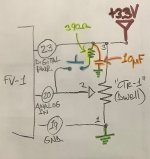
Sorry, I don't have a schematic. Basically, the normally open momentary switch is connected to pins 2 and 3 of the dwell pot (control 1 in the schematic). Based on others who did it, there is also a resistor (i used 390 ohm), mine is between pin 3 and one of the momentary pins. Hope that makes sense...
 

Attachments

  • previewImage.jpg
    previewImage.jpg
    115.4 KB · Views: 11
I will give this a go, but to clarify, when you say 'across', do i connect each lead of the cap to each lead of the resistor? Still learning all this stuff!
 
Should one side of the capacitor go to ground? Like so:
IMG_0611.jpeg

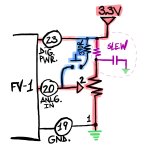
It looks like the Dwell pot/Momentary switch are controlling a 3.3V CV (Control Voltage) going to Pin 20: Analog In.
So the resistor/cap combo would act as a passive LPF, aka Slew Limiter, for that CV…
 
I will give this a go, but to clarify, when you say 'across', do i connect each lead of the cap to each lead of the resistor? Still learning all this stuff!
Should one side of the capacitor go to ground? Like so:
View attachment 114959

It looks like the Dwell pot/Momentary switch are controlling a 3.3V CV (Control Voltage) going to Pin 20: Analog In.
So the resistor/cap combo would act as a passive LPF, aka Slew Limiter, for that CV…
TBH, I'm not entirely sure if it should go to ground or directly across the resistor without testing it. And testing it will not hurt anything - whether it works or not. It's a shot in the dark, but should work in theory, one way or the other.
 
Okay, I have been playing around with this, and I think it is going to work. The transition time is not as long as I like, but I am going to try higher caps. Possibly a dumb question, can I use electrolytic caps (then connect + to resistor and - to ground)? They are the only ones I have at your suggested 10uf.

Also, this is harder than I thought to test! Its difficult to tell how much change there is between caps, as it is reverb, and a wash of sound regardless, plus the natural guitar decay. I need a break, I think I'm hearing things at this point...
 
Last edited:
Or should it be like this?
IMG_0612.jpeg

Because you’re trying to slew limit (slowly ramp) the voltage that is now going to the Pot Path when you open the Momentary Path… 🤔
 
Okay, I have been playing around with this, and I think it is going to work. The transition time is not as long as I like, but I am going to try higher caps. Possibly a dumb question, can I use electrolytic caps (then connect + to resistor and - to ground)? They are the only ones I have at your suggested 10uf.

Also, this is harder than I thought to test! Its difficult to tell how much change there is between caps, as it is reverb, and a wash of sound regardless, plus the natural guitar decay. I need a break, I think I'm hearing things at this point...
You an use an electrolytic cap. Just keep the + side pointed towards the more positive voltage direction.
Glad you're trying additional options. (y)
 
Back
Top