Stuff you wanted to know but were afraid to ask

Max 1 hour from start to Gerber files.
Thanks, I don't trust wiring 40 of these suckers (4pin and 9pin, which can be used via the same layout) by hand, so a daughterboard it's going to be. Now, let's see if I can find someone reading this, willing to do so for a fee. €30,- is the avarage hourly wage in the Netherlands these days. 😌
 
Last edited:
Isn’t this pretty much the same as running a parallel blender? I use one of those Sonicake Portals, before owned an OBNE Signal Blender, to mix my wet delays or whatever in. The Portal can be set to run in series or parallel.

Terribly sorry, I somehow missed this question.

A: NOPE!
It is NOT like running a parallel blender, which mixes two (or more) audio signals together — can be dry & wet (ex reverb/delay), fuzz & chorus, OD & Phaser, etc. I've known of at least one bass player who blends up to four parallel audio signals at a time.

↱FUZZ ⤵︎​
↱CHORUS ⤵︎​
DRY > Dry > > > > > > = FOUR-LAYER CAKE
↳REVERB >⤴︎​


In the scenario I describe in post #651, there is but one (1) audio path in series, and two identical side-chain dry paths whose sole function is to trigger something such as the envelope of a filter (manipulating the audio path) and/or the compressor.

So, as mentioned in my previous post, when the I have some heavy fuzz with the Quack Machine after...

...without side-chain, the fuzz compresses the signal which dulls the attack of the filter's quack (which can be a good thing for an excessively quacky circuit like the DOD FX25), but I PLAY BASS, which already dulls down the amount of perceived quack so ...

...with side-chain, I route the audio-signal through heavy fuzz, but the Quack Machine after it isn't being triggered by the heavily compressed-by-fuzz audio-signal and going "QUACK" it's getting the DRY-TRIGGER direct off my bass with all my playing dynamics unsquashed for a full-bandwidth broad-spectrum fuzzed out
QUACK!

SO it doesn't matter if I have in series OD > TREMOLO > EQ > FUZZ > QUACK > COMPRESSOR > OCTAVE-DOWN > PHASER-SYNTH... whatever the series-order, any effect that gets triggered is being triggered by the raw unaffected signal right off my bass.

 
Terribly sorry, I somehow missed this question.

A: NOPE!
It is NOT like running a parallel blender, which mixes two (or more) audio signals together — can be dry & wet (ex reverb/delay), fuzz & chorus, OD & Phaser, etc. I've known of at least one bass player who blends up to four parallel audio signals at a time.

↱FUZZ ⤵︎​
↱CHORUS ⤵︎​
DRY > Dry > > > > > > = FOUR-LAYER CAKE
↳REVERB >⤴︎​


In the scenario I describe in post #651, there is but one (1) audio path in series, and two identical side-chain dry paths whose sole function is to trigger something such as the envelope of a filter (manipulating the audio path) and/or the compressor.

So, as mentioned in my previous post, when the I have some heavy fuzz with the Quack Machine after...

...without side-chain, the fuzz compresses the signal which dulls the attack of the filter's quack (which can be a good thing for an excessively quacky circuit like the DOD FX25), but I PLAY BASS, which already dulls down the amount of perceived quack so ...

...with side-chain, I route the audio-signal through heavy fuzz, but the Quack Machine after it isn't being triggered by the heavily compressed-by-fuzz audio-signal and going "QUACK" it's getting the DRY-TRIGGER direct off my bass with all my playing dynamics unsquashed for a full-bandwidth broad-spectrum fuzzed out
QUACK!

SO it doesn't matter if I have in series OD > TREMOLO > EQ > FUZZ > QUACK > COMPRESSOR > OCTAVE-DOWN > PHASER-SYNTH... whatever the series-order, any effect that gets triggered is being triggered by the raw unaffected signal right off my bass.

A matrix mixer? Pladask Matrice maybe there is a second hand mono version second hand.

 
Last edited:
A matrix mixer? Pladask Matrice maybe there is a second hand mono version second hand.


You could make that work either as a parallel mixer or as a single audio-path with side-chain triggers, but... for the latter, that's overkill and expensive for the basic splitting needed for a side-chain or two.

Even either of my two Klein Bottles is overkill.


All that's needed for the side-chain is Robert's SPLITTER, you don't even need his MIXER.

Maybe that's what people are missing here. There's no need for a MIXER, just need the SPLITTER to do the side-chain dealio.
 
Last edited:
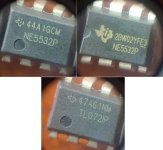
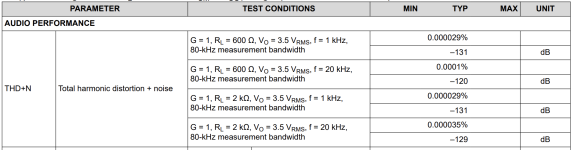
Is it safe to assume the NE5532 on the top right is from the new process that has the specs changed for the worse? Should I just hook one up to +/- 20V and see if the magic smoke comes out?
chips.jpg
I got a mixed bag of both kinds in a single order from a trustworthy supplier. TL072 is included for reference, from the same order. My guess is the date codes mean 2014 on the left (and TL072) and 2022 on the right but I'm not really sure. The pins look different on the one on the right. The TI website wasn't very helpful toward checking the date codes.

I'm really going to treasure the old style NE5532 since they're spec'd for 600 ohm loads.
 
Back
Top