Tau Pipe Phaser V1.02 Build (Joint Effort)

Cybercow

Well-known member
Considering there are a few of us who procured a Haible Tau Pipe Phaser PCB, thought to start a joint effort build thread.

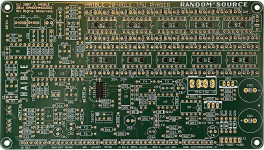
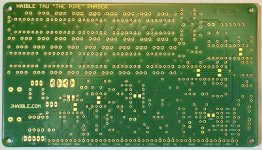
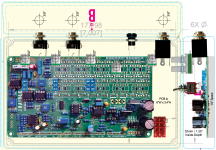
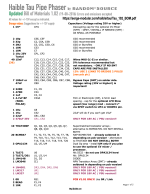
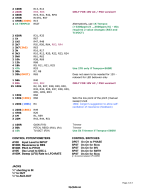
For starters, here are a coupla reference pics of the Haible Tau Pipe Phaser v 1.02 PCB.
(I got mine pre-loaded with the LM3046 chips & related caps installed.)
My intent is to build it out with the 18V AC supply and house it in a 1590DD as a foot pedal. While I will not be using the CV stuff, I'll still populate ALL the appropriate bits for potential expansion in the future.

The only difficult part to find was the 1K Tempco resistor. @tegendemuur was kind enough to point out that Banzai carries them. I have a couple (along with an orange paint 1590DD enclosure and a handful of 1N34A diodes) on the way from them. The order arrived in the US but is hung-up in Chicago for import clearance since the 26th. (Grrrrr.)

Tau_Phaser_PCB_v1.02_Front.png

Tau_Phaser_PCB_v1.02_Back.jpg
(I added the silkscreen text by editing the image and carefully identifying each group and connection point. The component IDs were set to help identify the actual "R6" location as "R15H1".)
 
Last edited:
Following the BOM for V1.02, I see there is an "R6" @ 2K7 Ω and "R23" @ 3K3 referenced; but I am unable to locate those two designated footprints on the PCB.

There is also no "R5" in the BOM or on the PCB.

I've reached out to Random-Source and Serge-Modular for advice. Meanwhile, any thoughts?
 
Last edited:
I wonder if both r5 and r6 were removed in a previous revision. I am going to start populating my Tau Phaser along with the Triple Chorus PCB. I haven't soldered anything in yet but I’m slowly getting resistors and diodes populated.
 
I wonder if both r5 and r6 were removed in a previous revision. I am going to start populating my Tau Phaser along with the Triple Chorus PCB. I haven't soldered anything in yet but I’m slowly getting resistors and diodes populated.
I have to say how much I admire your collective enterprise taking on such a daunting circuit. Wishing you every success with it.
 
When I am home I'll share pictures of my NOS board, this way we can eliminate the oddities and see where certain components in the BOM belong, as I believe the one available is an imperfect version, containing items from the previous version. It literally says you can't trust the BOM, which is why a group effort like this is appreciated!!
 
Last edited:
To paraphrase Twin Peaks, the resistors are not what they seem. 😅 On your board, the trimmer all the way on the left.
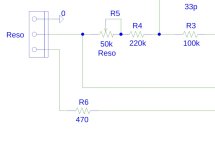
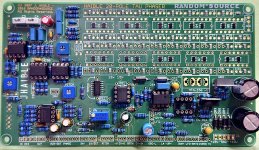
View attachment 114544

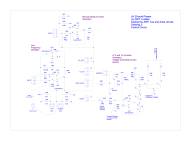
All schematics here: http://jhaible.com/legacy/tau/jh_tau.html
Ah! Not what they seem indeed! My PCB does NOT show an "R5" or "R6" on silkscreen anywhere. And note too please that to my own embarrassment I located "R23" - stuffed neatly between to 8-pin DIPs; U2 & U3.

One the matter of "R6" @ 2K7 Ω, I was able to establish that "R6" is a typo on the v1.02 BOM and it is actually "R55" when following the schematic - as "R55" does not appear in the BOM.

I did a little tracing around that RESO trimpot to see what's up with "R6" @ 470Ω and it appears that "R6" on the schematic is actually "R15H1" on the PCB. So the BOM and schematic may need some small tweaks.

I'm hoping I can get this fired up on the first go around with no errors.
 
Last edited:
I've begun the population but still awaiting a few components. The tented resistors (RR5 & RR6) are series combo'd to make up the BOM's call for 240Ω. Will be replacing those with single 240Ω resistors when they arrive.)

Still deciding whether to use headers or wire things directly to the header groups. And if I'll implement the CV Mix control.

Tau_Phaser_PCB_v1.02_Populated_00.jpg
 
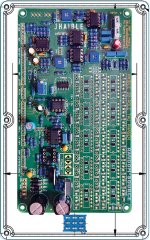
I've decided to build my Tau Pipe Phaser out as a stand-alone pedal. And after doing some gut-stuffing mockups in Photoshop, it seems this build is better suited to a 1590D rather than a 1590DD enclosure to house the 6" x 3.4" Tau PCB. The 1590DD's depth is at a mere 1.25" making it an extremely tight fit depth wise when considering the height profile of the finished board is almost 1" - even with carefully selected low-profile caps. The two TO-220 regulators are the real culprits tho. With the 1590D enclosure's 2" depth, there is sufficient room for board's components height and some control pots (which typically consume nearly ½" in depth).

I intend to mount the PCB to the inside of the enclosure's lid and use shielded wiring for ALL the signal path wiring. So while it may not be "pretty" on the inside, it will be solid. So I'm likely going to solder the off-board wiring directly to the PCB instead of using headers. And since the circuit has a a stereo output option, I'll be using a 4PDT stomp switch. (Wiring for that in near future post.) And seeing as this is just my first gut-stuffing mockup, I can see that there are a couple other options for mounting the PCB and associated hardware. So this initial consideration may change going forward.

Tau_Pipe_Test_Fit_Mockup_01.png
 
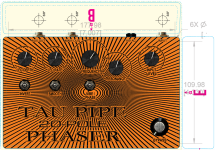
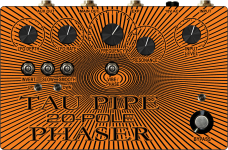
So after a few days of futzing with the build layout in Photoshop, I think I finally came up with a nice solution for stuffing everything into a Mammoth 1590DD enclosure that I was able to procure from Banzai - can't seem to find them anywhere else. Even Google searches do not show Mammoth enclosures anywhere. (The difference between a Mammoth 1590DD and a Hammond 1590DD is the the Mammoth uses only 4 screws - instead of 6 - to fix the lid. That opens up the center area of sides open with no screw-tang well.) Was able to save a few mm here and there with the omitted screw-tang wells and using 9mm pots.

I'm considering the addition of an expression jack to allow the Frequency range some foot action. There's room for one.

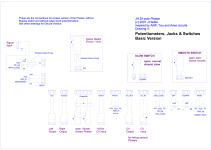
Tau_Phaser_PS_Mockup.png

The PCB will mounted to the inside of the lid with ¼" spacers screwed thru the plate.
Tau_Phaser_PS_Fit_Mockup.png

Still waiting on a few precious parts to finish populating the board.
 
Last edited:
Lovely pipe visual!

No slow switch for you? (LFO: slow mode option has been added (simply connect L* to UP2 or DOWN1 via SPDT switch).)

It's a regular complaint with phasers, that folks find that the LFO isn't going slow enough for them... Guess it's for people who don't really want to hear the effect but just kinda want to sense it in the background?

Banzai told me last week that their entire CA3046 stock has vanished (about 40 pieces). Could take over a month for them to send the backorder.
 
Last edited:
Slow switch? I've not seen a reference for one in any of the documentation collected so far. Where does it go? Would that involve C54?
 
Slow switch? I've not seen a reference for one in any of the documentation collected so far. Where does it go? Would that involve C54?
LFO: slow mode option has been added (simply connect L* to UP2 or DOWN1 via SPDT switch).

It's indeed that cap!
 
Thanks!

Observations . . .
There is a C54 (470nF) AND a C54A (4.7µF NP) and it appears that C54A is connected to C54 where it connects to pin 2 of U6. Ergo, shorting the "L" pad point to the common connection pads of UP2 or DWN1 will increase the capacitance value between pins 1 & 2 of U6 from 470nF to 5.17µF. Cool! (I had to trace those runs to be sure.)
 
Last edited:
Thanks!

Observations . . .
There is a C54 (470nF) AND a C54A (4.7µF NP) and it appears that C54A is connected to C54 where it connects to pin 2 of U6. Ergo, shorting the "L" pad point to the common connection pads of UP2 or DWN1 will increase the capacitance value between pins 1 & 2 of U6 from 470nF to 5.17µF. Cool! (I had to trace those runs to be sure.)
Thanks man, for the details on that slow switch, as it's the one thing I need to implement myself on the old board. Seems easy enough, putting the cap right on the switch and to the pin on U6.
 
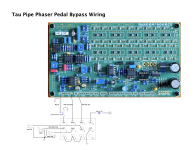
Getting down to the actual wiring of my Tau build. Because of the board's complexity and novelty, it's a tedious process for me. Meanwhile, here's a diagram for how I'll be doing the bypass switch - using a 4PDT stomp switch.

Tau Pipe Phaser True Bypass Switching Schematic.png
Because the input is mono, when bypassed, the output will also be mono for both the Main & Aux outputs.
Will probably need to add a voltage divider in front of the Bypass LED because I'm not too sure about using the +15V rail to supply that LED.

I'll have photos of the wiring layout soon.
 
Last edited:
Back
Top