
Chuck D. Bones
Circuit Wizard
According to the Danelectro website, this circuit was designed in 1966 by Steve Ridinger, a resident of Nichols Canyon in Hollywood Ca., who would later go on to found Foxx pedals. This circuit was created out of thin air, and it kinda looks it. Sounds great right outta the box. The only mod I came up with was to replace C8 with 15nF and make the MID switch ON/OFF/ON. C8 = 1nF does nothing audible. C8 = 15nF provides some treble cut when TONE is below noon, without the mid scoop. The two gain controls (FUZZ & DRIVE) provide a huge range of gain and tone. With FUZZ & DRIVE dimed and TONE at noon, the gain is around 70dB. There is not a lot of compression, due to the asymmetric clipping and large headroom. The way this circuit is biased, all three transistors are right at the edge of saturation. Low FUZZ & DRIVE settings produces a warm distortion with just a few harmonics. At higher settings, the clipping becomes more and more asymmetric, producing a large amount of high-order harmonics. Note decay is smooth, no sputtering or gating. I built this to see if it could approximate the Spirit in the Sky tone. It doesn't. But there are plenty of vintage-style distortion and fuzz tones available. The volume changes quite a bit as TONE is rotated.

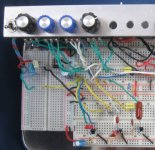
I subbed 2N5210 for Q2 & Q3. Q1 is bottom right, Q2 & Q3 are to the left of Q1.
Knobs (L-R): MiD sw - VOLUME - TONE - DRIVE - FUZZ

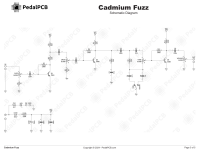
I subbed 2N5210 for Q2 & Q3. Q1 is bottom right, Q2 & Q3 are to the left of Q1.
Knobs (L-R): MiD sw - VOLUME - TONE - DRIVE - FUZZ