This Week on the Breadboard: The EHX Black Finger Sustainer

Chuck D. Bones

Circuit Wizard
Back when I was a young lad, my friend & roommate Richard bought a Black Finger. As per usual, I would cajole him into letting me take it apart & trace the circuit with the the promise that he'd get it back intact. A very interesting circuit indeed. Years later he sold it to me and I still have it. The gain stage is a shitty little 741 because that's all we had back then. You young whipper-snappers have it so easy with your TL072s and LM733s. Q1 boosts the signal going into the 741 to reduce noise. A CA3080 OTA in the feedback loop acts as a VCA (voltage controlled amplifier). Actually, it's a current-controlled amplifier, but the principle still applies. The CA3080, made by RCA, was the first commercial OTA. The LM13700 is basically two of those plus a pair of Darlington emitter followers in a 16-pin package. Q2-Q5 make a very fast and very accurate peak detector. It seems like a whole lotta parts, but the performance cannot be matched. This compressor does not pop. One of the best features of this compressor is it retains some of the dynamics. Notice that the circuit runs on two 9V batteries providing ±9V rails.

EHX Blackfinger.gif

This circuit works very well, but would benefit from a refresh using some more modern technology. I replaced Q1 and IC1 with a TL072. I fiddled a few component values to get more range out of the SUSTAIN knob, retuned the TONE filter and deleted the output buffer (Q6). I added a charge pump to make a -9V rail. C8 is not strictly necessary since U1-7 sits within a few mV of GND. Max gain is around 64dB.

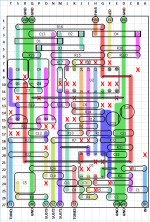
Black Finger - cb mod v0.5 sheet 1.png
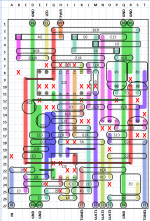
Black Finger - cb mod v0.5 sheet 2.png

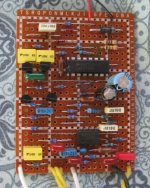
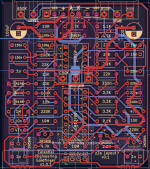
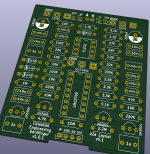
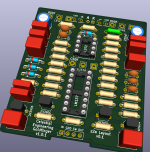
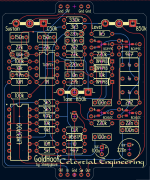
The charge pump and power conditioning is on the far left. U1 is lower right, U2 is lower left. The peak detector is top center and the tone network is upper left. I used a non-polar 10uF aluminum cap for C4, but a polarized tantalum cap works well too. The DC voltage across C4 is a few mV.

Knobs (L-R): LEVEL - TONE - SUSTAIN
Black Finger - cb mod v0.5 breadboard 02.jpg
 
Last edited:
I was curious so I read up on this a bit -- do I understand correctly that at a high level the CA3080/LM13700 are acting as a voltage-controlled resistor to vary the gain of the op-amp, and the control voltage for this is from the peak-detector circuit implemented by the four transistors?
 
Does the TL072 noticeably improve the noise floor?
Yes.
Is there any operational difference between the vintage CA3080 and the LM13700?
No difference when using just the OTA. The Darlingtons come in handy in filter circuits but are not needed here.

I was curious so I read up on this a bit -- do I understand correctly that at a high level the CA3080/LM13700 are acting as a voltage-controlled resistor to vary the gain of the op-amp, and the control voltage for this is from the peak-detector circuit implemented by the four transistors?
Close. The OTA (U2A) acts like a current-controlled resistor. The peak detector (Q2-Q5) outputs a current proportional to the peak amplitude at the output of U1B. That current is used to control the effective resistance of U2A.
 
Back
Top