


Chuck D. Bones
Circuit Wizard
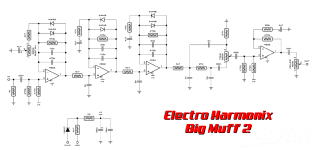
Guitar PCB offered this PCB as a bonus during a recent promotion. It's an interesting all-opamp version of the traditional BMP architecture. Note the diode soft-clipping on three stages, instead of the usual two. The gain is throttled in the 1st stage feedback loop, instead of between stages 1 & 2. The most striking difference is that each clipping stage is non-inverting, which means it has a built-in clean bleed. The result is significantly less compression than the standard BMP circuit. There is still plenty of sustain, but the attack has a lot more dynamics. The first three stages are DC-coupled and all of the coupling caps are oversized. The bottom-end of the freq response approaches DC. The feedback caps roll-off the treble just below 700Hz. If you like a thick, sludgy bottom-end, then this pedal is for you. Should work well as a Bass pedal, but I have not tried it yet. The 4.7K / 4.7nF low-pass filters between stages roll-off at around 7KHz. The Tone network is the usual BMP thing with a scoop around 1KHz. Quite dark at zero and pretty bright at 10. The last stage has too much gain and can saturate if TONE is set below 3. EHX minimized the BOM by using the same part values in several places in the circuit.

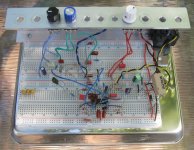
This is the stock circuit, with some of the coupling caps reduced to tighten up the bottom-end. I used a TL074 quad opamp.
Knobs (L-R): LEVEL - TONE - SUSTAIN

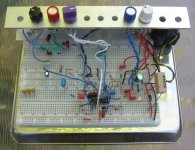
So then I decided to have my way with the circuit. After several iterations, this is where I landed.
Knobs (L-R): LEVEL - TREBLE - MID - BASS - SUSTAIN

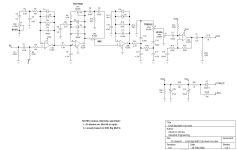
First thing I did was create a common Vref supply. The cost: one 47uF cap. I tried a few different configurations for the BASS control, but this one worked the best and did not require too many additional parts. I moved the SUSTAIN control to the 2nd stage and increased its range. Like the original BMP, this circuit is heavily mid-focused. I added a variable mid-cut centered at 600Hz to reduce the mid focus. I also reduced the feedback caps in the 1st & 2nd stages for a little bit more clarity at lower SUSTAIN settings. I retuned the tone network for a flat freq response at noon, strictly a matter of personal preference. To avoid saturating the 4th stage, I moved the LEVEL pot ahead of the 4th stage. With BASS, MID and SUSTAIN dimed, it's almost as sludgy as the original circuit. Turning down the BASS & MID lets chords ring true. There is no clean setting on this baby. Even with BASS, MID & SUSTAIN at zero, the gain at the output of the 3rd stage is around 40dB from 200Hz to 3KHz.
At the end of the day, it's just another dirt pedal. But it's fun to play with and has a nice tonal palette. The multiple limiting stages and clean bleeds make for a smooth note decay. If you only want 4 knobs, then the MID pot could be replaced by a pair of 47K resistors or the MID circuit could be deleted altogether.

This is the stock circuit, with some of the coupling caps reduced to tighten up the bottom-end. I used a TL074 quad opamp.
Knobs (L-R): LEVEL - TONE - SUSTAIN
So then I decided to have my way with the circuit. After several iterations, this is where I landed.
Knobs (L-R): LEVEL - TREBLE - MID - BASS - SUSTAIN
First thing I did was create a common Vref supply. The cost: one 47uF cap. I tried a few different configurations for the BASS control, but this one worked the best and did not require too many additional parts. I moved the SUSTAIN control to the 2nd stage and increased its range. Like the original BMP, this circuit is heavily mid-focused. I added a variable mid-cut centered at 600Hz to reduce the mid focus. I also reduced the feedback caps in the 1st & 2nd stages for a little bit more clarity at lower SUSTAIN settings. I retuned the tone network for a flat freq response at noon, strictly a matter of personal preference. To avoid saturating the 4th stage, I moved the LEVEL pot ahead of the 4th stage. With BASS, MID and SUSTAIN dimed, it's almost as sludgy as the original circuit. Turning down the BASS & MID lets chords ring true. There is no clean setting on this baby. Even with BASS, MID & SUSTAIN at zero, the gain at the output of the 3rd stage is around 40dB from 200Hz to 3KHz.
At the end of the day, it's just another dirt pedal. But it's fun to play with and has a nice tonal palette. The multiple limiting stages and clean bleeds make for a smooth note decay. If you only want 4 knobs, then the MID pot could be replaced by a pair of 47K resistors or the MID circuit could be deleted altogether.
Last edited:


 I simply didn't expect a 5 Watt resistor in a circuit like this.